



Question: Need help with this MATLAB question, many thanks if you can help me with it! Most materials expand as their temperature increases. One way to
Need help with this MATLAB question, many thanks if you can help me with it!
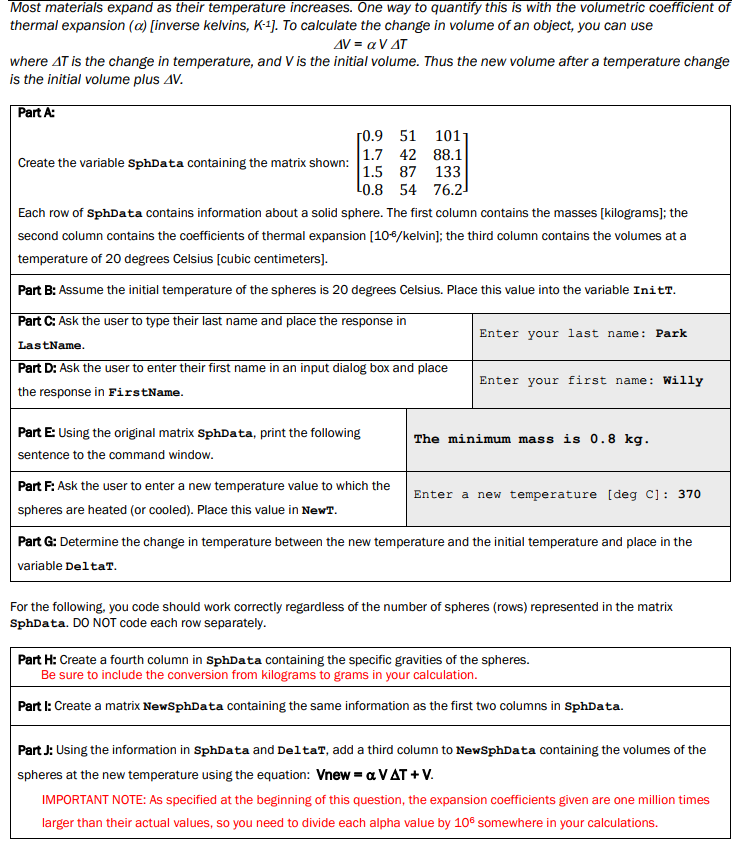
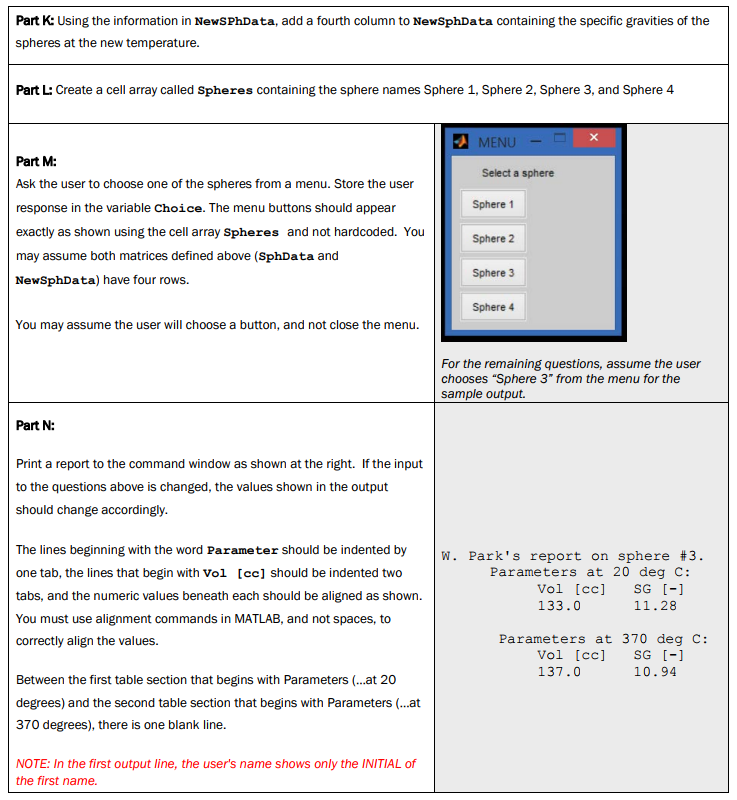
Most materials expand as their temperature increases. One way to quantify this is with the volumetric coefficient of thermal expansion (a) [inverse kelvins, K-1]. To calculate the change in volume of an object, you can use where AT is the change in temperature, and V is the initial volume. Thus the new volume after a temperature change is the initial volume plus Part A: 0.9 51 101 1.7 42 88.1 1.5 87 133 0.8 54 76.2 Create the variable SphData containing the matrix shown: Each row of SphData contains information about a solid sphere. The first column contains the masses [kilograms]: the second column contains the coefficients of thermal expansion [10-6/kelvin]; the third column contains the volumes at a temperature of 20 degrees Celsius [cubic centimeters]. Part B: Assume the initial temperature of the spheres is 20 degrees Celsius. Place this value into the variable InitT Part C: Ask the user to type their last name and place the response in LastName Part D: Ask the user to enter their first name in an input dialog box and place the response in FirstName Enter your last name: Parlk Enter your first name: Willy Part E: Using the original matrix SphData, print the following sentence to the command window Part F: Ask the user to enter a new temperature value to which the spheres are heated (or cooled). Place this value in NewT Part G: Determine the change in temperature between the new temperature and the initial temperature and place in the variable DeltaT The minimum mass is 0.8 kg Enter a new temperature [deg C]: 370 For the following, you code should work correctly regardless of the number of spheres (rows) represented in the matrix SphData. DO NOT code each row separately Part H: Create a fourth column in SphData containing the specific gravities of the spheres. Be sure to include the conversion from kilograms to grams in your calculation. Part I: Create a matrix NewSphData containing the same information as the first two columns in SphData. Part J: Using the information in SphData and DeltaT, add a third column to NewSphData containing the volumes of the spheres at the new temperature using the equation: Vnew- V + V IMPORTANT NOTE: As specified at the beginning of this question, the expansion coefficients given are one million times larger than their actual values, so you need to divide each alpha value by 106 somewhere in your calculations. Most materials expand as their temperature increases. One way to quantify this is with the volumetric coefficient of thermal expansion (a) [inverse kelvins, K-1]. To calculate the change in volume of an object, you can use where AT is the change in temperature, and V is the initial volume. Thus the new volume after a temperature change is the initial volume plus Part A: 0.9 51 101 1.7 42 88.1 1.5 87 133 0.8 54 76.2 Create the variable SphData containing the matrix shown: Each row of SphData contains information about a solid sphere. The first column contains the masses [kilograms]: the second column contains the coefficients of thermal expansion [10-6/kelvin]; the third column contains the volumes at a temperature of 20 degrees Celsius [cubic centimeters]. Part B: Assume the initial temperature of the spheres is 20 degrees Celsius. Place this value into the variable InitT Part C: Ask the user to type their last name and place the response in LastName Part D: Ask the user to enter their first name in an input dialog box and place the response in FirstName Enter your last name: Parlk Enter your first name: Willy Part E: Using the original matrix SphData, print the following sentence to the command window Part F: Ask the user to enter a new temperature value to which the spheres are heated (or cooled). Place this value in NewT Part G: Determine the change in temperature between the new temperature and the initial temperature and place in the variable DeltaT The minimum mass is 0.8 kg Enter a new temperature [deg C]: 370 For the following, you code should work correctly regardless of the number of spheres (rows) represented in the matrix SphData. DO NOT code each row separately Part H: Create a fourth column in SphData containing the specific gravities of the spheres. Be sure to include the conversion from kilograms to grams in your calculation. Part I: Create a matrix NewSphData containing the same information as the first two columns in SphData. Part J: Using the information in SphData and DeltaT, add a third column to NewSphData containing the volumes of the spheres at the new temperature using the equation: Vnew- V + V IMPORTANT NOTE: As specified at the beginning of this question, the expansion coefficients given are one million times larger than their actual values, so you need to divide each alpha value by 106 somewhere in your calculations
Step by Step Solution
There are 3 Steps involved in it

Get step-by-step solutions from verified subject matter experts