







Question: Need help with this problem Calculating marginal revenue from a linear demand curve The blue curve on the following graph represents the demand curve facing
Need help with this problem
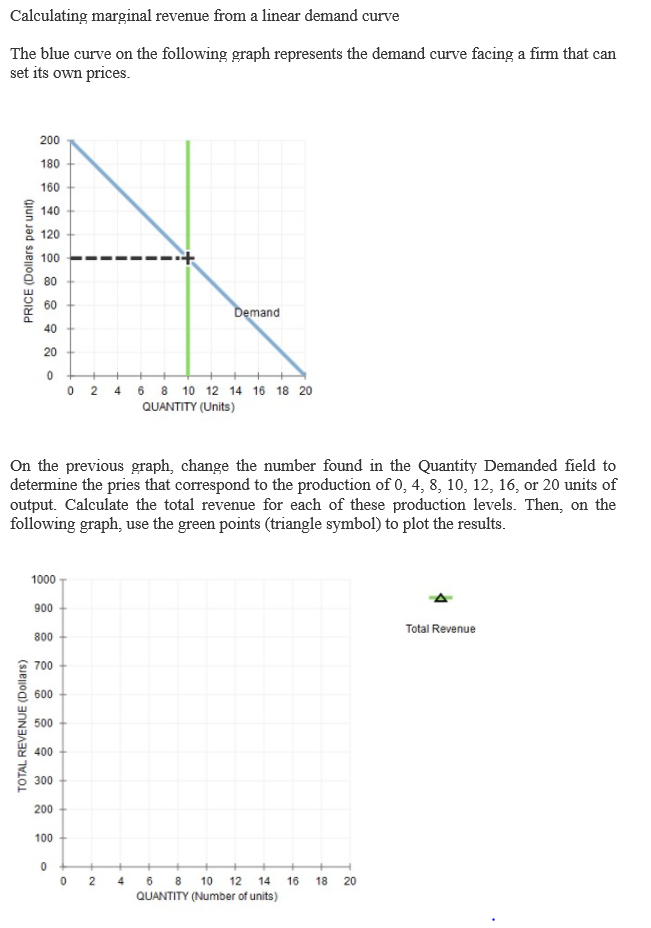
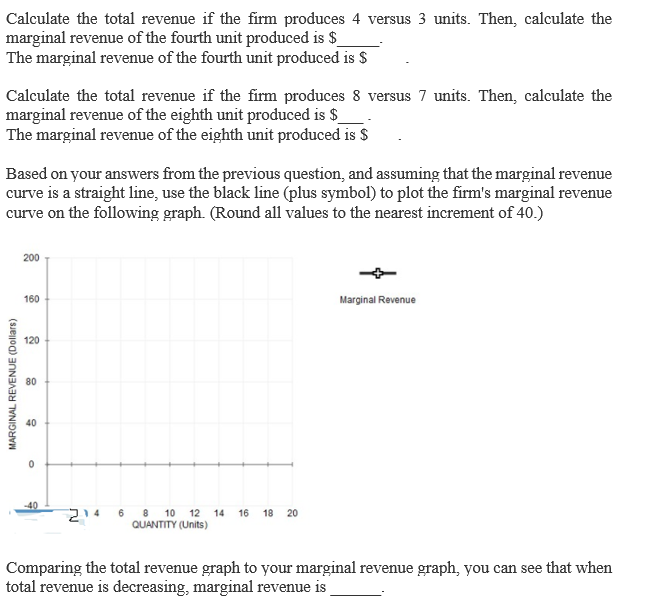
Calculating marginal revenue from a linear demand curve The blue curve on the following graph represents the demand curve facing a firm that can set its own prices. 200 180 160 PRICE (Dollars per unit) 140 120 100 B: 8 8 Demand O 0 4 6 8 10 12 14 16 18 20 QUANTITY (Units) On the previous graph, change the number found in the Quantity Demanded field to determine the pries that correspond to the production of 0, 4, 8, 10, 12, 16, or 20 units of output. Calculate the total revenue for each of these production levels. Then, on the following graph, use the green points (triangle symbol) to plot the results. 1000 900 800 Total Revenue TOTAL REVENUE (Dollars) 700 600 500 400 300 200 100 0 2 4 6 8 10 12 14 16 18 20 QUANTITY (Number of units)Calculate the total revenue if the firm produces 4 versus 3 units. Then, calculate the marginal revenue of the fourth unit produced is $ The marginal revenue of the fourth unit produced is $ Calculate the total revenue if the firm produces 8 versus 7 units. Then, calculate the marginal revenue of the eighth unit produced is $ The marginal revenue of the eighth unit produced is $ Based on your answers from the previous question, and assuming that the marginal revenue curve is a straight line, use the black line (plus symbol) to plot the firm's marginal revenue curve on the following graph. (Round all values to the nearest increment of 40.) 200 160 Marginal Revenue MARGINAL REVENUE (Dollars) 120 BO 40 214 6 8 10 12 14 16 18 20 QUANTITY (Units) Comparing the total revenue graph to your marginal revenue graph, you can see that when total revenue is decreasing, marginal revenue is
Step by Step Solution
There are 3 Steps involved in it

Get step-by-step solutions from verified subject matter experts
 Study Help