







Question: need help with this question to apply in excel Suppose an anemometer is set up at a height of 2 m above the ground in
need help with this question to apply in excel
Suppose an anemometer is set up at a height of 2 m above the ground in a corn field. Use equation (3.27) to calculate the velocity profiles up to a height of 5 m above the ground when the anemometer measures a velocity of 4 m/s and
a. the corn is at a height of 0.5 m;
b. the corn is at a height of 1.5 m. Plot both profiles on the same graph (arithmetic axes), with z on the vertical axis (m) and u(z) on the horizontal axis (m/s)
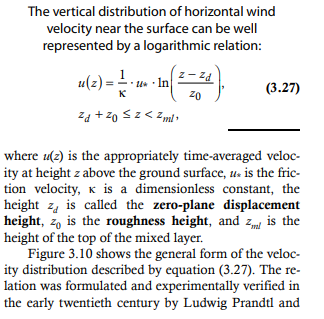
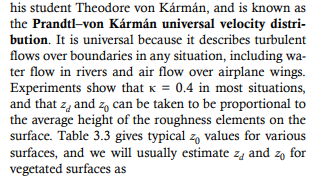
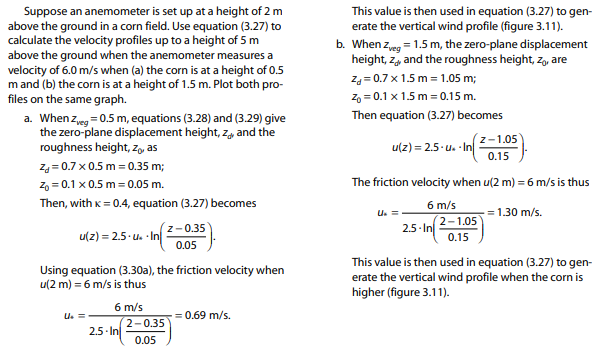
The vertical distribution of horizontal wind velocity near the surface can be well represented by a logarithmic relation: "(2) = . UN . In K 20 (3.27) where u(z) is the appropriately time-averaged veloc- ity at height z above the ground surface, u. is the fric- tion velocity, k is a dimensionless constant, the height z is called the zero-plane displacement height, z, is the roughness height, and z is the height of the top of the mixed layer. Figure 3.10 shows the general form of the veloc- ity distribution described by equation (3.27). The re- lation was formulated and experimentally verified in the early twentieth century by Ludwig Prandtl andhis student Theodore von Karman, and is known as the Prandtl-von Karman universal velocity distri- bution. It is universal because it describes turbulent flows over boundaries in any situation, including wa- ter flow in rivers and air flow over airplane wings. Experiments show that k = 0.4 in most situations, and that z and z, can be taken to be proportional to the average height of the roughness elements on the surface. Table 3.3 gives typical z, values for various surfaces, and we will usually estimate z and z, for vegetated surfaces asSuppose an anemometer is set up at a height of 2 m This value is then used in equation (3.27) to gen- above the ground in a corn field. Use equation (3.27) to erate the vertical wind profile (figure 3.11). calculate the velocity profiles up to a height of 5 m b. When Zyna = 1.5 m, the zero-plane displacement above the ground when the anemometer measures a height, z, and the roughness height, zo, are velocity of 6.0 m/s when (a) the corn is at a height of 0.5 m and (b) the corn is at a height of 1.5 m. Plot both pro- Z= 0.7 x 1.5 m = 1.05 m; files on the same graph. Zo =0.1 x 1.5 m = 0.15 m. a. When Zveg = 0.5 m, equations (3.28) and (3.29) give Then equation (3.27) becomes the zero-plane displacement height, z, and the roughness height, zo as u(z) = 2.5 - u. . In Z-1.05 0.15 Z= 0.7 x 0.5 m = 0.35 m; Zo =0.1 x 0.5 m = 0.05 m. The friction velocity when u(2 m) = 6 m/s is thus Then, with k = 0.4, equation (3.27) becomes 6 m/s = 1.30 m/s. u(z) = 2.5 . U. . In Z-0.35 2.5 - In 2-1.05 0.15 0.05 Using equation (3.30a), the friction velocity when This value is then used in equation (3.27) to gen- w(2 m) =6 m/s is thus erate the vertical wind profile when the corn is higher (figure 3.11). 6 m/s = 0.69 m/s. 2-0.35 2.5 - In 0.05
Step by Step Solution
There are 3 Steps involved in it

Get step-by-step solutions from verified subject matter experts
 Study Help