







Question: need help with this use c++ and send me the answer on my email COSC 3360/6310 - Fundamentats of OptaATing Srstems Assignment H1: Phocess Schtouthe
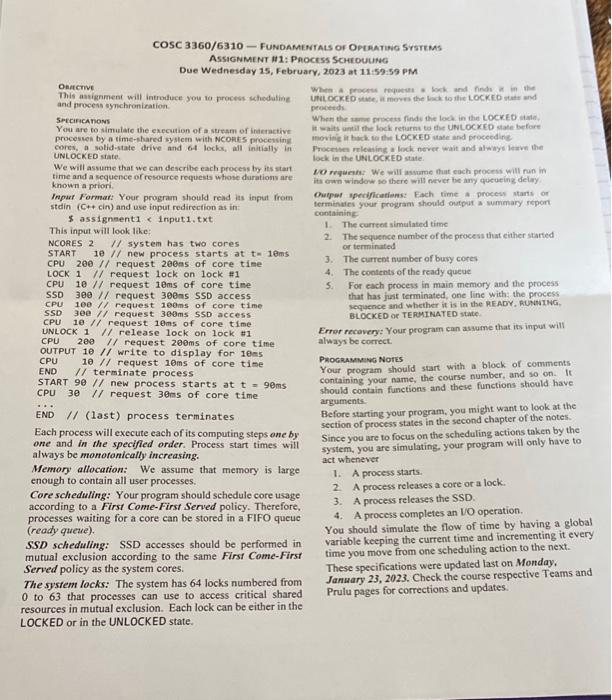
COSC 3360/6310 - Fundamentats of OptaATing Srstems Assignment H1: Phocess Schtouthe Due Wednesday 15, February, 2023 at 11:59:59 PM Onuctive. and process synchronication. Sreciricanons You are to simulate the exccution of a strem of ineractive in waits until the lock returns to the UnLockCD state before. processen by a lime-shared system with NCOACS processing moving in back to the LOCKED wate and proseedine cores, a solid-state drive and 64 locks, all initially in Procense relening a lock nover wait and alwhys lerve the UNLOCKED state. We will assume that we can describe each process by its start lock in the UNLOCKED state. time and a sequence of resource requests whose dirations are: 20 requate: We will assume that each process will run in. known a prioni. its ewn window so there will never be any queueing delay. Inpur Format: Your program should read its input from Outpat specifications: Each fime a prosess atarts or stdin (C++cin) and use input redirection as in: $ assignnent1 \& input1, txt terminaies your program should output a summary nepont This input will look the: NCORES 2 I/ system has two cores containing START 10// new process starts at t=10ms 1. The currect simulated time CPU 200// request 206as of core tine 2. The sequence number of the process that either started LOCK 1 // request lock on lock \#1 or terminated CPU 10/ / request 10ms of core time 3. The current number of busy cores SSD 300// request 300 ns SSD access 4. The contents of the ready queue CPU 100 f. request 100ms of core time 5. For each process in main memory and the process SSD 300 If request 300ms 550 access CPU 10 il request 10ms of core time UNLOCK 1 // release lock on lock \#1 CPU 209 // request 200ms of core time OUTPUT 10lf write to display for 10en CPU 10 / request 10ms of core time CPU 30 // request 30ms of core time END // (1ast) process terminates arguments. END I/ (1ast) process terminates Before starting your program, you might want to look at the Each process will execute each of its computing steps ane by section of process states in the second chapter of the notesi. one and in the speciffed order. Process start times will Since you are to focus on the scheduling actions taken by the always be mortotonically increasing. Memory allocation: We assume that memory is large act whenever enough to contain all user processes. Core scheduling: Your program should schedule core usage according to a First Come-First Served policy. Therefore, 1. A process starts. processes waiting for a core can be stored in a FIFO queue (ready queue). You should simulate the flow of time by having a global nutual exclusing: SSD accesses should be performed in. variable keeping the current time and incrementing it every nutual exclusion according to the same First Come-First time you move from one scheduling action to the next. ierved policy as the system cores. These specifications were updated last on Monday. to 63 that processes can January 23, 2023. Check the course respective Teams and to 63 that processes can use to access critical shared sources in mutual exclusion. Each lock can be either in the OCKED or in the UNLOCKED state
Step by Step Solution
There are 3 Steps involved in it

Get step-by-step solutions from verified subject matter experts
 Study Help