







Question: Need matlab solution Flow over Flat Plates - Forced Convection Heat Transfer Coefficient In separate cases, air or water at 20C are flowing over the
Need matlab solution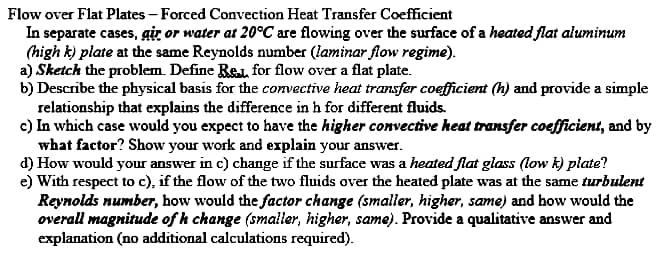
Flow over Flat Plates - Forced Convection Heat Transfer Coefficient In separate cases, air or water at 20C are flowing over the surface of a heated flat aluminum (high k) plate at the same Reynolds number (laminar flow regime). a) Sketch the problem. Define Real for flow over a flat plate. b) Describe the physical basis for the convective heat transfer coefficient (h) and provide a simple relationship that explains the difference in h for different fluids. c) In which case would you expect to have the higher convective heat transfer coefficient, and by what factor? Show your work and explain your answer. d) How would your answer in c) change if the surface was a heated flat glass (low k) plate? e) With respect to c), if the flow of the two fluids over the heated plate was at the same turbulent Reynolds number, how would the factor change (smaller, higher, same) and how would the overall magnitude of h change (smaller, higher, same). Provide a qualitative answer and explanation (no additional calculations required). Flow over Flat Plates - Forced Convection Heat Transfer Coefficient In separate cases, air or water at 20C are flowing over the surface of a heated flat aluminum (high k) plate at the same Reynolds number (laminar flow regime). a) Sketch the problem. Define Real for flow over a flat plate. b) Describe the physical basis for the convective heat transfer coefficient (h) and provide a simple relationship that explains the difference in h for different fluids. c) In which case would you expect to have the higher convective heat transfer coefficient, and by what factor? Show your work and explain your answer. d) How would your answer in c) change if the surface was a heated flat glass (low k) plate? e) With respect to c), if the flow of the two fluids over the heated plate was at the same turbulent Reynolds number, how would the factor change (smaller, higher, same) and how would the overall magnitude of h change (smaller, higher, same). Provide a qualitative answer and explanation (no additional calculations required)
Step by Step Solution
There are 3 Steps involved in it

Get step-by-step solutions from verified subject matter experts
 Study Help