







Question: need only conclusions 2. KNOWLEDGE, SKILLS AND ABILLITIES Knowledge, skills and abilities necessary for effective performances in teamwork differ from those required for accomplishing individual
need only conclusions
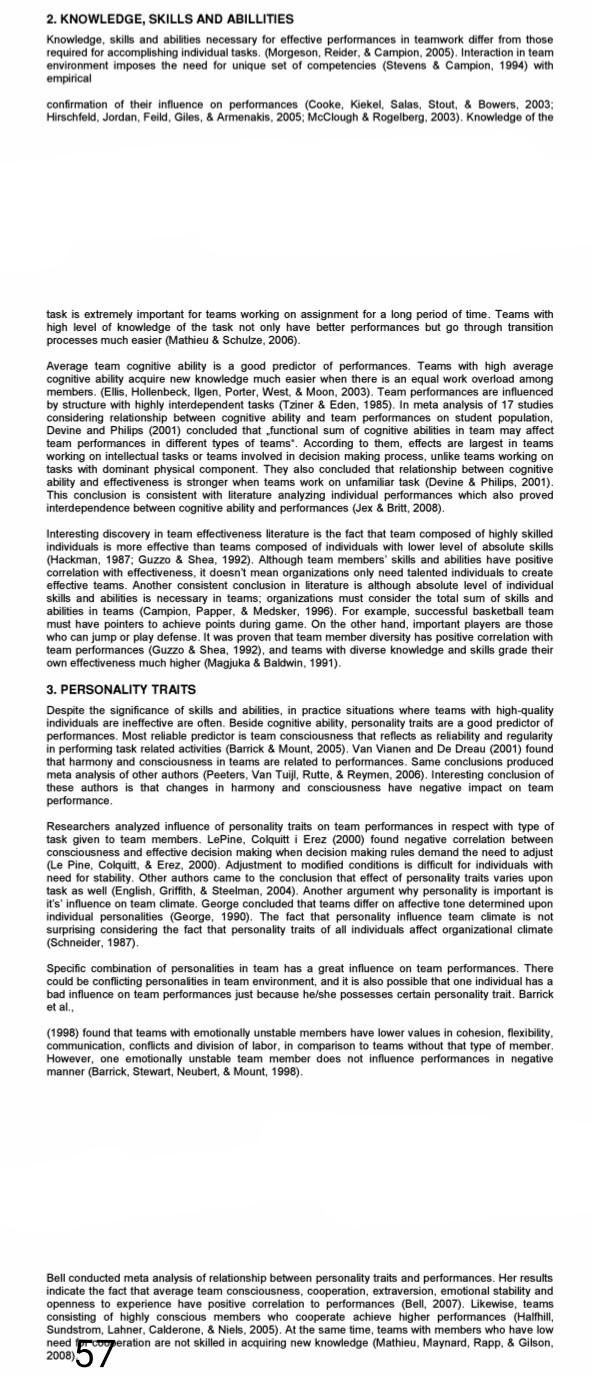
2. KNOWLEDGE, SKILLS AND ABILLITIES Knowledge, skills and abilities necessary for effective performances in teamwork differ from those required for accomplishing individual tasks. (Morgeson, Reider, & Campion, 2005). Interaction in team environment imposes the need for unique set of competencies (Stevens & Campion, 1994) with empirical confirmation of their influence on performances (Cooke, Kiekel, Salas, Stout, & Bowers, 2003 Hirschfeld, Jordan, Feild, Giles, & Armenakis, 2005; McClough & Rogelberg, 2003). Knowledge of the task is extremely important for teams working on assignment for a long period of time. Teams with high level of knowledge of the task not only have better performances but go through transition processes much easier (Mathieu & Schulze, 2006). Average team cognitive ability is a good predictor of performances. Teams with high average cognitive ability acquire new knowledge much easier when there is an equal work overload among members. (Ellis, Hollenbeck, Ilgen, Porter, West, & Moon, 2003). Team performances are influenced by structure with highly interdependent tasks (Tziner & Eden, 1985). In meta analysis of 17 studies considering relationship between cognitive ability and team performances on student population, Devine and Philips (2001) concluded that functional sum of cognitive abilities in team may affect team performances in different types of teams'. According to them, effects are largest in teams working on intellectual tasks or teams involved in decision making process, unlike teams working on tasks with dominant physical component. They also concluded that relationship between cognitive ability and effectiveness is stronger when teams work on unfamiliar task (Devine & Philips, 2001). This conclusion is consistent with literature analyzing individual performances which also proved interdependence between cognitive ability and performances (Jex & Britt, 2008). Interesting discovery in team effectiveness literature is the fact that team composed of highly skilled individuals is more effective than teams composed of individuals with lower level of absolute skills (Hackman, 1987; Guzzo & Shea, 1992). Although team members' skills and abilities have positive correlation with effectiveness, it doesn't mean organizations only need talented individuals to create effective teams. Another consistent conclusion in literature is although absolute level of individual skills and abilities is necessary in teams; organizations must consider the total sum of skills and abilities in teams (Campion, Papper, & Medsker, 1996). For example, successful basketball team must have pointers to achieve points during game. On the other hand, important players are those who can jump or play defense. It was proven that team member diversity has positive correlation with team performances (Guzzo & Shea, 1992), and teams with diverse knowledge and skills grade their own effectiveness much higher (Magjuka & Baldwin, 1991). 3. PERSONALITY TRAITS Despite the significance of skills and abilities, in practice situations where teams with high-quality individuals are ineffective are often. Beside cognitive ability, personality traits are a good predictor of performances. Most reliable predictor is team consciousness that reflects as reliability and regularity in performing task related activities (Barrick & Mount, 2005). Van Vianen and De Dreau (2001) found that harmony and consciousness in teams are related to performances. Same conclusions produced meta analysis of other authors (Peeters, Van Tuijl, Rutte, & Reymen, 2006). Interesting conclusion of these authors is that changes in harmony and consciousness have negative impact on team performance. Researchers analyzed influence of personality traits on team performances in respect with type of task given to team members. LePine, Colquitt i Erez (2000) found negative correlation between consciousness and effective decision making when decision making rules demand the need to adjust (Le Pine, Colquitt, & Erez, 2000). Adjustment to modified conditions is difficult for individuals with need for stability. Other authors came to the conclusion that effect of personality traits varies upon task as well (English, Griffith, & Steelman, 2004). Another argument why personality is important is it's influence on team climate. George concluded that teams differ on affective tone determined upon individual personalities (George, 1990). The fact that personality influence team climate is not surprising considering the fact that personality traits of all individuals affect organizational climate (Schneider, 1987) Specific combination of personalities in team has a great influence on team performances. There could be conflicting personalities in team environment, and it is also possible that one individual has a bad influence on team performances just because he/she possesses certain personality trait. Barrick et al., (1998) found that teams with emotionally unstable members have lower values in cohesion, flexibility, communication, conflicts and division of labor, in comparison to teams without that type of member However, one emotionally unstable team member does not influence performances in negative manner (Barrick, Stewart, Neubert, & Mount, 1998). Bell conducted meta analysis of relationship between personality traits and performances. Her results indicate the fact that average team consciousness, cooperation, extraversion, emotional stability and openness to experience have positive correlation to performances (Bell, 2007). Likewise, teams consisting of highly conscious members who cooperate achieve higher performances (Halfhill, Sundstrom, Lahner, Calderone, & Niels, 2005). At the same time, teams with members who have low need pr cooperation are not skilled acquiring new knowledge (Mathieu, Maynard, Rapp. & Gilson, 2008) 57Step by Step Solution
There are 3 Steps involved in it
1 Expert Approved Answer
Step: 1 Unlock

Question Has Been Solved by an Expert!
Get step-by-step solutions from verified subject matter experts
Step: 2 Unlock
Step: 3 Unlock
 Study Help