







Question: need only conclusions In column Group there is 1 if company got bankrupt and 2 if company is still active. Column PNN shows group in
need only conclusions
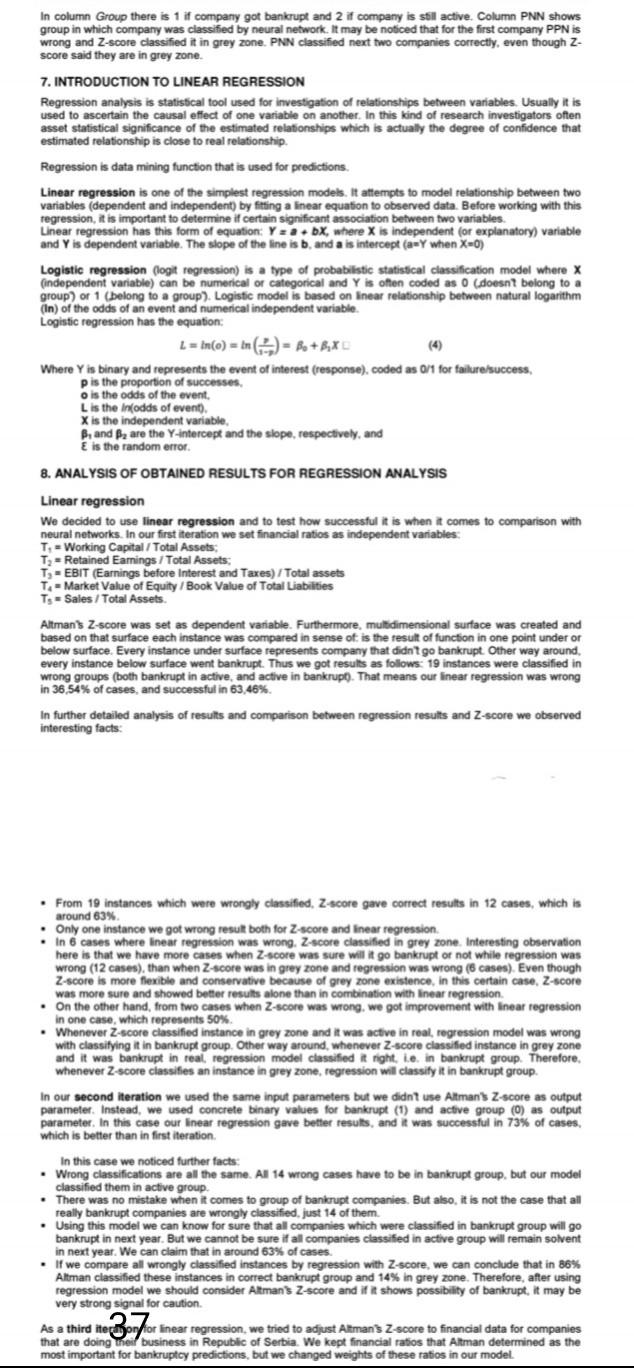
In column Group there is 1 if company got bankrupt and 2 if company is still active. Column PNN shows group in which company was classified by neural network. It may be noticed that for the first company PPN is wrong and Z-score classified it in grey zone. PNN classified next two companies correctly, even though Z- score said they are in grey zone. 7. INTRODUCTION TO LINEAR REGRESSION Regression analysis is statistical tool used for investigation of relationships between variables Usually it is used to ascertain the causal effect of one variable on another. In this kind of research investigators often asset statistical significance of the estimated relationships which is actually the degree of confidence that estimated relationship is close to real relationship Regression is data mining function that is used for predictions. Linear regression is one of the simplest regression models. It attempts to model relationship between two variables (dependent and independent) by fitting a linear equation to observed data Before working with this regression, it is important to determine if certain significant association between two variables Linear regression has this form of equation: Y = 3.bX, where X is independent (or explanatory) variable and Y is dependent variable. The slope of the line is b, and a is intercept (asy when X=0) Logistic regression (logit regression) is a type of probabilistic statistical classification model where X independent variable) can be numerical or categorical and Y is often coded as o doesnt belong to a group) or 1 (belong to a group). Logistic model is based on inear relationship between natural logarithm (In) of the odds of an event and numerical independent variable Logistic regression has the equation: L = n(e) - in () - Bo+B,XO Where Y is binary and represents the event of interest (response). coded as 0/1 for failure/success. p is the proportion of successes, o is the odds of the event. L is the infodds of event). X is the independent variable, B, and Bare the Y-intercept and the slope, respectively, and E is the random error 8. ANALYSIS OF OBTAINED RESULTS FOR REGRESSION ANALYSIS Linear regression We decided to use linear regression and to test how successful it is when it comes to comparison with neural networks. In our first iteration we set financial ratios as independent variables: T, = Working Capital / Total Assets T = Retained Earnings / Total Assets: TEBIT (Earnings before interest and Taxes) Total assets T-Market Value of Equity Book Value of Total Liabilities Ts Sales/Total Assets Altman's Z-score was set as dependent variable. Furthermore, multidimensional surface was created and based on that surface each instance was compared in sense of is the result of function in one point under or below surface. Every instance under surface represents company that didn't go bankrupt. Other way around. every instance below surface went bankrupt. Thus we got results as follows: 19 instances were classified in wrong groups (both bankrupt in active, and active in bankrupt. That means our linear regression was wrong in 36,54% of cases, and successful in 63,46% In further detailed analysis of results and comparison between regression results and Z-score we observed interesting facts From 19 instances which were wrongly classified, Z-score gave correct results in 12 cases, which is around 63% . Only one instance we got wrong result both for Z-score and linear regression In 6 cases where linear regression was wrong. Z-score classified in grey zone. Interesting observation here is that we have more cases when Z-score was sure will it go bankrupt or not while regression was wrong (12 cases), than when Z-score was in grey zone and regression was wrong (6 cases). Even though Z-score is more flexible and conservative because of grey zone existence, in this certain case. Z-score was more sure and showed better results alone than in combination with linear regression On the other hand, from two cases when Z-score was wrong, we got improvement with inear regression in one case, which represents 50% Whenever Z-score classified instance in grey zone and it was active in real, regression model was wrong with classifying it in bankrupt group. Other way around, whenever Z-score classified instance in grey zone and it was bankrupt in real regression model classified R night. le. in bankrupt group. Therefore, whenever Z-score classifies an instance in grey zone, regression will classify it in bankrupt group In our second iteration we used the same input parameters but we didn't use Altman's Z-score as output parameter. Instead, we used concrete binary values for bankrupt (1) and active group (C) as output parameter. In this case our linear regression gave better results, and it was successful in 73% of cases, which is better than in first iteration In this case we noticed further facts: Wrong classifications are all the same. Al 14 wrong cases have to be in bankrupt group, but our model classified them in active group There was no mistake when it comes to group of bankrupt companies. But also, it is not the case that all really bankrupt companies are wrongly classified, just 14 of them . Using this model we can know for sure that al companies which were classified in bankrupt group will go bankrupt in next year. But we cannot be sure if all companies classified in active group will remain solvent in next year. We can claim that in around 63% of cases . If we compare all wrongly classified instances by regression with Z-score, we can conclude that in 86% Altman classified these instances in correct bankrupt group and 14% in grey zone. Therefore, after using regression model we should consider Altman's Z-score and if it shows possibility of bankrupt, it may be very strong signal for caution. As a third iter oortor inear regression, we tried to adjust Altman's Z-score to financial data for companies that are doing well business in Republic of Serbia. We kept financial ratios that Altman determined as the most important for bankruptcy predictions, but we changed weights of these ratios in our modelStep by Step Solution
There are 3 Steps involved in it
1 Expert Approved Answer
Step: 1 Unlock

Question Has Been Solved by an Expert!
Get step-by-step solutions from verified subject matter experts
Step: 2 Unlock
Step: 3 Unlock
 Study Help