







Question: need only conclusions trained staff are capable enough to prepare and announce appropriate messages, control their statements and interact well with the media. They also
need only conclusions
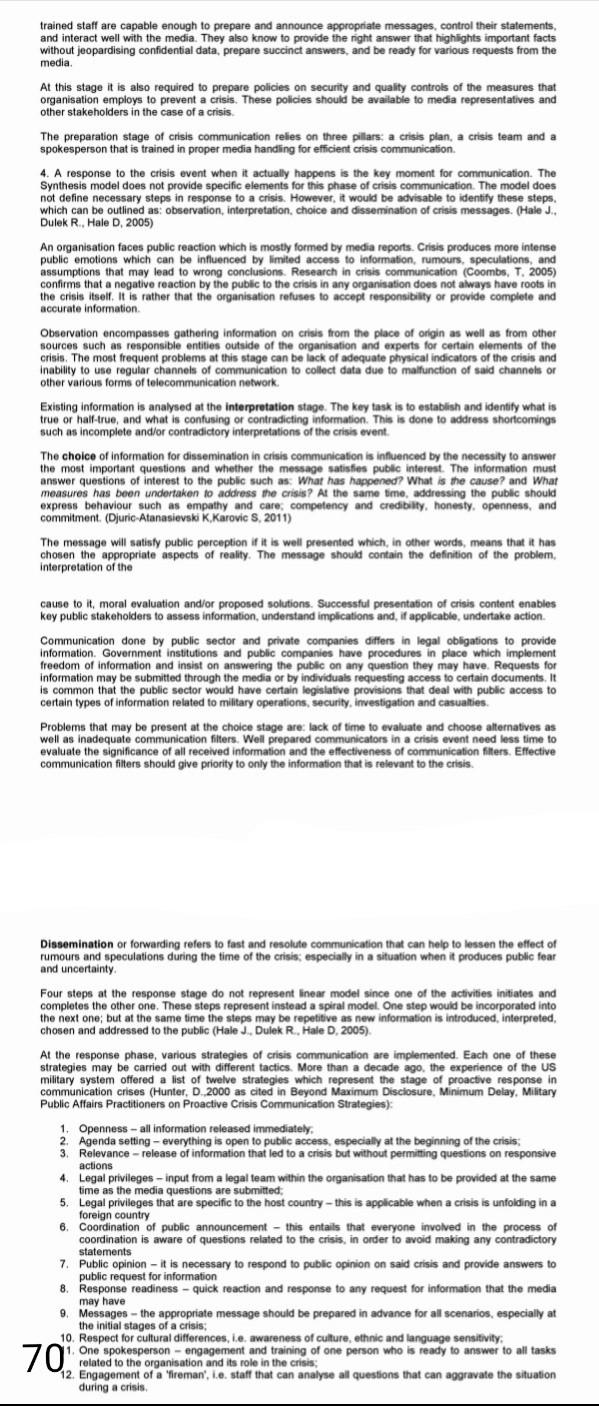
trained staff are capable enough to prepare and announce appropriate messages, control their statements and interact well with the media. They also know to provide the night answer that highlights important facts without jeopardising confidential data, prepare succinct answers, and be ready for various requests from the media At this stage it is also required to prepare policies on security and quality controls of the measures that organisation employs to prevent a crisis. These policies should be available to media representatives and other stakeholders in the case of a crisis The preparation stage of crisis communication relies on three pillars: a crisis plan, a crisis team and a spokesperson that is trained in proper media handing for efficient crisis communication 4. A response to the crisis event when it actually happens is the key moment for communication. The Synthesis model does not provide specific elements for this phase of crisis communication. The model does not define necessary steps in response to a crisis. However, it would be advisable to identify these steps which can be outlined as observation, interpretation, choice and dissemination of crisis messages. (Hale J.. Dulek R. Hale D, 2005) An organisation faces public reaction which is mostly formed by media reports. Crisis produces more intense public emotions which can be influenced by limited access to information, rumours, speculations, and assumptions that may lead to wrong conclusions. Research in crisis communication (Coombs, T. 2005) confirms that a negative reaction by the public to the crisis in any organisation does not always have roots in the crisis itself. It is rather that the organisation refuses to accept responsibility or provide complete and accurate information Observation encompasses gathering Information on crisis from the place of origin as well as from other sources such as responsible entities outside of the organisation and experts for certain elements of the crisis. The most frequent problems at this stage can be lack of adequate physical indicators of the crisis and inability to use regular channels of communication to collect data due to malfunction of said channels or other various forms of telecommunication network Existing information is analysed at the interpretation stage. The key task is to establish and identify what is true or half-true, and what is confusing or contradicting information. This is done to address shortcomings such as incomplete and/or contradictory interpretations of the crisis event. The choice of information for dissemination in crisis communication is influenced by the necessity to answer the most important questions and whether the message satisfies public interest. The information must answer questions of interest to the public such as: What has happened? What is the cause? and What measures has been undertaken to address the crisis? At the same time, addressing the public should express behaviour such as empathy and care competency and credibilty, honesty, openness, and commitment. (Djuric Atanasievski, Karovic S. 2011) The message will satisfy public perception if it is well presented which, in other words, means that it has chosen the appropriate aspects of reality. The message should contain the definition of the problem, interpretation of the cause to it, moral evaluation and/or proposed solutions. Successful presentation of crisis content enables key public stakeholders to assess information, understand implications and, if applicable, undertake action Communication done by public sector and private companies differs in legal obligations to provide information. Government institutions and public companies have procedures in place which implement freedom of information and insist on answering the public on any question they may have. Requests for information may be submitted through the media or by individuals requesting access to certain documents. It is common that the public sector would have certain legislative provisions that deal with public access to certain types of information related to military operations, security, investigation and casualties Problems that may be present at the choice stage are: lack of time to evaluate and choose alternatives as well as inadequate communication filters. Well prepared communicators in a crisis event need less time to evaluate the significance of all received information and the effectiveness of communication filters. Effective communication filters should give priority to only the information that is relevant to the crisis. Dissemination or forwarding refers to fast and resolute communication that can help to lessen the effect of rumours and speculations during the time of the crisis especially in a situation when it produces public fear and uncertainty Four steps at the response stage do not represent linear model since one of the activities initiates and completes the other one. These steps represent instead a spiral model. One step would be incorporated into the next one, but at the same time the steps may be repetitive as new information is introduced, interpreted, chosen and addressed to the public (Hale J.. Dulek R., Hale D, 2005) At the response phase, various strategies of crisis communication are implemented. Each one of these strategies may be carried out with different tactics. More than a decade ago, the experience of the US military system offered a list of twelve strategies which represent the stage of proactive response in communication crises (Hunter, D. 2000 as cited in Beyond Maximum Disclosure. Minimum Delay, Military Public Affairs Practitioners on Proactive Crisis Communication Strategies): Openness - all information released immediately 2. Agenda setting - everything is open to public access, especially at the beginning of the crisis 3. Relevance-release of information that led to a crisis but without permitting questions on responsive actions 4. Legal privileges - input from a legal team within the organisation that has to be provided at the same time as the media questions are submitted, 5. Legal privileges that are specific to the host country - this is applicable when a crisis is unfolding in a foreign country 6. Coordination of public announcement - this entails that everyone involved in the process of coordination is aware of questions related to the crisis, in order to avoid making any contradictory statements 7. Public opinion - it is necessary to respond to public opinion on said crisis and provide answers to public request for information 8. Response readiness - quick reaction and response to any request for information that the media may have 9. Messages - the appropriate message should be prepared in advance for all scenarios, especially at the initial stages of a crisis: 10. Respect for cultural differences, i.e. awareness of culture, ethnic and language sensitivity, One spokesperson - engagement and training of one person who is ready to answer to all tasks related to the organisation and its role in the crisis 12. Engagement of a fireman', le staff that can analyse all questions that can aggravate the situation during a crisis 70)Step by Step Solution
There are 3 Steps involved in it
1 Expert Approved Answer
Step: 1 Unlock

Question Has Been Solved by an Expert!
Get step-by-step solutions from verified subject matter experts
Step: 2 Unlock
Step: 3 Unlock
 Study Help