Question: Need self explanatory solution for the attached mini case questions of 250 words each. 1. Using your knowledge, the data provided and the global/multi-local mapping,
Need self explanatory solution for the attached mini case questions of 250 words each.
1. Using your knowledge, the data provided and the global/multi-local mapping, can you decide whether mobile technology is a global industry?
2. Can you do the analysis for each component of the industry?
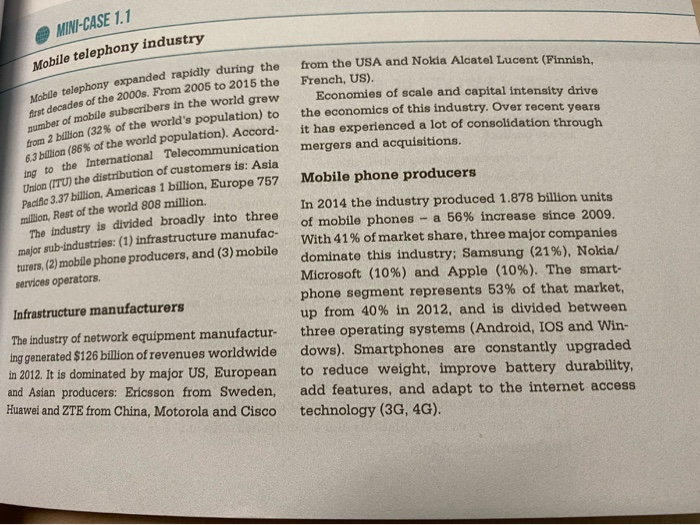
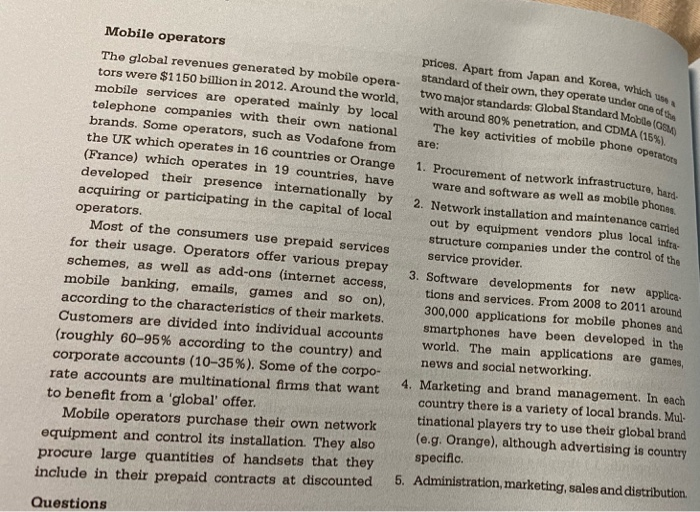
Mobile telephony expanded rapidly during the first decades of the 2000s. From 2005 to 2015 the number of mobile subscribers in the world grew from 2 billion (32% of the world's population) to MINI-CASE 1.1 Mobile telephony industry from the USA and Nokia Alcatel Lucent (Finnish, French, US). Economies of scale and capital intensity drive the economics of this industry. Over recent years it has experienced a lot of consolidation through mergers and acquisitions. 3.3 billion (86% of the world population). Accord ing to the International Telecommunication Union (ITU) the distribution of customers is: Asia Pacific 3.37 billion, Americas 1 billion, Europe 757 million, Rest of the world 808 million The industry is divided broadly into three major sub-industries: (1) infrastructure manufac- turers, (2) mobile phone producers, and (3) mobile services operators. Mobile phone producers In 2014 the industry produced 1.878 billion units of mobile phones - a 56% increase since 2009. With 41% of market share, three major companies dominate this industry: Samsung (21%), Nokia/ Microsoft (10%) and Apple (10%). The smart- phone segment represents 53% of that market, up from 40% in 2012, and is divided between three operating systems (Android, IOS and Win- dows). Smartphones are constantly upgraded to reduce weight, improve battery durability, add features, and adapt to the internet access technology (3G, 4G). Infrastructure manufacturers The industry of network equipment manufactur- ing generated $126 billion of revenues worldwide in 2012. It is dominated by major US, European and Asian producers: Ericsson from Sweden, Huawei and ZTE from China, Motorola and Cisco prices. Apart from Japan and Korea, which standard of their own, they operate under one of the two major standards: Global Standard Mobile M) The key activities of mobile phone operators ware and software as well as mobile phones with around 80% penetration, and CDMA (15%). are: 1. Procurement of network infrastructure, hard. Mobile operators The global revenues generated by mobile opera- tors were $1150 billion in 2012. Around the world, mobile services are operated mainly by local telephone companies with their own national brands. Some operators, such as Vodafone from the UK which operates in 16 countries or Orange (France) which operates in 19 countries, have developed their presence internationally by acquiring or participating in the capital of local operators. Most of the consumers use prepaid services for their usage. Operators offer various prepay schemes, as well as add-ons (internet access, mobile banking, emails, games and so on) according to the characteristics of their markets. Customers are divided into individual accounts (roughly 60-95% according to the country) and corporate accounts (10-35%). Some of the corpo- rate accounts are multinational firms that want to benefit from a 'global' offer. Mobile operators purchase their own network equipment and control its installation. They also procure large quantities of handsets that they include in their prepaid contracts at discounted 2. Network installation and maintenance camed out by equipment vendors plus local intra structure companies under the control of the service provider. 3. Software developments for new applica- tions and services. From 2008 to 2011 around 300,000 applications for mobile phones and smartphones have been developed in the world. The main applications are games, news and social networking. 4. Marketing and brand management. In each country there is a variety of local brands. Mul: tinational players try to use their global brand (e.g. Orange), although advertising is country specific 5. Administration, marketing, sales and distribution Questions









 Study Help