







Question: Need solution ASAP! Jugs (This is a variation on Exercise 14 in Chapter 10.1 of the textbook) Two jugs A and B have capacities of
Need solution ASAP!
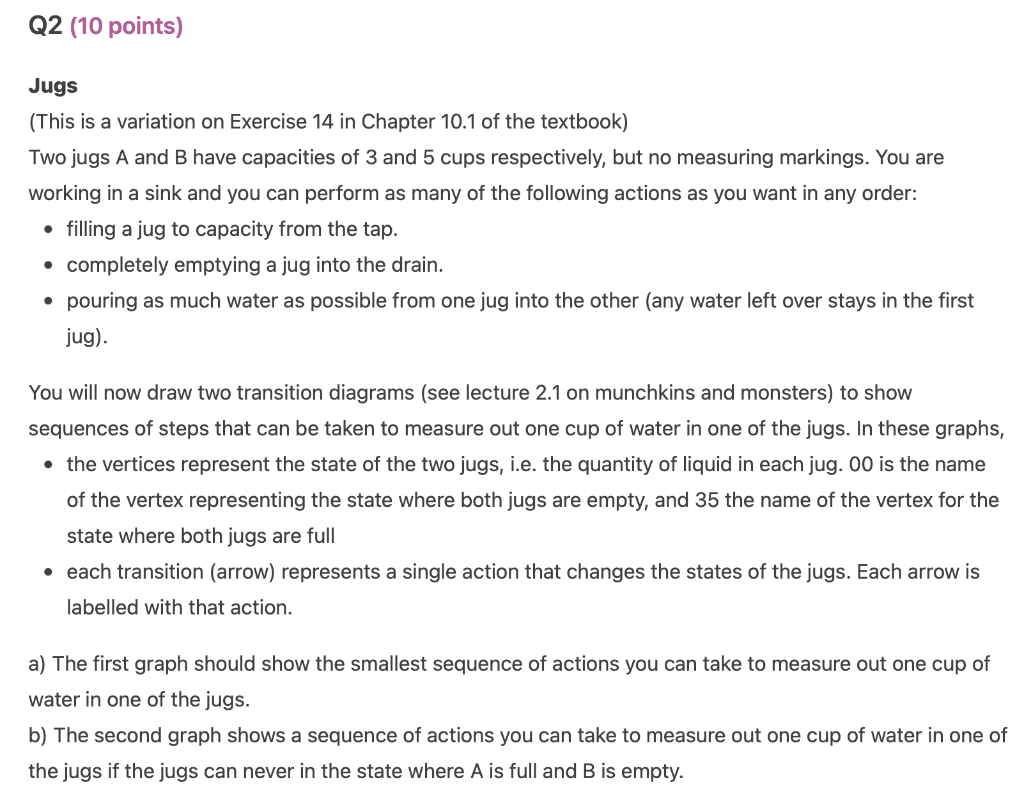
Jugs (This is a variation on Exercise 14 in Chapter 10.1 of the textbook) Two jugs A and B have capacities of 3 and 5 cups respectively, but no measuring markings. You are working in a sink and you can perform as many of the following actions as you want in any order: - filling a jug to capacity from the tap. - completely emptying a jug into the drain. - pouring as much water as possible from one jug into the other (any water left over stays in the first jug). You will now draw two transition diagrams (see lecture 2.1 on munchkins and monsters) to show sequences of steps that can be taken to measure out one cup of water in one of the jugs. In these graphs, - the vertices represent the state of the two jugs, i.e. the quantity of liquid in each jug. 00 is the name of the vertex representing the state where both jugs are empty, and 35 the name of the vertex for the state where both jugs are full - each transition (arrow) represents a single action that changes the states of the jugs. Each arrow is labelled with that action. a) The first graph should show the smallest sequence of actions you can take to measure out one cup of water in one of the jugs. b) The second graph shows a sequence of actions you can take to measure out one cup of water in one o the jugs if the jugs can never in the state where A is full and B is empty
Step by Step Solution
There are 3 Steps involved in it

Get step-by-step solutions from verified subject matter experts
 Study Help