







Question: Need the mathematical or excel solution for this involving all the given constraints. Promotion Challenges at Gulmarg Skis Management at Gulmarg Skis was surprised in
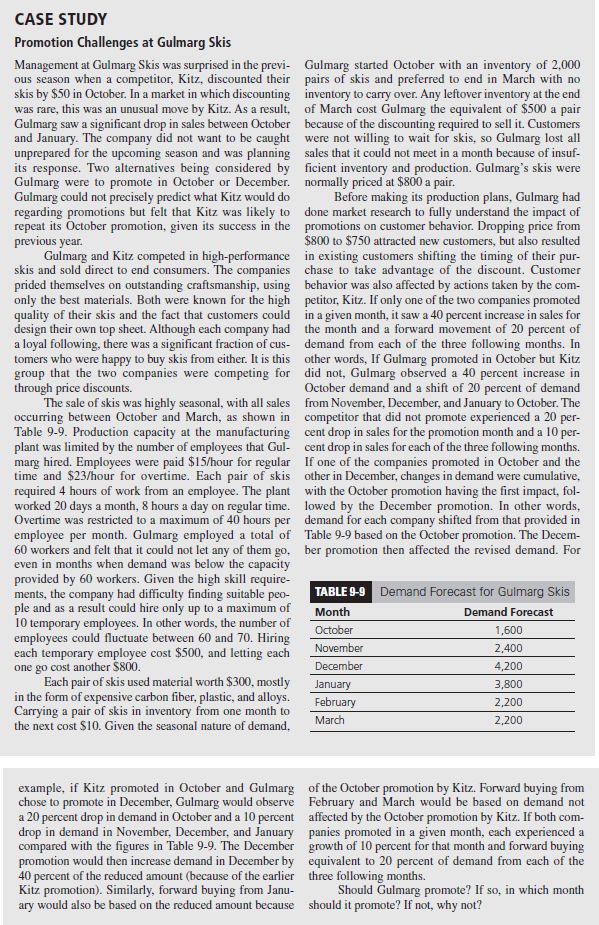
Need the mathematical or excel solution for this involving all the given constraints.
Promotion Challenges at Gulmarg Skis Management at Gulmarg Skis was surprised in the previ Gulmarg started October with an inventory of 2,000 skis by $50 in October. In a market in which discounting was rare, this was an unusual move by Kitz. As a result, Gulmarg saw a significant drop in sales between October inventory to carry over. Any leftover inventory at the end of March cost Gulmarg the equivalent of $500 a pair because of the discounting required to sell it. Customers cau unprepared for the upcoming season and was planning its response. Two alternatives being considered by Gulmarg were to promote in October or December. Gulmarg could not precisely predict what Kitz would do regarding promotions but felt that Kitz was likely to sales that it could not meet in a month because of insuf ficient inventory and production. Gulmarg's skis were normally priced at $800 a pair. Before making its production plans, Gulmarg had done market research to fully understand the impact of Gulmarg and Kitz competed in high-performance skis and sold direct to end consumers. The companies prided themselves on outstanding craftsmanship, using only the best materials. Both were known for the high quality of their skis and the fact that customers could design their own top sheet. Although each company had a loyal following, there was a significant fraction of cus- tomers who were happy to buy skis from either. It is this 800 to $750 attracted new customers, but also resulted in existing customers shifting the timing of their pur chase to take advantage of the discount. Customer behavior was also affected by actions taken by the com- petitor, Kitz. If only one of the two companies promoted in a given month, it saw a 40 percent increase in sales for the month and a forward movement of 20 percent of demand from each of the three following months. In other words, If Gulmarg promoted in October but Kitz The sale of skis was highly seasonal, with all sales occurring between October and March, as shown in Table 9-9. Production capacity at the manufacturing plant was limited by the number of employees that Gul- marg hired. Employees were paid $15/hour for regular time and $23/hour for overtime. Each pair of skis required 4 hours of work from an employee. The plant worked 20 days a month, 8 hours a day on regular time. Overtime was restricted to a maximum of 40 hours per employee per month. Gulmarg employed a total of 60 workers and felt that it could not let any of them go, even in months when demand was below the capacity provided by 60 workers. Given the high skill require- ments, the company had difficulty finding suitable peo- ple and as a result could hire only up to a maximum of from November, December, and January to October. The competitor that did not promote experienced a 20 per cent drop in sales for the promotion month and a 10 per cent drop in sales for each of the three following months. If one of the companies promoted in October and the other in December, changes in demand were cumulative, with the October promotion having the first impact, fol- lowed by the December promotion. In other words, Table 9-9 based on the October promotion. The Decem- ber promotion then affected the revised demand. For employees could fluctuate between 60 and 70. Hiring each temporary employee cost $500, and letting each November Each pair of skis used material worth $300, mostly anuary in the form of expensive carbon fiber, plastic, and alloys. the next cost $10. Given the seasonal nature of demand example, if Kitz promoted in October and Gulmarg chose to promote in December, Gulmarg would observe a 20 percent drop in demand in October and a 10 percent drop in demand in November, December, and January compared with the figures in Table 9-9. The December promotion would then increase demand in December by 40 percent of the reduced amount (because of the earlier Kitz promotion). Similarly, forward buying from Janu- ary would also be based on the reduced amount because of the October promotion by Kitz. Forward buying from February and March would be based on demand not affected by the October promotion by Kitz. If both com- panies promoted in a given month, each experienced a growth of 10 percent for that month and forward buying equivalent to 20 percent of demand from each of the three following months. should it promote? If not, why not
Step by Step Solution
There are 3 Steps involved in it

Get step-by-step solutions from verified subject matter experts
 Study Help