







Question: need the solutions in pro model software asap please will definitely give upvote for right answer 1. Jobs arrive to an arriving queue in batches
need the solutions in pro model software asap please will definitely give upvote for right answer 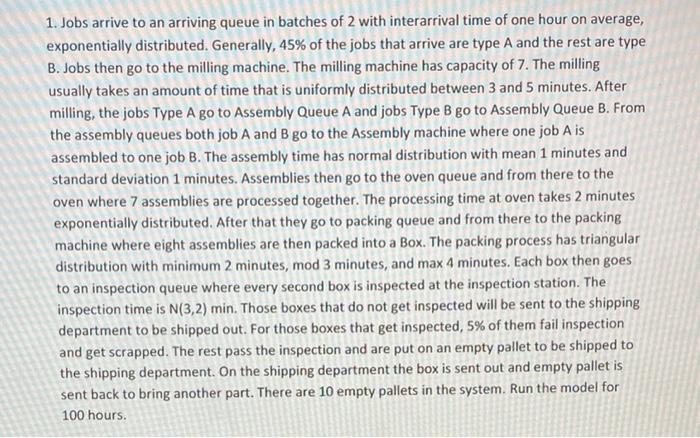
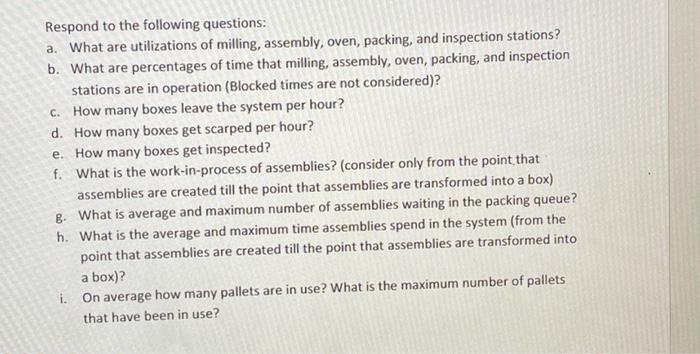
1. Jobs arrive to an arriving queue in batches of 2 with interarrival time of one hour on average, exponentially distributed. Generally, 45% of the jobs that arrive are type A and the rest are type B.Jobs then go to the milling machine. The milling machine has capacity of 7. The milling usually takes an amount of time that is uniformly distributed between 3 and 5 minutes. After milling, the jobs Type A go to Assembly Queue A and jobs Type B go to Assembly Queue B. From the assembly queues both job A and B go to the Assembly machine where one job Ais assembled to one job B. The assembly time has normal distribution with mean 1 minutes and standard deviation 1 minutes. Assemblies then go to the oven queue and from there to the oven where 7 assemblies are processed together. The processing time at oven takes 2 minutes exponentially distributed. After that they go to packing queue and from there to the packing machine where eight assemblies are then packed into a Box. The packing process has triangular distribution with minimum 2 minutes, mod 3 minutes, and max 4 minutes. Each box then goes to an inspection queue where every second box is inspected at the inspection station. The inspection time is N(3,2) min. Those boxes that do not get inspected will be sent to the shipping department to be shipped out. For those boxes that get inspected, 5% of them fail inspection and get scrapped. The rest pass the inspection and are put on an empty pallet to be shipped to the shipping department. On the shipping department the box is sent out and empty pallet is sent back to bring another part. There are 10 empty pallets in the system. Run the model for 100 hours. Respond to the following questions: a. What are utilizations of milling, assembly, oven, packing, and inspection stations? b. What are percentages of time that milling, assembly, oven, packing, and inspection stations are in operation (Blocked times are not considered)? C. How many boxes leave the system per hour? d. How many boxes get scarped per hour? e. How many boxes get inspected? f. What is the work-in-process of assemblies? (consider only from the point that assemblies are created till the point that assemblies are transformed into a box) 8. What is average and maximum number of assemblies waiting in the packing queue? h. What is the average and maximum time assemblies spend in the system (from the point that assemblies are created till the point that assemblies are transformed into a box)? i. On average how many pallets are in use? What is the maximum number of pallets that have been in use? 1. Jobs arrive to an arriving queue in batches of 2 with interarrival time of one hour on average, exponentially distributed. Generally, 45% of the jobs that arrive are type A and the rest are type B.Jobs then go to the milling machine. The milling machine has capacity of 7. The milling usually takes an amount of time that is uniformly distributed between 3 and 5 minutes. After milling, the jobs Type A go to Assembly Queue A and jobs Type B go to Assembly Queue B. From the assembly queues both job A and B go to the Assembly machine where one job Ais assembled to one job B. The assembly time has normal distribution with mean 1 minutes and standard deviation 1 minutes. Assemblies then go to the oven queue and from there to the oven where 7 assemblies are processed together. The processing time at oven takes 2 minutes exponentially distributed. After that they go to packing queue and from there to the packing machine where eight assemblies are then packed into a Box. The packing process has triangular distribution with minimum 2 minutes, mod 3 minutes, and max 4 minutes. Each box then goes to an inspection queue where every second box is inspected at the inspection station. The inspection time is N(3,2) min. Those boxes that do not get inspected will be sent to the shipping department to be shipped out. For those boxes that get inspected, 5% of them fail inspection and get scrapped. The rest pass the inspection and are put on an empty pallet to be shipped to the shipping department. On the shipping department the box is sent out and empty pallet is sent back to bring another part. There are 10 empty pallets in the system. Run the model for 100 hours. Respond to the following questions: a. What are utilizations of milling, assembly, oven, packing, and inspection stations? b. What are percentages of time that milling, assembly, oven, packing, and inspection stations are in operation (Blocked times are not considered)? C. How many boxes leave the system per hour? d. How many boxes get scarped per hour? e. How many boxes get inspected? f. What is the work-in-process of assemblies? (consider only from the point that assemblies are created till the point that assemblies are transformed into a box) 8. What is average and maximum number of assemblies waiting in the packing queue? h. What is the average and maximum time assemblies spend in the system (from the point that assemblies are created till the point that assemblies are transformed into a box)? i. On average how many pallets are in use? What is the maximum number of pallets that have been in use Step by Step Solution
There are 3 Steps involved in it
1 Expert Approved Answer
Step: 1 Unlock

Question Has Been Solved by an Expert!
Get step-by-step solutions from verified subject matter experts
Step: 2 Unlock
Step: 3 Unlock
 Study Help