







Question: Please read and answer the question from Act 1, then Act 2 and finally questions 1-3. So in total, it's 5 questions. Thank you. ACT
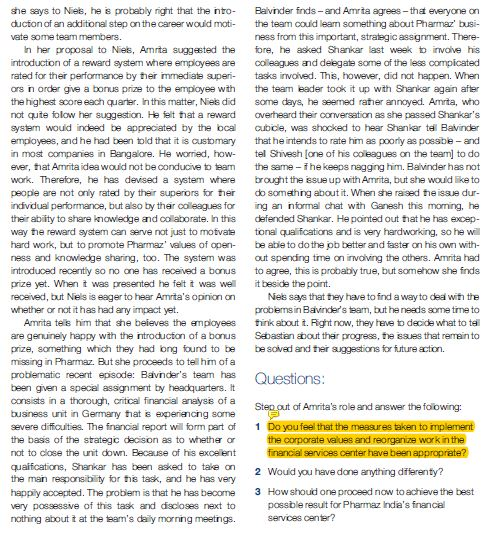
Please read and answer the question from Act 1, then Act 2 and finally questions 1-3.
So in total, it's 5 questions.
Thank you.
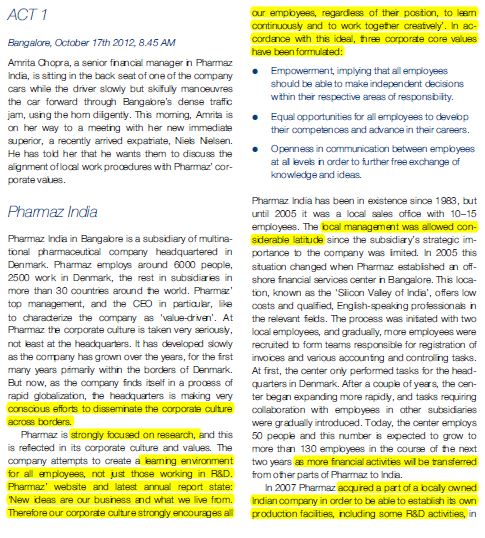
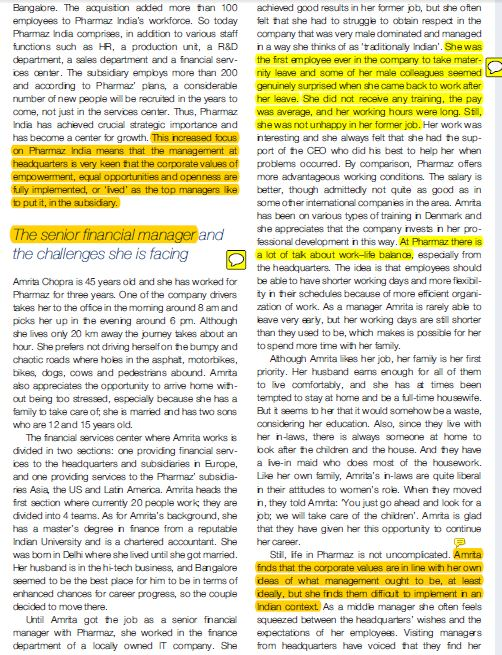
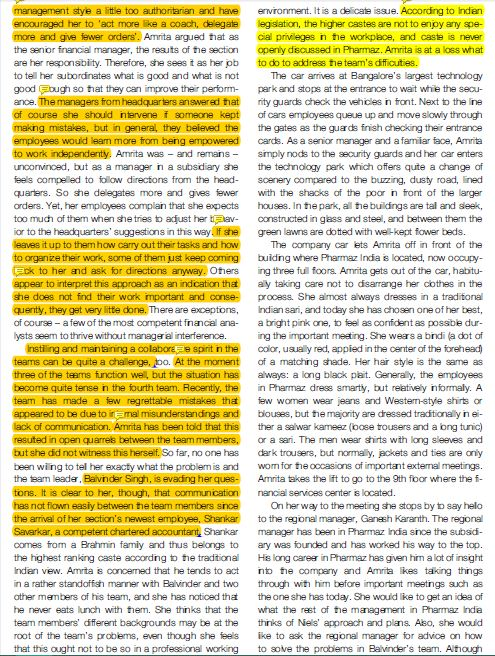
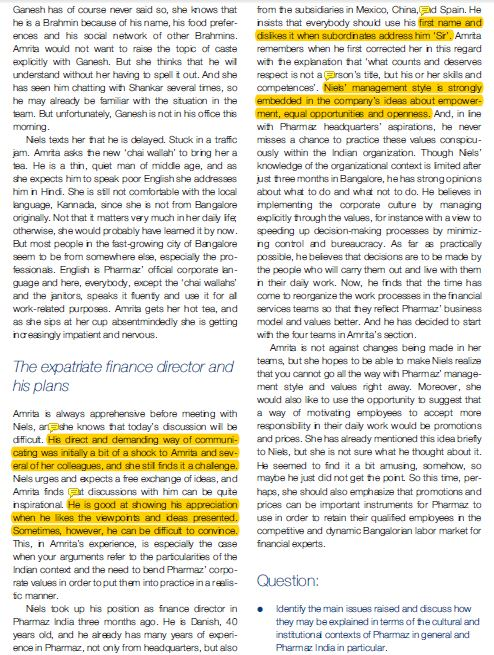
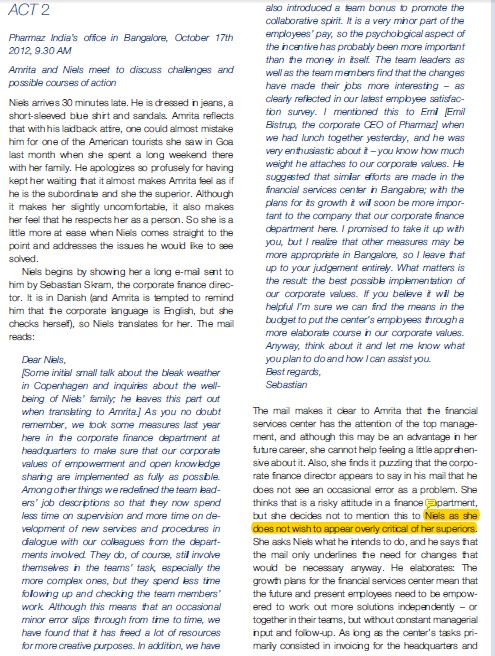
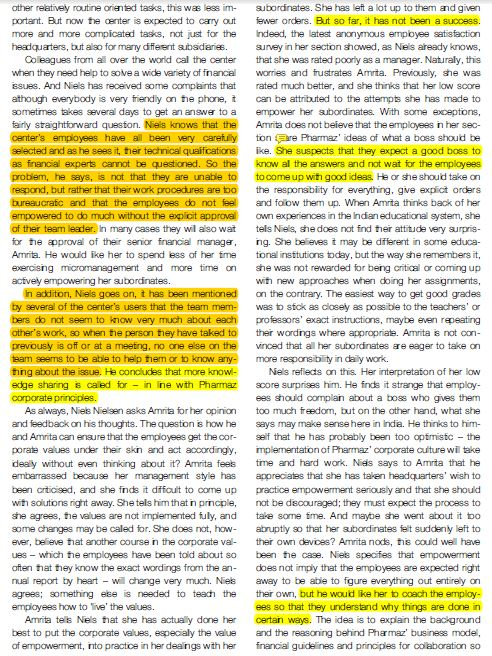
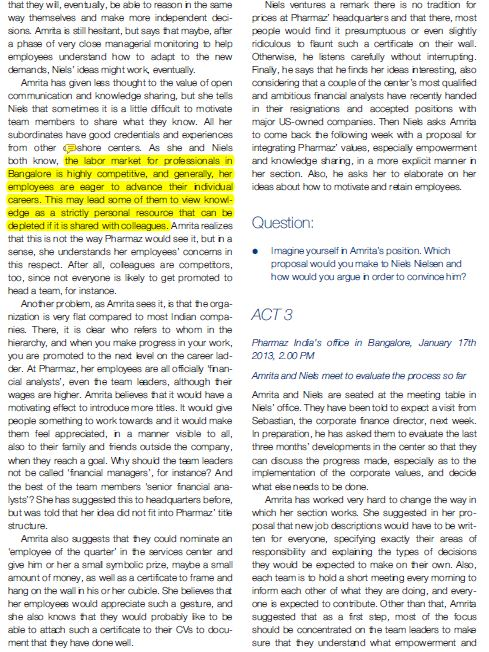
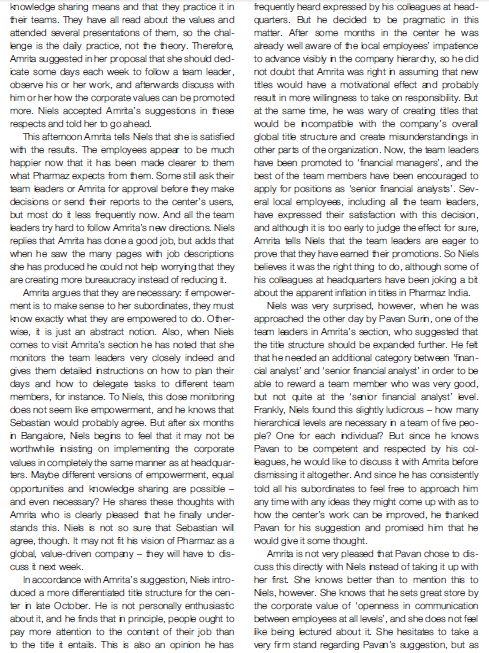
ACT 1 our employees, regardless of the position, to leam continuously and to work together creatively. In ac- cordance with this ideal, three corporate core values have been formulated: Empowerment, implying that all employees should be able to make independent decisions within the respective areas of responsibility Bangalore, October 17th 2012, 8.45 AM Amrita Chopra, a senior fnancial manager in Pharmaz India, is sitting in the back seat of one of the company cars while the driver slowly but skify manoeuvres the car forward through Bangalore's dense traffic jam, using the hom diigenty. This moming, Amrita is on her way to a meeting with her new immediate superior, a recently arrived expatriate, Niels Nielsen He has told her that he wants them to discuss the alignment of local work procedures wth Pharmaz' cor- borate Equal opportunities for all employees to develop their competences and advance in their careers. Operness in communication between employees at al levels in order to further free exchange of knowledge and ideas Pharmaz India Pharmaz India in Bangalore is a subsidiary of multina- tonal pharmaceutical company headquartered in Denmark. Pharmaz employs around 6000 people, 2500 work in Denmark, the rest in subsidiaries in more than 30 countries around the world. Pharmaz top management, and the CEO in particular, e to characterize the company as 'value-driven. At Pharmaz the corporate culture is taken very seriously, not least at the headquarters. It has developed slowly as the company has grown over the years, for the first many years primarily within the borders of Denmark. But now, as the company finds itself in a process of rapid gobalization, the headquarters is making very conscious efforts to disseminate the corporate culture across borders Pharmaz is strongly focused on research, and this is refected in its corporate culture and values. The company attempts to create a bang environment for all employees, not just those working in R&D. Pharmaz' website and latest annual report state: New deas are our business and what we live from. Therefore our corporate culture strongly encourages all Pharmaz India has been in existence since 1983, but until 2005 it was a local sales office with 10-15 employees. The cal management was allowed con- siderable latitude since the subsidiary's strategic im- portance to the company was imited. In 2005 this situation changed when Pharmaz estabished an off- shore financial services center in Bangalore. This loca- ton, known as the 'Silicon Valey of India', offers low costs and qualified, Engish-speaking professionals in the relevant fields. The process was initated with two local employees, and gradually, more employees were recruited to form teams responsible for registration of invoices and various accountng and control ng tasks. At frst, the center only performed tasks for the head- quarters in Denmark. After a couple of years, the cen- ter began expanding more rapidy, and tasis requiring collaboration with employees in other subsidiaries were gradually introduced. Today, the center employs 50 people and this number is epected to grow to more than 130 employees in the course of the next two years a more fnancial activities wil be transferred from other parts of Pharmaz to Inda. In 2007 Pharmaz acquired a part of a focaly owned Indian company in order to be able to establish its own production facilities, ncluding some R&D activities, in Bangalore. The acquistion added more than 100 achieved good results in her former oh, but she often employees to Pharmaz India's workforce. So today at that she had to struggle to obtain respect in the Pharme India comprises, in addition to various staff company that was very male dominated and managed unctions such as HR, a production unt, a R&D in a way she thinks of as 'taditional Indian'. She was department, a sales department and a fnancial serv- the frst employee ever in the company to take mater ces center. The subsidiary employs more than 200 nity leave and some of her male colleagues seemed and according to Pharma plans, a considerable genuinely surprised when she came back to work after number of new people will be recruited in the years to her leave. She did not receive any training, the pay come, not just in the services center. Thus, Pharmaz was average, and her working hours were long. St, India has achieved crucial strategic importance and she was noturhappy in her former job. Her work was has become a canter for growth. This increased focus nteresting and she always felt that she had the sup- on Pharmaz India means that the management at port of the CEO who did his best to help her when headquarters is very keen that the corporate values of problems occurred. By comparison, Pharmaz offers empowerment, equal opportunities and openness are more advantageous working conditions. The salary is sly implemented, or "ived' as the top managers like better, though admittedly not quite as good as in to put it in the subsidiary. some other international companies in the area. Amrta has been on various types of training n Denmark and she appreciates that the company nvests in her pro- The senior financial manager and fessional development in this way. At Pharmaz there is the challenges she is facing ol a lot of tak about work-life balance, especially from the headquarters. The idea is that employees should Amrita Chopra is 45 years old and she has worked for be able to have shorter working days and more fexibil- Pharma for three years. One of the company drivers ty in their schedules because of more efficient organi- takes her to the office in the moming around 8 am and zation of work. As a manager Amrita is rarely able to picks her up in the evening around 6 pm. Although bave very cry, but her working days are stil shorter she lives only 20 km away the pumey takes about an than they used to be, which makes is possible for her hour. She prefers not driving herself on the bumpy and to spend more time with her family. chaotic roads where holes in the asphat, motorbikes. Although Amrita likes her job, her family is her first bikes, dogs, cows and pedestrians abound. Amrita priority. Her husband earns enough for all of them also appreciates the opportunity to arrive home with to live comfortably, and she has a times been out being bo stressed, especially because she has a tempted to stay at home and be a full-time housewife. family to take care of she is married and has two sons But it seems to her that it would somehow be a waste, who are 12 and 15 years old. considering her education. Also, since they live with The fnancial services center where Amrita works is her in-laws, there is always someone at home to divided in two sections: one providing financial serv- ook after the children and the house. And they have ces to the headquarters and subsidiaries in Europe, a ive-in maid who does most of the housework. and one providing services to the Pharmaz' subsidia- Like her own family, Amrita's in-laws are quite liberal nes Asia, the US and Latin America. Amrita heads the in their attitudes to women's role. When they moved first section where currenty 20 people work they are in, they told Amrta: You just go ahead and look for a divided into 4 teams. As for Amrita's background, she por we wil take care of the chidren'. Amrtais gad has a master's degree in france from a reputable that they have given her this opportunity to continue Indian University and is a chartered accountant. She her career. was bom in Delhi where she lived until she got married. Sell, ife in Pharmaz is not uncomplicated. Amta Her husband is in the hi-tech business, and Bangalore finds that the corporate values are in line with her own seemed to be the best place for him to be in terms of dess of what management ought to be, at least enhanced chances for career progress, so the couple deely, but she fnds them dificut implement in an decided to move there. Indian context. As a midde manager she often feels Until Amta got the job as a senior fnanca squeezed between the headquarters' wishes and the manager with Pharmaz, she worked in the finance expectations of her employees. Visiting managers department of a localy owned IT company. She from headquarters have voiced that they find her management style a little too authoritarian and have encouraged her to 'act more like a coach, delegate more and give fewer orders'. Amrita argued that as the senior fnancial manager, the resuts of the section are her responsbility. Therefore, she sees tas her ob to tell her subordinates what is good and what is not good bugh so that they can improve their perform ance. The managers from headquarters answered that of course she should nervene i someone kept making mistakes, but in general, they believed the employees would learn more from being empowered to work independenty, Amrita was - and remans - unconvinced, but as a manager in a subsidiary she fals compelled to follow directions from the head quarters. So she delegates more and gives fewer orders. Yet, her employees complain that she expects too much of them when she tries to adjust her Flav- lor to the headquarters' suggestions in this way. If she leaves it up to them how carry out their tasks and how to organize their work, some of them ust keep coming Eck to her and ask for directions anyway. Others appear to interpret this approach as an indication that she does not find their work important and conse- quently, they get very litte done. There are exceptions, of course - a few of the most competent fnancial ana- lysts seem to thrive without managerial interference. Instiling and maintaining a colaboree spirit in the teams can be quite a challenge, too. At the moment three of the teams function well, but the situation has become quite tense in the fourth team. Recently, the team has made a few regrettable mistakes that appeared to be due to it mal misunderstandings and lack of communication. Amrita has been told that this resuted in open quarrels between the team members, but she did not witness this herself. So far, no one has been wing to tell her exacty what the problem is and the team leader, Balvinder Singh, is evading her ques- tions. It is clear to her, though, that communication has not flown easily between the team members since the arrival of her section's newest employee, Shankar Savarkar, a competent chartered accountant Shankar comes from a Brahmin family and thus belongs to the highest ranking caste according to the traditional Indian view. Amrta s concerned that he tends to act in a rather standoffish manner with Balvinder and two other members of his team, and she has noticed that he never eats lunch with them. She thinks that the team members' different backgrounds may be at the root of the team's problems, even though she feels that this ought not to be so in a professional working environment. It is a delicate issue. According to Indian legislation, the higher castes are not to enjoy any spe- cial privileges in the workplace, and caste is never openly dscussed in Pharmaz. Amrita is at a loss what to do to address the team's dificulties The car arrives at Bangalore's largest technology park and stops at the entrance to wait while the secu- rity guards check the vehicles in tont. Nect to the ine of cars employees queue up and move slowly through the gates as the guards finish checking their entrance carcis. As a senior manager and a familar face, Amrita simply nods to the security guards and her car enters the technology park which offers quite a change of scenery compared to the buzzing, dusty road, ined with the shacks of the poor in front of the larger houses. In the park, all the buildings are tal and sleek, constructed in glass and steel, and between them the green lawns are dotted with well-kept fower beds. The company car lets Amrita off in front of the buidng where Pharmaz India is located, now occupy- ing three full foors. Amrita gets out of the car, habtu- ay taking care not to disarrange her clothes in the process. She almost always dresses in a traditonal Indian sari, and today she has chosen one of her best, a bright pink one, to feel as confident as possible dur- ing the important meeting. She wears a bndi (a dot of color, usually red, appied in the center of the foreheach of a matching shade. Her har style is the same as always: a long black plait. Generally, the employees in Pharmaz dress smarty, but relatively normaly. A few women wear jeans and Western-style shirts or blouses, but the majority are dressed traditionally in e ther a salwar Kameez (loose trousers and a long tunic) or a sari. The men wear Shirts with long sleeves and dark trousers, but normally, jackets and ties are only wom for the occasions of important external meetings. Amrita takes the lift to go to the 9th floor where the f- nancial services center is located. On her way to the meeting she stops by to say helo to the regional manager, Ganesh Karanth. The regonal manager has been in Pharmaz India srce the subsid. ary was founded and has worked his way to the top. His long career in Pharmaz has given him a lot of insight in the company and Amrita likes taking things through with him before important meetings such as the one she has today. She would like to get an idea of what the rest of the management in Pharmaz India thinks of Nels' approach and plans. Also, she would like to ask the regional manager for advice on how to solve the problems in Balvinder's team. Although Ganesh has of course never said so, she knows that he is a Brahmin because of his name, his food prefer- ances and his social network of other Brahmins. Amrita would not want to raise the topic of caste splicitly with Ganesh. But she thinks that he will understand without her having spelt out. And she has seen him chatting with Shariar several times, so he may already be familiar with the situation in the team. But unfortunately, Ganesh is not in his offce this moming Nelstets her that he is delayedi Stuck in a trafic am. Ameta asks the new 'chai walan' to bring her a ha. He is a thin, quet man of middle age, and as she expects him to speak poor Engish she addresses him in Hindi. She is still not comfortable with the local language, Kannada, since she is not from Bangalore originally. Not that it matters very much in her day ife otherwise, she would probably have leamed it by now. But most people in the fast-growing city of Bangalore seem to be from somewhere else, especially the pro- fessionals. Engish Pharma' official corporate lan- guage and here, everybody, scept the 'chai wallahs and the janitors, speaks it fuenty and use it for all work-related purposes. Amrita gets her hot tee, and as she sips at her cup absentmindedly she is getting na asingly impatient and nervous. fom the subsidiaries in Mexico, China, Ed Spain. He nsists that everybody should use his first name and dislikes it when subordinates address him 'Sr Arta remembers when he first corrected her in this regard with the explanation that what counts and deserves respect is not a Frson's tite, but his or her skils and competences'. Nies' management style s strongly embedded in the company's ideas about empower- mant, equal opportunities and openness. And, in ine with Pharma headquarters' aspirations, he never misses a chance to practice these values conspicu- ously within the Indian organization. Though Nels' knowledge of the organizational context is imited after just three months in Bangalore, he has strong opinions about what to do and what not to do. He believes in implementing the corporate outure by managing explicitly through the values, for instance with a vew to speeding up decision-making processes by minimiz- ng control and bureaucracy. As far as practically possible, he beleves that decisions are to be made by the people who will carry them out and live with them in their daily work. Now, he inds that the time has come to reorganize the work processes in the financial Services teams so that they reflect Pharmaz' business model and values better. And he has decided to start with the four teams in Amrita's section Amrita s not against changes beng made in her teams, but she hopes to be able make Niels realize that you cannot go all the way with Pharmaz' manage- ment style and values right away. Moreover, she would also like to use the opportunity to suggest that a way of motivating employees to accept more responsibility in their day work would be promotions and prices. She has already mentioned this idea briefly t o Nies, but she is not sure what he thought about it. He seemed to find it a bit amusng, somehow, so maybe he just did not get the pont So this time, per- haps, she should also emphasize that promotions and prices can be important instruments for Pharmaz to use in order o retain their qualified employees n the compettive and dynamic Bangalorian labor market for fnancial experts The expatriate finance director and his plans Amrita s always apprehensive before meeting with Nels, ar she knows that today's discussion will be diffiout. His direct and demanding way of communi- cating was initally a bit of a shock to Amrita and sev eral of her colleagues, and she stil finds it a chalenge. Nels urges and expects a free exchange of ideas, and Amrita finds at discussions with him can be quite inspirational He is good at showing his appreciation when he likes the viewpoints and ideas presented. Sometimes, however, he can be difficut to convince This, in Amrita's experience, is especiay the case when your arguments refer to the particularities of the Indian context and the need to bend Pharmaz' corpo- rate values in order to put them into practice inares tc manner. Nels bok up his position as finance director in Pharmaz India three months ago. He s Danish, 40 years old, and he aready has many years of experi- ence in Pharmaz, not only from headquarters, but also Question: . Identify the main issues raised and discuss how they may be explained in terms of the cultural and institutional contexts of Pharmaz in general and Pharma India in particular. ACT 2 Pharmaz India's office in Bangalore, October 17th 2012, 9.30 AM Amrita and Niels meet to discuss challenges and possible courses of action Niels arrives 30 minutes late. He is dressed in jeans, a short-sleeved blue shirt and sandals Amrita reflects that with his laidback attre, one could almost mistake him for one of the American tourists she saw in Goa last month when she spent a long weekend there with her family. He apologizes so profusely for having kept her waiting that it almost makes Amrita feel as if he is the subordinate and she the superior. Although it makes her sightly uncomfortable, it also makes her feel that he respects her as a person. So she is a little more at ease when Niels comes straight to the point and addresses the issues he would like to see solved. Nels begins by showing her a long e-mai sant to him by Sebastian Skram, the corporate fnance direc- tor. It is in Danish and Amrita is tempted to remind him that the corporate language is Engish, but she checks herself), so Niels translates for her. The mai reacts: also introduced a sam bonus o promote the collaborative spirit. It is a very minor part of the employees' pay, so the psychobgical aspect of the incentive has probably been more important than the money in self The team leaders as well as the team members find that the changes have made their jobs more interesting -as clearly reflected in our latest empbyee satisfac ton suney. I mentioned this to Emil Emil Sistrup, the corporate CEO of Pharmaz) when we had lunch together yesterday, and he was very enthusiastic about t-you know how much weight he attaches to our corporate values. He suggested that similar efforts are made in the financial services consern Bangabe; with the plans for is growth i wil soon be more impor tant to the company that our corporate france department here. I promised to take it up with you, but I realize that other measures may be more appropriate in Bangalore, so I leave that up to your judgement entirey. What matters is the result the best possible implementation of our corporate values. If you believe I wil be helpful I'm sure we can find the means in the budget to put the center's empbyees througha more elaborate course in our corporate values Anyway, think about it and let me know what you plan to do and how I can assist you. Best regards, Sebastian Daar Niels, Some invita small talk about the bleak weather in Copenhagen and inquiries about the well- being of Niels' family he waves this part out when translating to Amrita) As you no doubt remember, we bok some measures last year here in the corporate finance department at Headquarters to make sure that our corporate values of empowerment and open knowledge sharing are implemented as fully as possible. Amongother things we redefned the team lead- ers' job descriptions so that they now spend less time on supervision and more time on de- velopment of new services and procedures in dialogue with our colleagues from the depart- ments involved They db, of course, stil involve themselves in the teams' task especially the more complex ones, but they spend less time folowing up and checking the team members work Although this means that an occasional minor error slips frough from time to time, we have found that has freed a lot of resources for more creative purposes. In addition, we have The mal makes it clear to Amrita that the financial services center has the attention of the top manage ment, and although this may be an advantage n her future career, she cannot help feeing a little apprehen- sive about it. Also, she finds it puzzing that the corpo- rate finance director appears to say in his mail that he does not see an occasional error as a problem. She thinks that is a risky attitude in a francepartment, but she decides not to mention this to Nels as she does not wish to appear overly critical of her superiors She asks Niels what he intends to do, and he says that the mail only underines the need for changes that would be necessary anyway. He elaborates The growth plans for the financial service center mean that the future and present enployees need to be empow- ered to work out more solutions independenty- together in their tears, but without constant managerial nput and folow-up. As ong as the center's tasks prie mariy consisted in invoicng for the headquarters and other relativey routine oriented tasks, this was less im- portant. But now the center is expected to carry out more and more complicated tasks, not just for the headquarters, but also for many different subsidare. Colleagues from all over the world call the center when they need help to solve a wide variety of fnanca SUBS. And Niels has received some complaints that athough everybody is very friendly on the phone, t sometmes kes several days to get an answer to a fairly staightforward question. Niels knows that the center's employees have all been very carefully selected and as he sees it their technical quaifcations as financial experts cannot be questioned. So the problem, he says, is not that they are unable to respond, but rather that their work procedures are bo bureaucratic and that the employees do not feel empowered to do much without the explicit approvel of their team leader in many cases they will also wat for the approval of their senior fnancial manager Amrita. He would like her to spend less of her fme exercisng micromanagement and more time on actvey empowering har subordinates In additon, Niels goes on,t has been mentioned by several of the center's users that the team mem- bers do not seem to know very much about each other's work, so when the person they have taked to previousy is off or at a meeting, no one else on the team seems to be able to help them or to know any thing about the issue. He concludes that more knowl- edge sharing is called for - in ne with Pharmaz corporate principles As always, Niels Nielsen asks Amrita for her opinion and feedback on his thoughts. The question is how he and Amrita can ensure that the employees get the cor- porate values under their skin and act accordingly, dealy without even thinking about it? Amrita fees embarrassed because her management style has been crticised, and she inds it difficult to come up with solutions right away. She tels him that in princple, she agrees, the values are not implemented fully, and some changes may be caled for. She does not, how ever, believe that another course in the corporate val UBS - which the employees have been told about so often that they know the exact wordings from the an- nual report by heart-will change very much. Nies agrees; something else is needed to teach the employees how to live the values. Amrita tels Nels that she has actually done her best to put the corporate values, especially the value of empowerment to practice in her deaings with her subordinates. She has let a lot up to them and given fewer orders. But so far, it has not been a suCOBSS indeed, the latest anonymous employee satisfaction Suney in her section showed, as Neis aready knows, that she was rated poorly as a manager. Naturally, this worries and frustrates Amta. Previously, she was rated much better, and she thinks that her low score can be attributed to the attempts she has made to empower her subordinates. With some exceptons, Amrit does not beieve that the employees in her sec- ton Fire Pharmaz' ideas of what a boss should be lie. She suspects that they expect a good boss to know al the answers and not wat for the employees to come up with good ideasHe or she should take on the responsibility for everything, give explict orders and follow them up. When Amta thinks back of her own experiences in the Indian educational system, she tels Niels, she does not find ther attitude very surpris ng. She believes t may be different in some educa tional instutions today, but the way she remembers it, she was not rewarded for beng critical or coming up with new approaches when doing her assignments, on the contrary. The easiest way to get good grades was to stok as closely as possible to the teachers' or professors' exact instructions, maybe even repeating ther wordngs where appropriate. Amrita s not con- vinced that all her subordinates are eager to take on more responsibility in daily work. Niels reflects on this. Her interpretaton of her low score surprises him. He finds it strange that employ ees should complain about a boss who gives them too much freedom, but on the other hand, what she says may make sense here in India. He thinks to him self that he has probably been too optimiste - the implementation of Pharmace corporate culture will take time and hard work. Nids says to Amrita that he appreciates that she has taken headquarters' wish to practice empowerment seriously and that she should not be discouraged; they must expect the process to take some fme. And maybe she went about it bo abruptly so that her subordinates felt suddenly left to their own devices? Amrita nods, this could well have been the case. Niels specifies that empowerment does not imply that the employees are expected right away to be able to fgure everything out entirely on ther own, but he would like her coach the employ- ees so that they understand why things are done in certain ways. The idea is to explain the bac ground and the reasoning behind Pharmaz' business model fnancial guidelines and principles for collaboration so that they wil, eventually, be able to reason in the same way themselves and make more independent dec sons. Amrta is still hastant, but says that maybe, after a phase of very close managerial monitoring b help employees understand how to adapt to the new demands, Nels'ideas might work eventually Amrita has given as thought to the value of open communication and knowledge sharing, but she tels Niels that sometimes it is a little difficult to motivate team members to share what they know. Al her subordinates have good credentials and eperiences from other shore center As she and Niels both know, the labor market for professionals in Bangalore is highly competitive, and generally, her employees are eager to advance their individual careers. This may lead some of them to view know- edge as a strictly personal resource that can be depleted if it is shared with colleagues. Amrita realizes that this is not the way Pharmaz would see it, but in a sense, she understands her employees' conoems in this respect. After all, coleagues are competitors, too, since not everyone is likely to get promoted to head a team, for instance. Another problem, as Amrita sees it, is that the orga- nization is very flat compared to most Indian compa nies. There, it is clear who refers to whom in the Niels ventures a remark there is no tradition or prices at Pharmaz' headquarters and that there, most people would find it presumptuous or even sightly ridiculous b faunt such a certficate on their wall. Otherwise, he stens carefully without interrupting. Fray, he says that he finds her ideas nteresting, also considering that a couple of the center's most qualified and ambitious francal analysts have recenty handed in the resignations and accepted positions with major US-owned companies. Then Niels asks Amrita to come back the following week with a proposal for integrating Pharmaz' values, especially empowerment and knowledge shang, in a more explicit mannern her section. Also, he asks her to elaborate on her ideas about how to motivate and retain employees Question: Imagine yourself in Amrita's position. Which proposal would you make to Niels Nelsen and how would you arguen order to convince hm? ACT 3 Pharmaz India's office in Bangalore, January 17th 2013, 2.00 PM you are promoted to the next level on the career lad - der. At Pharmaz, her employees are all officia y fnan- cial analysts', even the team leaders, although their wages are higher. Amrita believes that it would have a motivating effect to introduce more titles. It would give people something to work towards and it would make them feel appreciated, n a manner visible to al also to their family and friends outside the company, when they reach a goal. Why should the team leaders not be called 'fnancial managers, for instance? And the best of the team members senior fnancial ana- ysts'? She has suggested this to headquarters before, but was told that her dea did not fit into Pharmaz' title structure Amrita also suggests that they could nominate an employee of the quarter' in the services center and give him or her a smal symbolic prize, maybe a smal amount of money, as well as a certificate to frame and hang on the wall in his or her cubicle. She believes that her employees would appreciate such a gesture, and she also knows that they would probably like to be able to attach such a certificate to their CVs to docu- ment that they have done well Amrita and Niets meet to evaluate the process so far Amrita and Niels are seated at the meeting table in Niels' office. They have been told to expect a visit from Sebastian, the corporate finance director, next week. in preparation, he has asked them to evaluate the last three months' developments in the center so that they can discuss the progress made, especialy as to the implementation of the corporate values, and decide what else needs to be done. Amrita has worked very hard to change the way in which her section works. She suggested in her pro- posal that new job descriptions would have to be writ- ten for everyone, specifying exacty their areas of responsbility and planng the types of decisions they would be spected to make on ther own. Also, each teamis b hold a short meetng every moming to inform each other of what they are doing, and every- one is expected to contribute. Other than that, Amita suggested that as a first step, most of the focus should be concentrated on the team leaders to male sure that they understand what empowerment and knowledge sharing means and that they practice it in ther teams. They have alread about the values and attended several presentations of them, so the chal enge is the daily practice, not the theory. Therefore Amrita suggested in her proposal that she should ded- cate some days each week to folow a team leader observe his or her work, and afterwards discuss with him or her how the corporate values can be promoted more. Niels accepted Amrta's suggestions in these respects and told herb go ahead This afternoon Amrita tels Nels that she is satisfied with the results. The employees appear to be much happier now that it has been made clearer b them what Pharmaz expects from them. Some stil ask their ham baders or Amrita for approval before they make decisions or send their reports to the center's users. but most do it less frequently now. And all the team baders try hard to follow Amrita's new directions. Niels replies that Amrta has done a good job, but adds that when he saw the many pages with job descriptions she has produced he would not hep worrying that they are creating more bureaucracy instead of reducing t Amrita argues that they are necessary: Tempower- ment is to make sense to her subordinates, they must Inow exactly what they are empowered to do. Ofer wise, t is just an abstract notion. Also, when Niels comes to visit Amrita's section he has noted that she monitors the team leaders very closely indeed and gives them detailed instructions on how to plan their days and how to delegate tasks to different team members, for instanca. To Niels, this dose monitoring does not seem like empowerment, and he knows that Sebastian would probably agree. But after six months in Bangalore, Nels begins to feel that it may not be worthwhie insisting on implementing the corporate values in completely the same manner as at headquar- ers. Maybe different versions of empowerment, equal opportunites and knowledge sharing are possible - and even necessary? He shares these thoughts with Amrita who is clearly pleased that he finaly under stands this. Niels is not so sure that Sebastian wil agree, though. It may not ft his vision of Pharmaz as a global, valus-driven company - they will have bds- cuss t next week In accordance with Amrita's suggestion, Niels intro- duced a more differentiated title structure for the cen- en late October. He is not personally enthusiastic about it, and he finds that in principle, people ought to pay more attention to the content of their job than o the tite tentals. This is also an opinion he has frequently heard expressed by his colleagues at head- quarters. But he decided b be pragmatic in this matte. After some months in the center he was already well aware of the boal employees' impatence to advance visby in the company herarchy, so he did not doubt that Amrita was right n assuming that new ttles would have a motivational effect and probably resit in more willingness to take on responsibility. But at the same time, he was wary of creating ttles that would be incompafble with the company's overal global title structure and create misunderstandings in other parts of the organization. Now, the team leaders have been promoted to 'nancial managers, and the best of the team members have been encouraged to apply for positions as senior financial analysts'. Sev- eral local employees, including al the team waders, have expressed their satsfaction with this decision, and although it is too early to judge the effect for sure, Amrita tells Nels that the team leaders are eager to prove that they have earned her promotions. So Niels believes it was the right thing to do, although some of h is colleagues at headquarters have been joking a bt about the apparent inflation in titles in Pharmaz India Nels was very surprised, however, when he was approached the other day by Pavan Surn, one of the team leaders in Amrita's section, who suggested that the title structure should be expanded further. He fet that he needed an additional category between nan cal analyst' and 'senior financial analyst' in order to be able to reward a team member who was very good, but not quite at the 'senior financial analyst' evel. Franidy, Nels found this slightly ludicrous - how many hierarchical levels are necessary in a team of five peo- ple? One for each individua? But since he knows Paven to be competent and respected by his col- leagues, he would like to discuss it with Amrita before dismissing it altogether. And since he has consistently told all his subordinates to feel free to approach him any time with any ideas they might come up with as to how the center's work can be improved, he thanked Paven for his suggestion and promised him that he would give it some thought. Anita is not very pleased that Pavan chose to dis- cuss this directly with Nels instead of taking it up with her frst She knows better than to mention this to Nels, however. She knows that he sets great store by the corporate value of 'openness in communication between employees at all levels, and she does not feel like being lectured about it She hesitate to take a very frm stand regarding Pavan's suggestion, but as she says to Niels, he is probably night that the nto- Balvinder finds-and Amrta agrees that everyone on ducton of an additional step on the career would moti- the team could learn something about Pharmaz busi- vate some team members. ness from this important, strategic assignment. There In her proposal to Nies, Amita suggested the fore, he asked Shankar last week b involve his introduction of a reward system where employees are colleagues and delegate some of the less compicated rated for their performance by their immediate super tasks involved. This, however, did not happen. When ors in order gve a bonus prize to the employee with the team leader took it up with Shankar again after the highest score each quarter. In this matter, Nias did some days, he seemed rather annoyed. Amrta, who not quite folow her suggestion. He fait that a reward overheard their conversation as she passed Shankar's system would indeed be appreciated by the calcubicle, was shocked to hear Shanlar tel Bavinder employees, and he had been bld that it is customary that he intends to rate him as poorly as possible and in most companies in Bangalore. He worried, how- tel Shivash (one of his colleagues on the team to do ever, that Amrita idea would not be conducive tem the same - he keeps nagging him. Balvinder has not work. Therefore, he has devised a system where brought the ssue up with Amrita, but she would like to people are not only rated by their superiors for their do something about it. When she raised the issue dur- individual performance, but also by their colleagues for ing an normal chat with Ganesh this moming, he their ability to share knowledge and collaborate. In this defended Shankar. He pointed out that he has excep- way the reward system can serve not just to motvate tional qualifications and is very hardworking, so he will hard work, but to promote Pharmaz' values of open- be able to do the pb better and faster on his own with ness and knowledge sharing, too. The system was out spending time on involving the others. Amrita had introduced recently so no one has received a bonus to agree, this is probably true, but somehow she inds prize yet. When it was presented he felt it was well it beside the point. received, but Nels is eager to hear Amrita's opinion on Nes says that they have to find a way to deal with the whether or not it has had any impact yet. problems in Bavinder's team, but he needs some time to Amrita tells him that she beleves the employees think about it. Right now, they have decide what to tell are genuinely happy with the introducton of a bonus Sebastian about their progress, the issues that remain to prize, something which they had ong found to be be solved and their suggestions for future action missing in Pharmaz. But she proceeds to tell him of a problematic recent episode: Bavinder's team has Questions: been given a special assignment by headquarters. It consists in a thorough, critical financial analysis of a Step out of Amrita's role and answer the following business unit in Germany that is experiencing some wevere difficulties. The financial report will form part of 1 Do you feel that the measures taken to mplement the basis of the strategic decison as to whether or the corporate values and reorganize work in the not to close the unit down. Because of his excelent financial services Center have been approprate? utentions. S i has been asked to take on 2 Would you have done anything differenty? the main responsibility for this task, and he has very happly accepted. The problem is that he has become 3 How should one proceed now to achieve the best very possessve of this task and discloses next to possible result for Pharmaz India's finance nothing about t at the team's daily morning meetings. Services centaStep by Step Solution
There are 3 Steps involved in it
1 Expert Approved Answer
Step: 1 Unlock

Question Has Been Solved by an Expert!
Get step-by-step solutions from verified subject matter experts
Step: 2 Unlock
Step: 3 Unlock
 Study Help