







Question: Needing help on this question, I will rate :) 4.1 Algorithim Format Algorithm (Function) Name: breadthSearch Input G=(V, E) a graph s, starting node t,
Needing help on this question, I will rate :)
4.1 Algorithim Format
Algorithm (Function) Name: breadthSearch
Input
G=(V, E) a graph
s, starting node
t, terminating node
Output
hasPath = true: there is a path from s to t
= false otherwise
Side effects
N.A.
Auxiliary data
Q: a queue // a node in the queue means its neighbors need to be inspected
// visited[i]: 0 means i is not visited, 1 otherwise
Plan
1. put s into Q, and hasPath := false
2. while Q is not empty
3. take/remove the first element u from Q
4. if u is t
5. hasPath := true
6. break
7. else
8. mark u as visited
9. for each {u, v} \in E // put the un-visited neighbors of u into Q
10. if v is not visited
11. put v into Q
End of algorithm
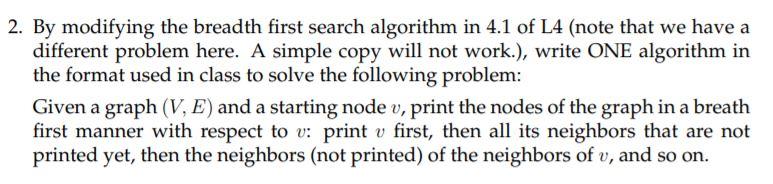
2. By modifying the breadth first search algorithm in 4.1 of L4 (note that we have a different problem here. A simple copy will not work.), write ONE algorithm in the format used in class to solve the following problem: Given a graph (V, E) and a starting node v, print the nodes of the graph in a breath first manner with respect to v: print v first, then all its neighbors that are not printed yet, then the neighbors (not printed) of the neighbors of v, and so on. 2. By modifying the breadth first search algorithm in 4.1 of L4 (note that we have a different problem here. A simple copy will not work.), write ONE algorithm in the format used in class to solve the following problem: Given a graph (V, E) and a starting node v, print the nodes of the graph in a breath first manner with respect to v: print v first, then all its neighbors that are not printed yet, then the neighbors (not printed) of the neighbors of v, and so on
Step by Step Solution
There are 3 Steps involved in it

Get step-by-step solutions from verified subject matter experts
 Study Help