







Question: Needing help to correct my answer (t= ?). Do students reduce study time in classes where they achieve a higher midterm score? In a Journal
Needing help to correct my answer (t= ?).
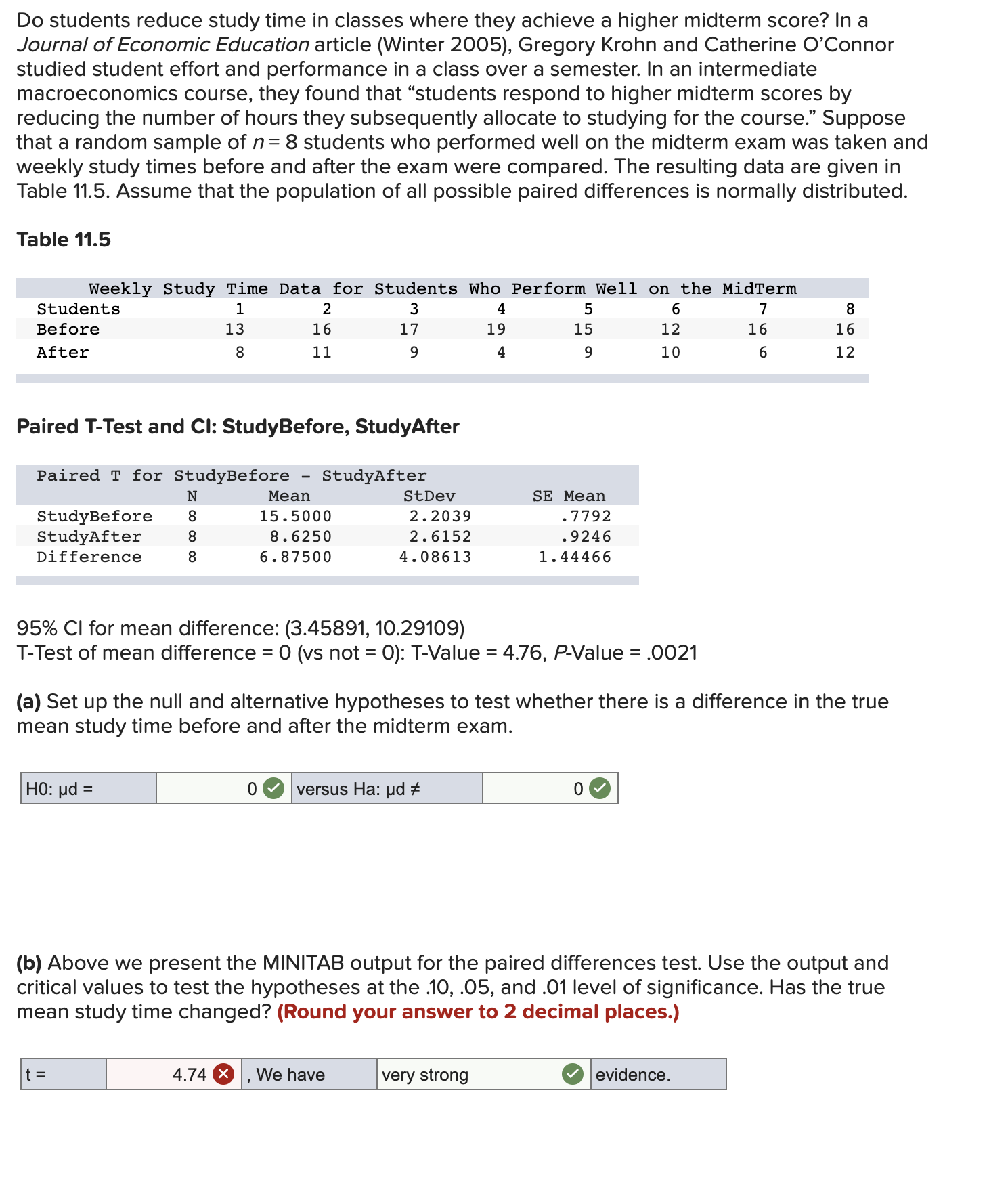
Do students reduce study time in classes where they achieve a higher midterm score? In a Journal of Economic Education article (Winter 2005), Gregory Krohn and Catherine O'Connor studied student effort and performance in a class over a semester. In an intermediate macroeconomics course, they found that "students respond to higher midterm scores by reducing the number of hours they subsequently allocate to studying for the course.\" Suppose that a random sample of n = 8 students who performed well on the midterm exam was taken and weekly study times before and after the exam were compared. The resulting data are given in Table 11.5. Assume that the population of all possible paired differences is normally distributed. Table 11.5 Weekly Study Time Data for Students Who Perform Well on the MidTerm Students 1 2 3 4 5 6 7 8 Before 13 16 17 19 15 12 16 16 After 8 11 9 4 9 10 6 12 Paired T-Test and CI: StudyBefore, StudyAfter Paired T for StudyBefore - StudyAfter N Mean StDev SE Mean StudyBefore 8 15.5000 2.2039 .7792 StudyAfter 8 8.6250 2.6152 .9246 Difference 8 6.87500 4.08613 1.44466 95% CI for mean difference: (3.45891,10.29109) T-Test of mean difference = 0 (vs not = 0): T-Value = 4.76, P-Value = .0021 (a) Set up the null and alternative hypotheses to test whether there is a difference in the true mean study time before and after the midterm exam. m (b) Above we present the MINITAB output for the paired differences test. Use the output and critical values to test the hypotheses at the .10, .05, and .01 level of significance. Has the true mean study time changed? (Round your answer to 2 decimal places.)
Step by Step Solution
There are 3 Steps involved in it

Get step-by-step solutions from verified subject matter experts
 Study Help