



Question: NEOMED TECHNOLOGIES CASE STUDY ANALYSIS Thank you in advance! 2. Examples of shellfish would be shrimp, lobster, COMPANY HISTORY AND FOUNDERS scallops, oysters, clams, and
NEOMED TECHNOLOGIES CASE STUDY ANALYSIS
Thank you in advance!
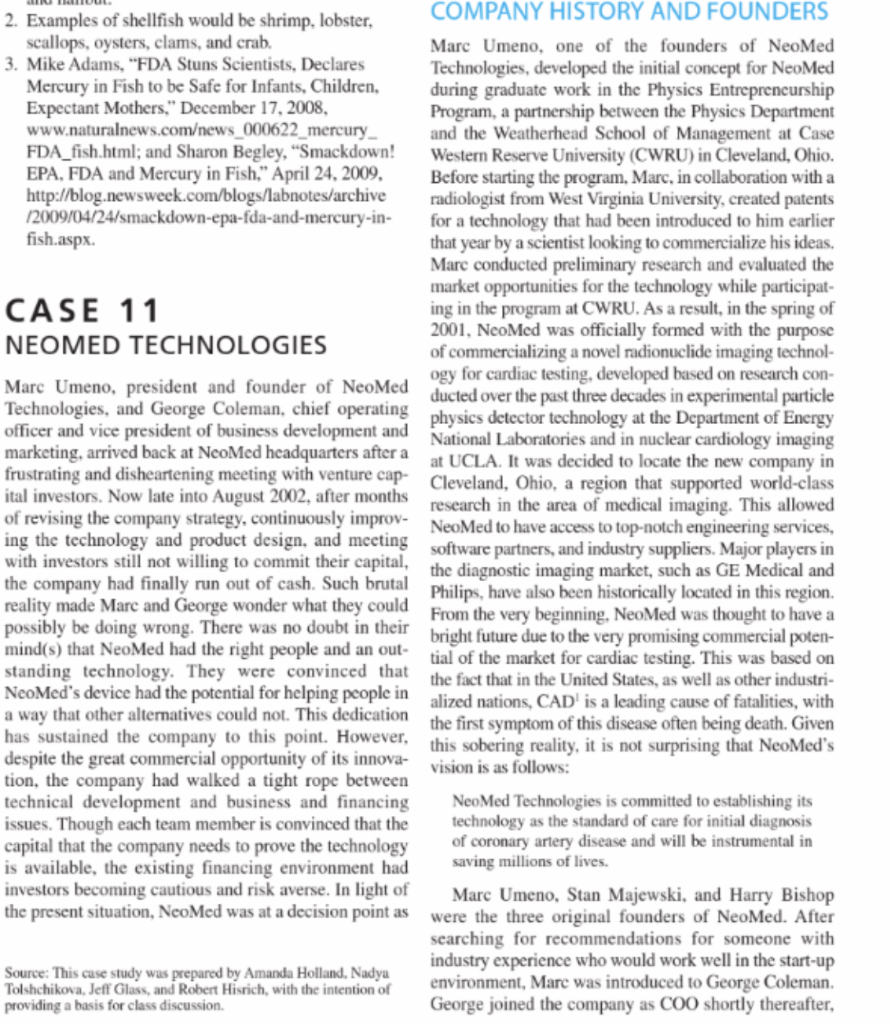
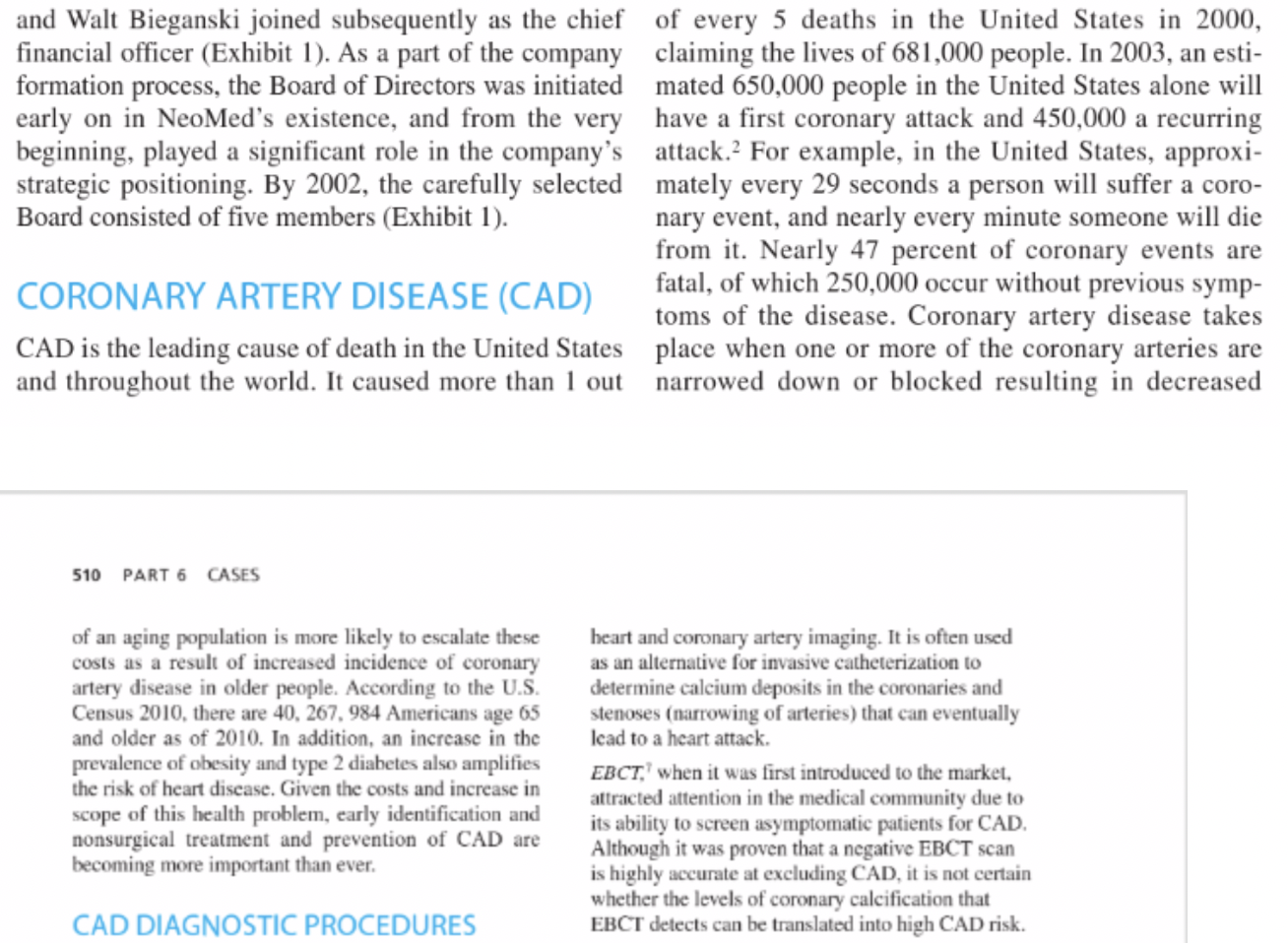
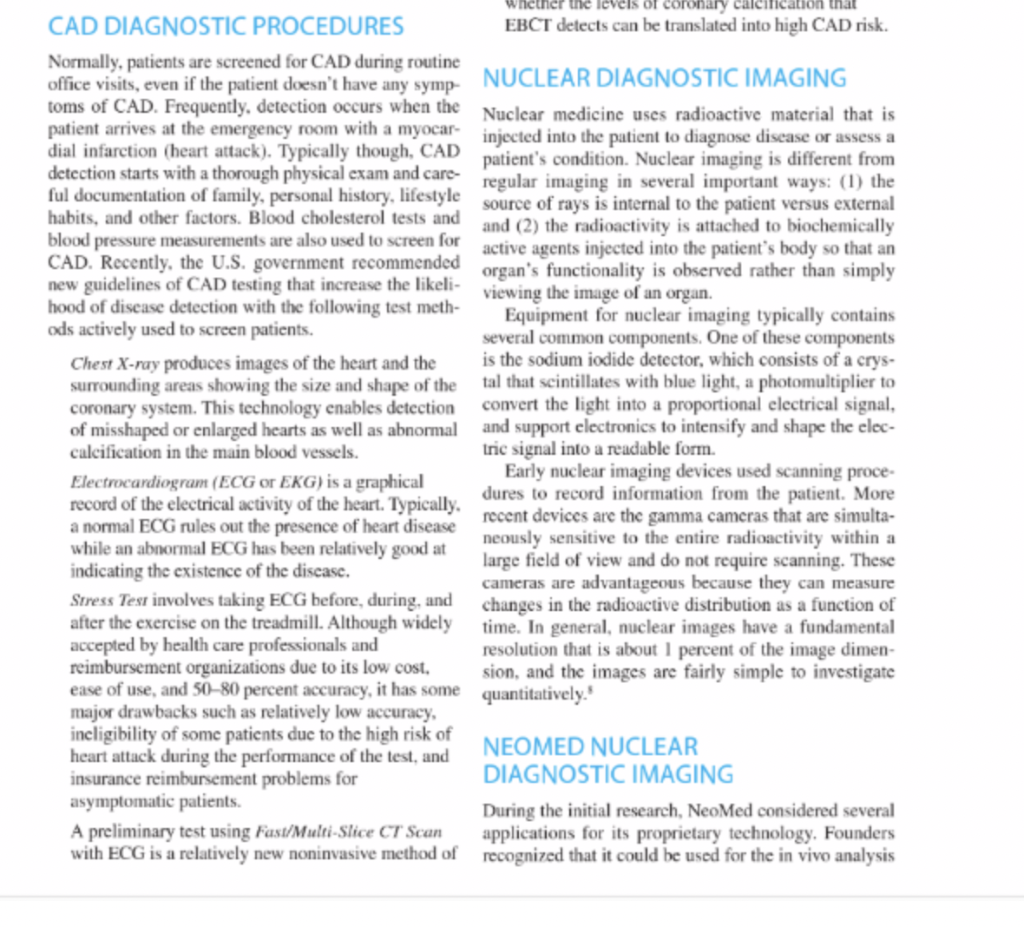
2. Examples of shellfish would be shrimp, lobster, COMPANY HISTORY AND FOUNDERS scallops, oysters, clams, and crab. Marc Umeno, one of the founders of NeoMed 3. Mike Adams, "FDA Stuns Scientists, Declares Technologies, developed the initial concept for NeoMed Mercury in Fish to be Safe for Infants, Children, during graduate work in the Physics Entrepreneurship Expectant Mothers," December 17, 2008, Program, a partnership between the Physics Department www.naturalnews.comews_000622_mercury and the Weatherhead School of Management at Case FDA_fish.html; and Sharon Begley, Smackdown! Western Reserve University (CWRU) in Cleveland, Ohio. EPA, FDA and Mercury in Fish," April 24, 2009, Before starting the program, Marc, in collaboration with a http://blog.newsweek.com/blogs/labnotes/archive radiologist from West Virginia University, created patents 12009/04/24/smackdown-epa-fda-and-mercury-in- for a technology that had been introduced to him earlier fish.aspx. that year by a scientist looking to commercialize his ideas. Mare conducted preliminary research and evaluated the market opportunities for the technology while participat- CASE 11 ing in the program at CWRU. As a result, in the spring of 2001, NeoMed was officially formed with the purpose NEOMED TECHNOLOGIES of commercializing a novel radionuclide imaging technol- Marc Umeno, president and founder of NeoMed ogy for cardiac testing, developed based on research con- ducted over the past three decades in experimental particle Technologies, and George Coleman, chief operating officer and vice president of business development and physics detector technology at the Department of Energy National Laboratories and in nuclear cardiology imaging marketing, arrived back at NeoMed headquarters after a at UCLA. It was decided to locate the new company in frustrating and disheartening meeting with venture cap- ital investors. Now late into August 2002, after months research in the area of medical imaging. This allowed Cleveland, Ohio, a region that supported world-class of revising the company strategy, continuously improv- NeoMed to have access to top-notch engineering services, ing the technology and product design, and meeting software partners, and industry suppliers. Major players in with investors still not willing to commit their capital, the diagnostic imaging market, such as GE Medical and the company had finally run out of cash. Such brutal Philips, have also been historically located in this region. reality made Marc and George wonder what they could From the very beginning, NeoMed was thought to have a possibly be doing wrong. There was no doubt in their bright future due to the very promising commercial poten- mind(s) that NeoMed had the right people and an out- tial of the market for cardiac testing. This was based on standing technology. They were convinced that the fact that in the United States, as well as other industri- NeoMed's device had the potential for helping people in alized nations, CAD' is a leading cause of fatalities, with a way that other alternatives could not. This dedication the first symptom of this disease often being death. Given has sustained the company to this point. However, this sobering reality, it is not surprising that NeoMed's despite the great commercial opportunity of its innova- vision is as follows: tion, the company had walked a tight rope between technical development and business and financing Neo Med Technologies is committed to establishing its issues. Though each team member is convinced that the technology as the standard of care for initial diagnosis capital that the company needs to prove the technology of coronary artery disease and will be instrumental in is available, the existing financing environment had saving millions of lives. investors becoming cautious and risk averse. In light of Marc Umeno, Stan Majewski, and Harry Bishop the present situation, NeoMed was at a decision point as were the three original founders of NeoMed. After searching for recommendations for someone with industry experience who would work well in the start-up Source: This case study was prepared by Amanda Holland, Nadya Tolshchikova, Jeff Glass, and Robert Histich, with the intention of environment, Marc was introduced to George Coleman. providing a basis for class discussion. George joined the company as COO shortly thereafter, and Walt Bieganski joined subsequently as the chief of every 5 deaths in the United States in 2000, financial officer (Exhibit 1). As a part of the company claiming the lives of 681,000 people. In 2003, an esti- formation process, the Board of Directors was initiated mated 650,000 people in the United States alone will early on in NeoMed's existence, and from the very have a first coronary attack and 450,000 a recurring beginning, played a significant role in the company's attack. For example, in the United States, approxi- strategic positioning. By 2002, the carefully selected mately every 29 seconds a person will suffer a coro- Board consisted of five members (Exhibit 1). nary event, and nearly every minute someone will die from it. Nearly 47 percent of coronary events are CORONARY ARTERY DISEASE (CAD) fatal, of which 250,000 occur without previous symp- toms of the disease. Coronary artery disease takes CAD is the leading cause of death in the United States place when one or more of the coronary arteries are and throughout the world. It caused more than 1 out narrowed down or blocked resulting in decreased 510 PART 6 CASES of an aging population is more likely to escalate these costs as a result of increased incidence of coronary artery disease in older people. According to the U.S. Census 2010, there are 40, 267, 984 Americans age 65 and older as of 2010. In addition, an increase in the prevalence of obesity and type 2 diabetes also amplifies the risk of heart disease. Given the costs and increase in scope of this health problem, early identification and nonsurgical treatment and prevention of CAD are becoming more important than ever. heart and coronary artery imaging. It is often used as an alternative for invasive catheterization to determine calcium deposits in the coronaries and stenoses (narrowing of arteries) that can eventually lead to a heart attack. EBCT, when it was first introduced to the market, attracted attention in the medical community due to its ability to screen asymptomatic patients for CAD. Although it was proven that a negative EBCT scan is highly accurate at excluding CAD, it is not certain whether the levels of coronary calcification that EBCT detects can be translated into high CAD risk. CAD DIAGNOSTIC PROCEDURES ther the levels of calcification that CAD DIAGNOSTIC PROCEDURES EBCT detects can be translated into high CAD risk. Normally, patients are screened for CAD during routine office visits, even if the patient doesn't have any symp NUCLEAR DIAGNOSTIC IMAGING toms of CAD. Frequently, detection occurs when the Nuclear medicine uses radioactive material that is patient arrives at the emergency room with a myocar injected into the patient to diagnose disease or assess a dial infarction (heart attack). Typically though, CAD patient's condition. Nuclear imaging is different from detection starts with a thorough physical exam and care regular imaging in several important ways: (1) the ful documentation of family, personal history, lifestyle source of rays is internal to the patient versus external habits, and other factors. Blood cholesterol tests and and (2) the radioactivity is attached to biochemically blood pressure measurements are also used to screen for active agents injected into the patient's body so that an CAD. Recently , the U.S. government recommended organ's functionality is observed rather than simply new guidelines of CAD testing that increase the likeli- hood of disease detection with the following test meth- viewing the image of an organ. Equipment for nuclear imaging typically contains ods actively used to screen patients. several common components. One of these components Chest X-ray produces images of the heart and the is the sodium iodide detector, which consists of a crys- surrounding areas showing the size and shape of the tal that scintillates with blue light, a photomultiplier to coronary system. This technology enables detection convert the light into a proportional electrical signal, of misshaped or enlarged hearts as well as abnormal and support electronics to intensify and shape the elec- calcification in the main blood vessels. tric signal into a readable form. Electrocardiogram (ECG or EKG) is a graphical Early nuclear imaging devices used scanning proce record of the electrical activity of the heart. Typically. dures to record information from the patient. More a normal ECG rules out the presence of heart disease recent devices are the gamma cameras that are simulta- while an abnormal ECG has been relatively good at neously sensitive to the entire radioactivity within a large field of view and do not require scanning. These indicating the existence of the discase. cameras are advantageous because they can measure Stress Test involves taking ECG before, during, and changes in the radioactive distribution as a function of after the exercise on the treadmill. Although widely time. In general, nuclear images have a fundamental accepted by health care professionals and resolution that is about 1 percent of the image dimen- reimbursement organizations due to its low cost, sion, and the images are fairly simple to investigate ease of use, and 50-80 percent accuracy, it has some quantitatively. major drawbacks such as relatively low accuracy, incligibility of some patients due to the high risk of heart attack during the performance of the test, and NEOMED NUCLEAR insurance reimbursement problems for DIAGNOSTIC IMAGING asymptomatic patients. During the initial research, NeoMed considered several A preliminary test using Fast/Multi-Slice CT Scan applications for its proprietary technology. Founders with ECG is a relatively new noninvasive method of recognized that it could be used for the in vivo analysisStep by Step Solution
There are 3 Steps involved in it
1 Expert Approved Answer
Step: 1 Unlock

Question Has Been Solved by an Expert!
Get step-by-step solutions from verified subject matter experts
Step: 2 Unlock
Step: 3 Unlock