







Question: Networking Media. Define & Discuss the different cable types (include the pros and cons of each): 41 Coax cable (copper) - a cable that consists
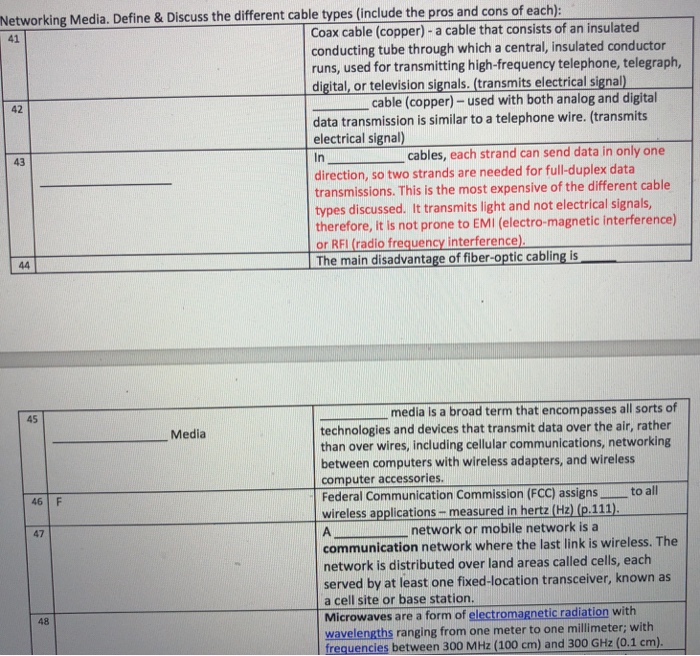
Networking Media. Define & Discuss the different cable types (include the pros and cons of each): 41 Coax cable (copper) - a cable that consists of an insulated conducting tube through which a central, insulated conductor runs, used for transmitting high-frequency telephone, telegraph, digital, or television signals. (transmits electrical signal) 42 cable (copper)- used with both analog and digital data transmission is similar to a telephone wire. (transmits electrical signal) In direction, so two strands are needed for full-duplex data transmissions. This is the most expensive of the different cable types discussed. It transmits light and not electrical signals, therefore, it is not prone to EMI (electro-magnetic interference) or RFl (radio frequency interference) The main disadvantage of fiber-optic cabling is 43 cables, each strand can send data in only on 45 media is a broad term that encompasses all sorts of Media technologies and devices that transmit data over the air, rather than over wires, including cellular communications, networking between computers with wireless adapters, and wireless computer accessories. Federal Communication Commission (FCC) assigns to all wireless applications- measured in hertz (Hz) (p.111) 46 F 47 network or mobile network is a communication network where the last link is wireless. The network is distributed over land areas called cells, each served by at least one fixed-location transceiver, known as a cell site or base station Microwaves are a form of electromagnetic radiation with wavelengths ranging from one meter to one millimeter; with frequencies between 300 MHz (100 cm) and 300 GHz (0.1 cm) 48
Step by Step Solution
There are 3 Steps involved in it

Get step-by-step solutions from verified subject matter experts
 Study Help