







Question: Newton's Method will converge to a true solution if you have a good initial approximation. If you don't it may not converge at all. Consider,
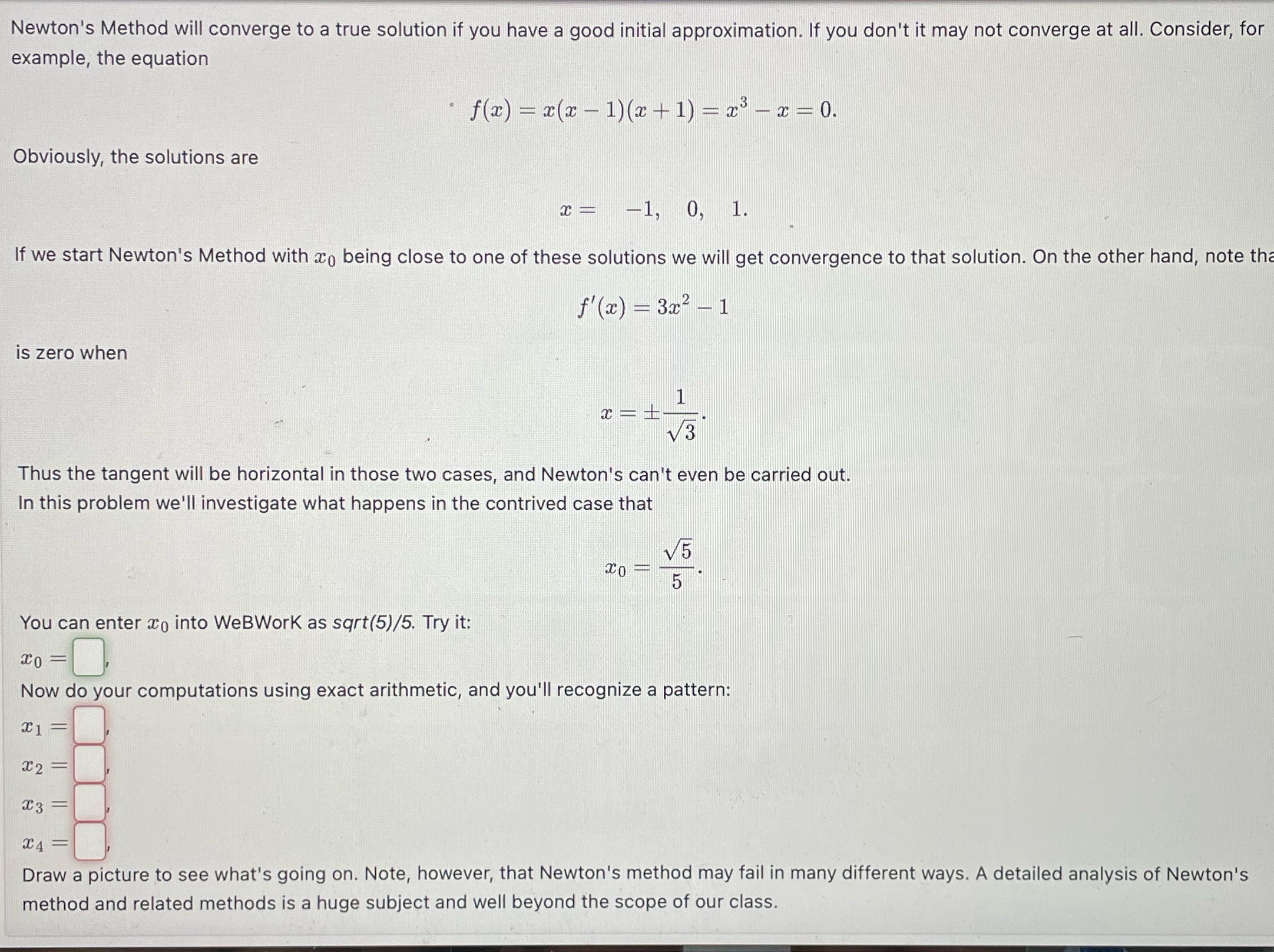
Newton's Method will converge to a true solution if you have a good initial approximation. If you don't it may not converge at all. Consider, for example, the equation f(x) =x(x - 1)(2 +1) =2 -z =0. Obviously, the solutions are -1, 0, 1. If we start Newton's Method with x0 being close to one of these solutions we will get convergence to that solution. On the other hand, note tha f'(x) = 3x2 -1 is zero when 3 Thus the tangent will be horizontal in those two cases, and Newton's can't even be carried out. In this problem we'll investigate what happens in the contrived case that 5 5 You can enter To into WeBWork as sqrt(5)/5. Try it: TO = Now do your computations using exact arithmetic, and you'll recognize a pattern: C 4 Draw a picture to see what's going on. Note, however, that Newton's method may fail in many different ways. A detailed analysis of Newton's method and related methods is a huge subject and well beyond the scope of our class
Step by Step Solution
There are 3 Steps involved in it

Get step-by-step solutions from verified subject matter experts
 Study Help