







Question: ng sectiques Protected vien saved References Mailings Review View Help can contain viruses. Unless you need to edit, it's safer to stay in Protected View

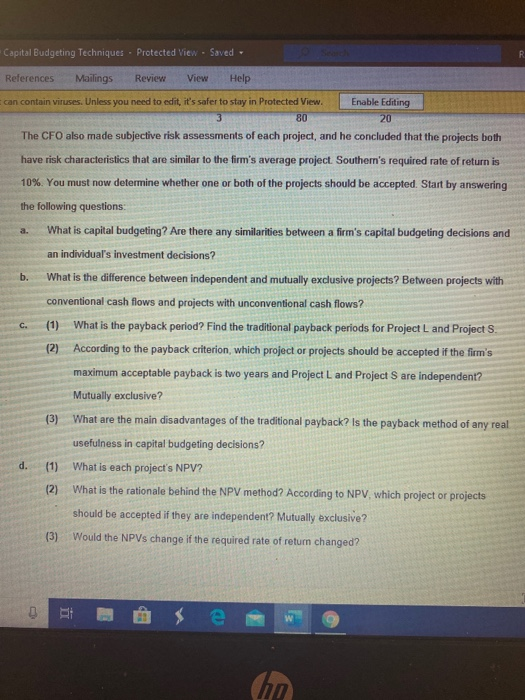

ng sectiques Protected vien saved References Mailings Review View Help can contain viruses. Unless you need to edit, it's safer to stay in Protected View Enable Editing Homework 9 Your boss, the chief financial officer (CFO) for Southern Textiles, has just handed you the estimated cash flows for two proposed projects Project Linvolves adding a new item to the firm's fabric line. It would take some time to build up the market for this product, so the cash inflows would increase over time. Projects involves an add-on to an existing line, and its cash flows would decrease over time. Both projects have 3- year lives because Southern is planning to introduce an entirely new fabric at that time. Here are the net cash flow estimates (in thousands of dollars); Expected Net Cash Flows Year Project Project S $(100) $(100) The CFO also made subjective risk assessments of each project, and he concluded that the projects both have risk characteristics that are similar to the firm's average project, Southern's required rate of return is 10%. You must now determine whether one or both of the projects should be accepted. Start by answering the following questions: What is capital budgeting? Are there any similarities between a firm's capital budgeting decisions and an individual's investment decisions? Capital Budgeting Techniques - Protected View - Saved - References Mailings Review View Help can contain vituses. Unless you need to edit it's safer to stay in Protected View Enable Editing The CFO also made subjective risk assessments of each project, and he concluded that the projects both have risk characteristics that are similar to the firm's average project. Southern's required rate of return is 10%. You must now determine whether one or both of the projects should be accepted. Start by answering the following questions: a. What is capital budgeting? Are there any similarities between a firm's capital budgeting decisions and an individual's investment decisions? What is the difference between independent and mutually exclusive projects? Between projects with conventional cash flows and projects with unconventional cash flows? C. (1) What is the payback period? Find the traditional payback periods for Project L and Project S (2) According to the payback criterion, which project or projects should be accepted If the firm's maximum acceptable payback is two years and Project L and Project S are independent? Mutually exclusive? (3) What are the main disadvantages of the traditional payback? Is the payback method of any real d. usefulness in capital budgeting decisions? (1) What is each project's NPV? (2) What is the rationale behind the NPV method? According to NPV, which project or projects should be accepted if they are independent? Mutually exclusive? (3) Would the NPVs change if the required rate of return changed? Capital Budgeting Techniques - Protected View - Saved Search RC References Mailings Review View Help can contain viruses. Unless you need to edit, it's safer to stay in Protected View Enable Editing Homework 9 e. (1) What is each project's IRR? (2) What is the logic behind the IRR method? According to IRR, which projects should be accepted if they are independent? Mutually exclusive? (3) Would the projects' IRRs change if the required rate of return changed? Explain. (4) Under what circumstances will we get 2 IRR's for the same project? f. (1) (2) Define the term modified internal rate of return (MIRR). How does the MIRR differ from the IRR
Step by Step Solution
There are 3 Steps involved in it

Get step-by-step solutions from verified subject matter experts
 Study Help