







Question: nk i 3. EVALUATION FRAMEWORK AND METHOD 59 method of selection of the optimal model consists of several steps (Figure 1). First of all it
nk i
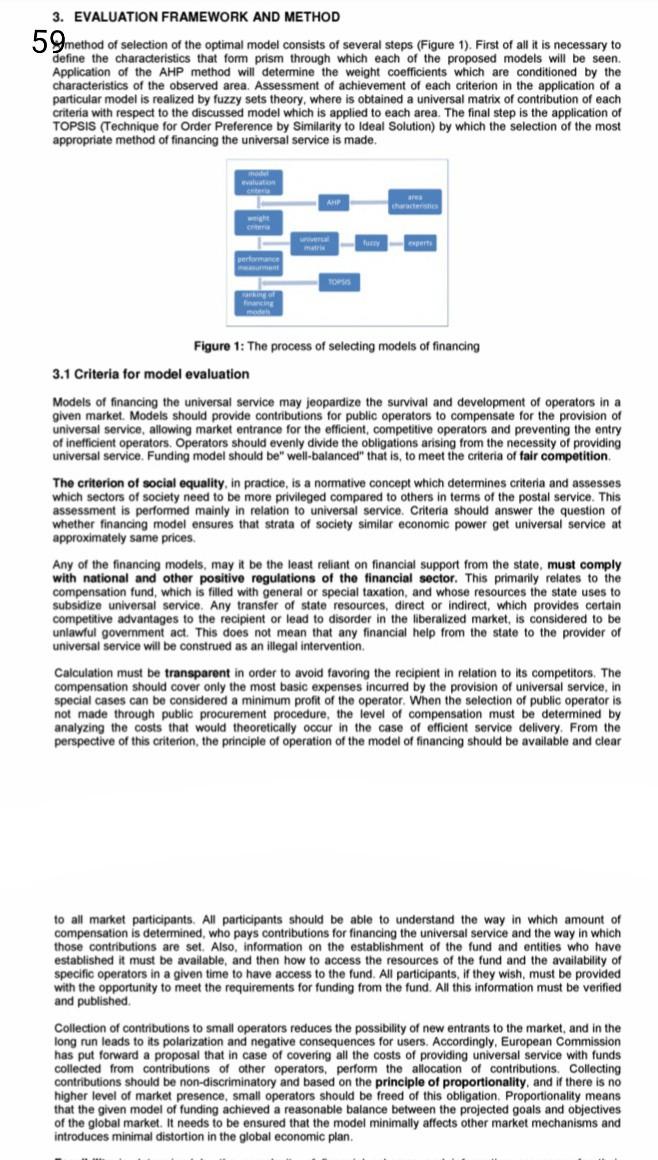
3. EVALUATION FRAMEWORK AND METHOD 59 method of selection of the optimal model consists of several steps (Figure 1). First of all it is necessary to define the characteristics that form prism through which each of the proposed models will be seen. Application of the AHP method will determine the weight coefficients which are conditioned by the characteristics of the observed area. Assessment of achievement of each criterion in the application of a particular model is realized by fuzzy sets theory, where is obtained a universal matrix of contribution of each criteria with respect to the discussed model which is applied to each area. The final step is the application of TOPSIS (Technique for Order Preference by Similarity to Ideal Solution) by which the selection of the most appropriate method of financing the universal service is made. AMP maria perts performance ROSS financing Figure 1: The process of selecting models 3.1 Criteria for model evaluation Models of financing the universal service may jeopardize the survival and development of operators in a given market. Models should provide contributions for public operators to compensate for the provision of universal service, allowing market entrance for the efficient, competitive operators and preventing the entry of inefficient operators. Operators should evenly divide the obligations arising from the necessity of providing universal service. Funding model should be well-balanced" that is, to meet the criteria of fair competition, The criterion of social equality, in practice, is a normative concept which determines criteria and assesses which sectors of society need to be more privileged compared to others in terms of the postal service. This assessment is performed mainly in relation to universal service. Criteria should answer the question of whether financing model ensures that strata of society similar economic power get universal service at approximately same prices. Any of the financing models, may it be the least reliant on financial support from the state, must comply with national and other positive regulations of the financial sector. This primarily relates to the compensation fund, which is filled with general or special taxation, and whose resources the state uses to subsidize universal service. Any transfer of state resources, direct or indirect, which provides certain competitive advantages to the recipient or lead to disorder in the liberalized market is considered to be unlawful government act. This does not mean that any financial help from the state to the provider of universal service will be construed as an illegal intervention Calculation must be transparent in order to avoid favoring the recipient in relation to its competitors. The compensation should cover only the most basic expenses incurred by the provision of universal service, in special cases can be considered a minimum profit of the operator. When the selection of public operator is not made through public procurement procedure, the level of compensation must be determined by analyzing the costs that would theoretically occur in the case of efficient service delivery. From the perspective of this criterion, the principle of operation of the model of financing should be available and clear to all market participants. All participants should be able to understand the way in which amount of compensation is determined, who pays contributions for financing the universal service and the way in which those contributions are set. Also, information on the establishment of the fund and entities who have established it must be available, and then how to access the resources of the fund and the availability of specific operators in a given time to have access to the fund. All participants, if they wish, must be provided with the opportunity to meet the requirements for funding from the fund. All this information must be verified and published Collection of contributions to small operators reduces the possibility of new entrants to the market, and in the long run leads to its polarization and negative consequences for users. Accordingly, European Commission has put forward a proposal that in case of covering all the costs of providing universal service with funds collected from contributions of other operators, perform the allocation of contributions. Collecting contributions should be non-discriminatory and based on the principle of proportionality, and if there is no higher level of market presence, small operators should be freed of this obligation. Proportionality means that the given model of funding achieved a reasonable balance between the projected goals and objectives of the global market. It needs to be ensured that the model minimally affects other market mechanisms and introduces minimal distortion in the global economic planStep by Step Solution
There are 3 Steps involved in it
1 Expert Approved Answer
Step: 1 Unlock

Question Has Been Solved by an Expert!
Get step-by-step solutions from verified subject matter experts
Step: 2 Unlock
Step: 3 Unlock
 Study Help