







Question: No . 1 4 - 1 4 3 0 Keller v . Miri Microsystems Page 7 The record before us establishes that there is a
No
Keller v Miri Microsystems
Page
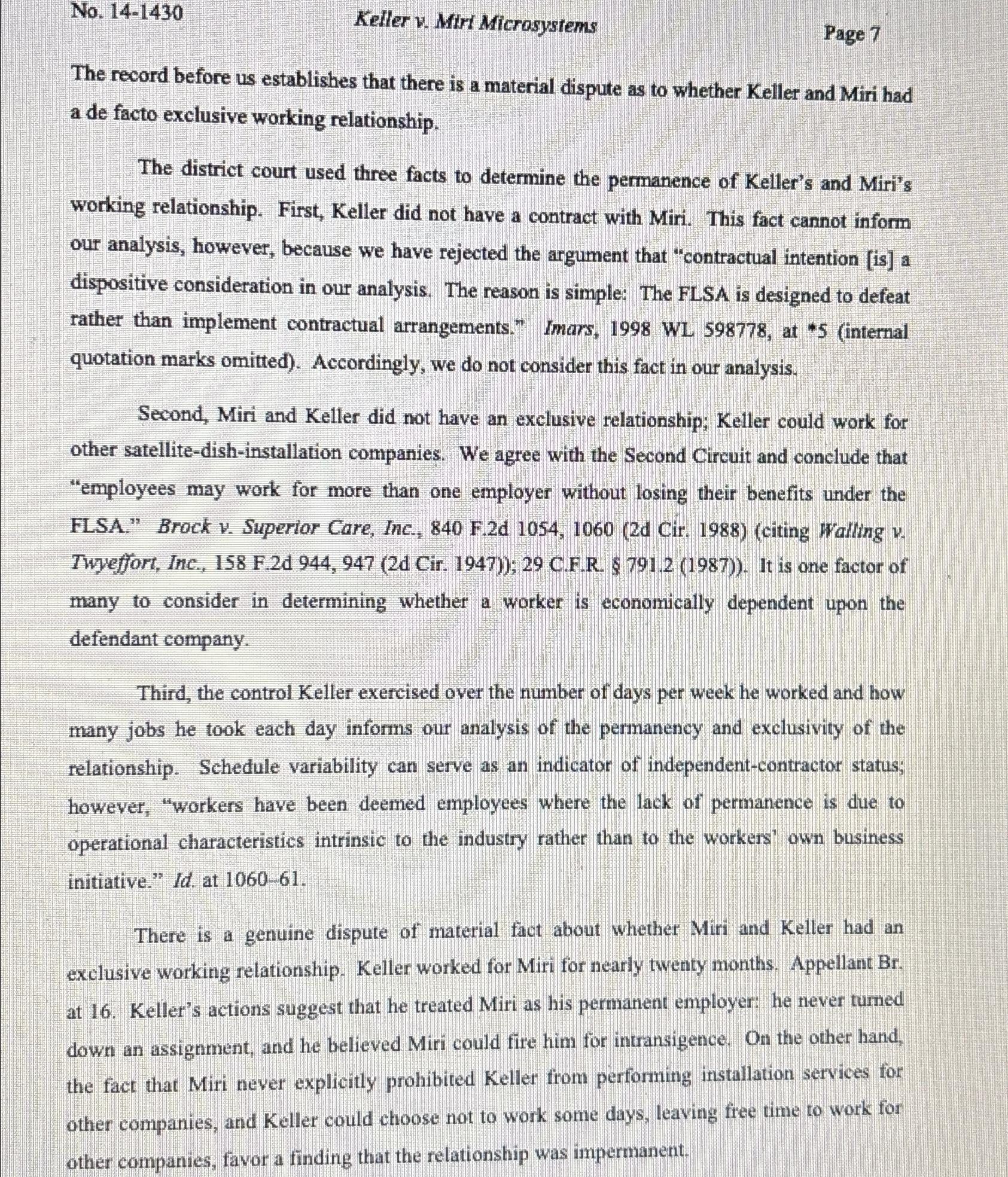
The record before us establishes that there is a material dispute as to whether Keller and Miri had a de facto exclusive working relationship.
The district court used three facts to determine the permanence of Keller's and Miri's working relationship. First, Keller did not have a contract with Miri. This fact cannot inform our analysis, however, because we have rejected the argument that "contractual intention is a dispositive consideration in our analysis. The reason is simple: The FLSA is designed to defeat rather than implement contractual arrangements." Imars, WL at internal quotation marks omitted Accordingly, we do not consider this fact in our analysis.
Second, Miri and Keller did not have an exclusive relationship; Keller could work for other satellitedishinstallation companies. We agree with the Second Circuit and conclude that "employees may work for more than one employer without losing their benefits under the FLSA." Brock v Superior Care, Inc., Fd d Cir. citing Walling v Twyeffort, Inc., Fd d Cir. ; CFR It is one factor of many to consider in determining whether a worker is economically dependent upon the defendant company.
Third, the control Keller exercised over the number of days per week he worked and how many jobs he took each day informs our analysis of the permanency and exclusivity of the relationship. Schedule variability can serve as an indicator of independentcontractor status; however, "workers have been deemed employees where the lack of permanence is due to operational characteristics intrinsic to the industry rather than to the workers' own business initiative." Id at
There is a genuine dispute of material fact about whether Miri and Keller had an exclusive working relationship. Keller worked for Miri for nearly twenty months. Appellant Br at Keller's actions suggest that he treated Miri as his permanent employer: he never turned down an assignment, and he believed Miri could fire him for intransigence. On the other hand, the fact that Miri never explicitly prohibited Keller from performing installation services for other companies, and Keller could choose not to work some days, leaving free time to work for other companies, favor a finding that the relationship was impermanent.
Step by Step Solution
There are 3 Steps involved in it
1 Expert Approved Answer
Step: 1 Unlock

Question Has Been Solved by an Expert!
Get step-by-step solutions from verified subject matter experts
Step: 2 Unlock
Step: 3 Unlock
 Study Help