







Question: No image plz, except excel output. Plz do only Part 6 & 7 Only ABC Manufacture Pty Ltd has two products, Product A and Product
No image plz, except excel output. Plz do only Part 6 & 7 Only
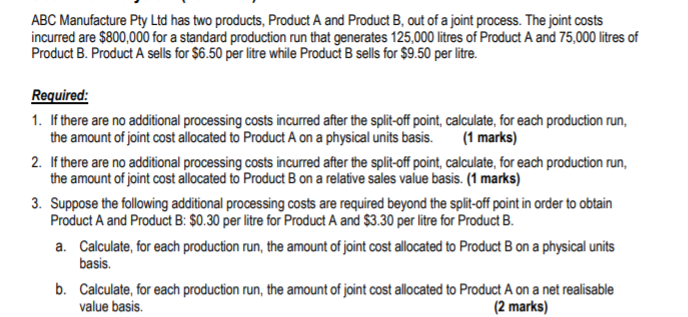
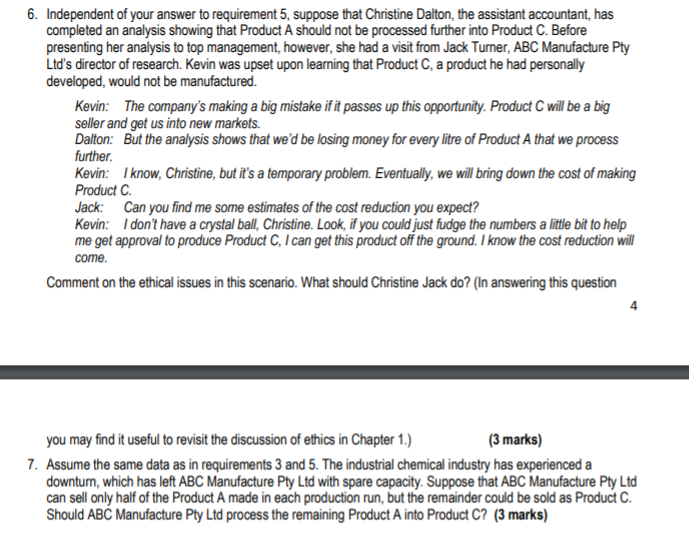
ABC Manufacture Pty Ltd has two products, Product A and Product B, out of a joint process. The joint costs incurred are $800,000 for a standard production run that generates 125,000 litres of Product A and 75,000 litres of Product B. Product A sells for $6.50 per litre while Product B sells for $9.50 per litre. Required: 1. If there are no additional processing costs incurred after the split-off point, calculate, for each production run, the amount of joint cost allocated to Product A on a physical units basis. (1 marks) 2. If there are no additional processing costs incurred after the split-off point, calculate, for each production run, the amount of joint cost allocated to Product B on a relative sales value basis. (1 marks) 3. Suppose the following additional processing costs are required beyond the split-off point in order to obtain Product A and Product B: $0.30 per litre for Product A and $3.30 per litre for Product B. a. Calculate, for each production run, the amount of joint cost allocated to Product B on a physical units basis. b. Calculate, for each production run, the amount of joint cost allocated to Product A on a net realisable value basis. (2 marks) 6. Independent of your answer to requirement 5, suppose that Christine Dalton, the assistant accountant, has completed an analysis showing that Product A should not be processed further into Product C. Before presenting her analysis to top management, however, she had a visit from Jack Turner, ABC Manufacture Pty Ltd's director of research. Kevin was upset upon learning that Product C, a product he had personally developed, would not be manufactured. Kevin: The company's making a big mistake if it passes up this opportunity. Product C will be a big seller and get us into new markets. Dalton: But the analysis shows that we'd be losing money for every litre of Product A that we process further. Kevin: I know, Christine, but it's a temporary problem. Eventually, we will bring down the cost of making Product C. Jack: Can you find me some estimates of the cost reduction you expect? Kevin: I don't have a crystal ball, Christine. Look, if you could just fudge the numbers a little bit to help me get approval to produce Product C, I can get this product off the ground. I know the cost reduction will come. Comment on the ethical issues in this scenario. What should Christine Jack do? (In answering this question 4 you may find it useful to revisit the discussion of ethics in Chapter 1.) (3 marks) 7. Assume the same data as in requirements 3 and 5. The industrial chemical industry has experienced a downturn, which has left ABC Manufacture Pty Ltd with spare capacity. Suppose that ABC Manufacture Pty Ltd can sell only half of the Product A made in each production run, but the remainder could be sold as Product C. Should ABC Manufacture Pty Ltd process the remaining Product A into Product C? (3 marks) ABC Manufacture Pty Ltd has two products, Product A and Product B, out of a joint process. The joint costs incurred are $800,000 for a standard production run that generates 125,000 litres of Product A and 75,000 litres of Product B. Product A sells for $6.50 per litre while Product B sells for $9.50 per litre. Required: 1. If there are no additional processing costs incurred after the split-off point, calculate, for each production run, the amount of joint cost allocated to Product A on a physical units basis. (1 marks) 2. If there are no additional processing costs incurred after the split-off point, calculate, for each production run, the amount of joint cost allocated to Product B on a relative sales value basis. (1 marks) 3. Suppose the following additional processing costs are required beyond the split-off point in order to obtain Product A and Product B: $0.30 per litre for Product A and $3.30 per litre for Product B. a. Calculate, for each production run, the amount of joint cost allocated to Product B on a physical units basis. b. Calculate, for each production run, the amount of joint cost allocated to Product A on a net realisable value basis. (2 marks) 6. Independent of your answer to requirement 5, suppose that Christine Dalton, the assistant accountant, has completed an analysis showing that Product A should not be processed further into Product C. Before presenting her analysis to top management, however, she had a visit from Jack Turner, ABC Manufacture Pty Ltd's director of research. Kevin was upset upon learning that Product C, a product he had personally developed, would not be manufactured. Kevin: The company's making a big mistake if it passes up this opportunity. Product C will be a big seller and get us into new markets. Dalton: But the analysis shows that we'd be losing money for every litre of Product A that we process further. Kevin: I know, Christine, but it's a temporary problem. Eventually, we will bring down the cost of making Product C. Jack: Can you find me some estimates of the cost reduction you expect? Kevin: I don't have a crystal ball, Christine. Look, if you could just fudge the numbers a little bit to help me get approval to produce Product C, I can get this product off the ground. I know the cost reduction will come. Comment on the ethical issues in this scenario. What should Christine Jack do? (In answering this question 4 you may find it useful to revisit the discussion of ethics in Chapter 1.) (3 marks) 7. Assume the same data as in requirements 3 and 5. The industrial chemical industry has experienced a downturn, which has left ABC Manufacture Pty Ltd with spare capacity. Suppose that ABC Manufacture Pty Ltd can sell only half of the Product A made in each production run, but the remainder could be sold as Product C. Should ABC Manufacture Pty Ltd process the remaining Product A into Product C
Step by Step Solution
There are 3 Steps involved in it

Get step-by-step solutions from verified subject matter experts
 Study Help