





Question: no need for a extended explenation, it will be fine with just the answer letter. thank you 14) The sales typically measured by a manufacturer

no need for a extended explenation, it will be fine with just the answer letter. thank you no need for a extended explenation, it will be
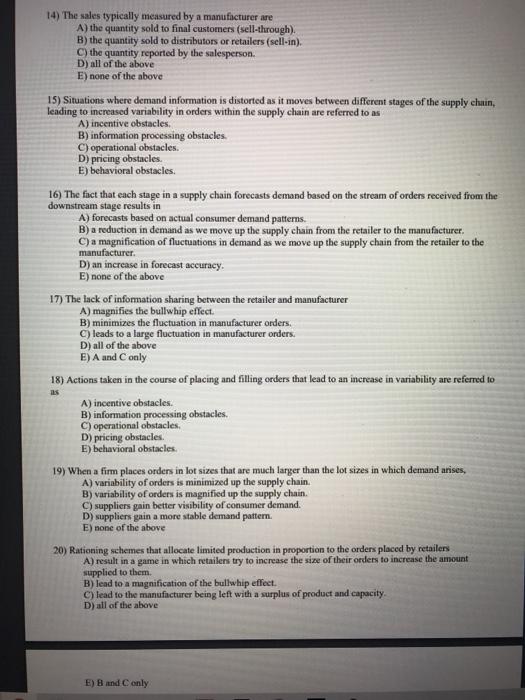
14) The sales typically measured by a manufacturer are A) the quantity sold to final customers (sell-through) B) the quantity sold to distributors or retailers (sell-in). C) the quantity reported by the salesperson. D) all of the above E) none of the above 15) Situations where demand information is distorted as it moves between different stages of the supply cluin, leading to increased variability in orders within the supply chain are referred to as A) incentive obstacles. B) information processing obstacles. C) operational obstacles D) pricing obstacles. E) behavioral obstacles. 16) The fact that each stage in a supply chain forecasts demand based on the stream of orders received from the downstream stage results in A) forecasts based on actual consumer demand patterns. B) a reduction in demand as we move up the supply chain from the retailer to the manufacturer C) a magnification of fluctuations in demand as we move up the supply chain from the retailer to the manufacturer D) an increase in forecast accuracy. E) none of the above 17) The lack of information sharing between the retailer and manufacturer A) magnifies the bullwhip effect. B) minimizes the fluctuation in manufacturer orders. leads to a large fluctuation in manufacturer onders. D) all of the above E) A and Conly 18) Actions taken in the course of placing and filling orders that lead to an increase in variability are referred to A) incentive obstacles. B) information processing obstacles. C) operational obstacles D) pricing obstacles E) behavioral obstacles 19) When a firm places orders in lot sizes that are much larger than the lot sizes in which demand arises, A) variability of orders is minimized up the supply chain. B) variability of orders is magnified up the supply chain C) suppliers gain better visibility of consumer demand. D) suppliers gain a more stable demand pattern. E) none of the above 20) Rationing schemes that allocate limited production in proportion to the orders placed by retailers A) result in a game in which retailers try to increase the size of their orders to increase the amount supplied to them. B) lead to a magnification of the bullwhip effect. C) lead to the manufacturer being left with a surplus of product and capacity D) all of the above ILS E) B and C only

Step by Step Solution

There are 3 Steps involved in it

1 Expert Approved Answer
Step: 1 Unlock blur-text-image

Question Has Been Solved by an Expert!

Get step-by-step solutions from verified subject matter experts

Step: 2 Unlock
Step: 3 Unlock

Students Have Also Explored These Related General Management Questions!