







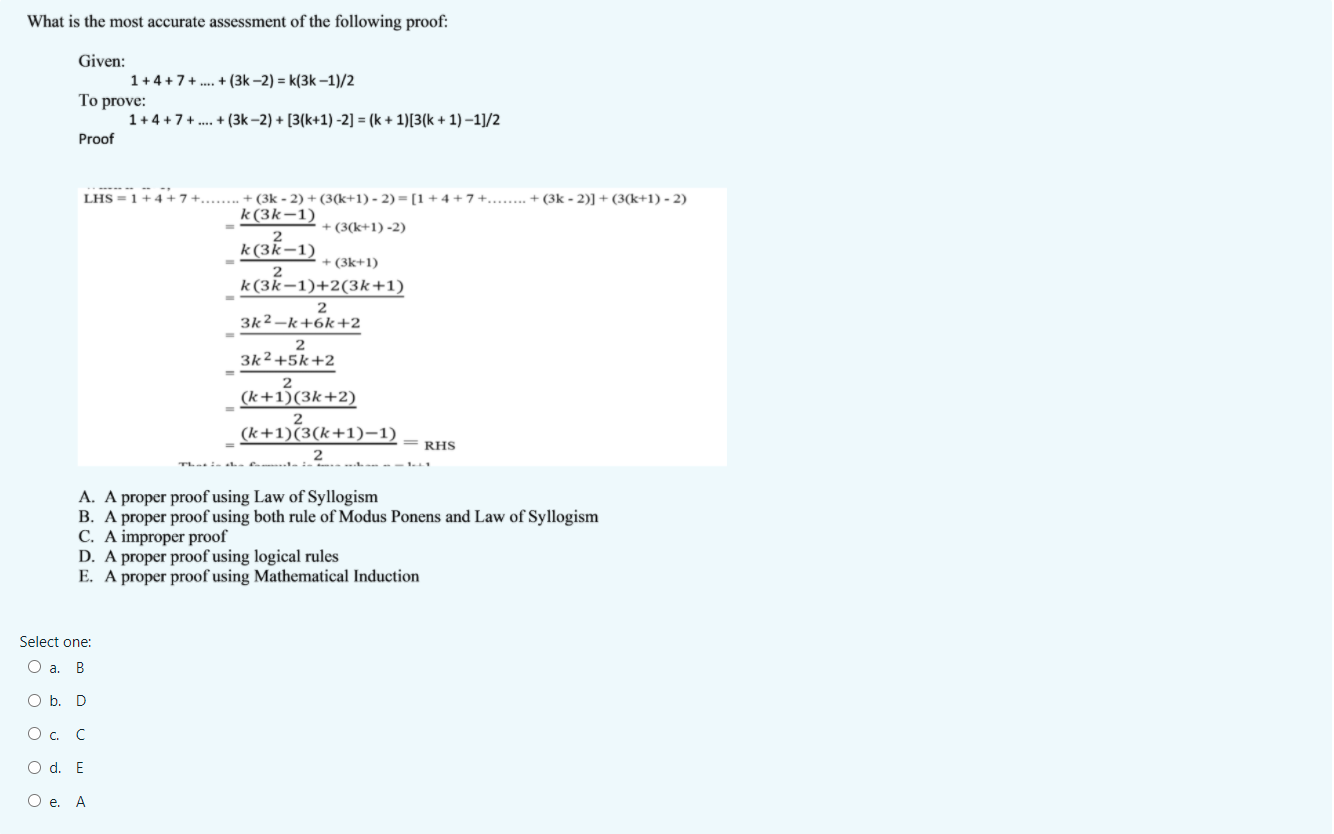
Question: No need solutions, just final answer will do What is the most accurate assessment of the following proof: Given: 1 +4 + 7 + ...
No need solutions, just final answer will do
![+ ... + (3k-2) + [3(k+1) -2] = (k + 1)[3(k +](https://dsd5zvtm8ll6.cloudfront.net/si.experts.images/questions/2024/09/66f3b71064ff1_14366f3b70fef7fe.jpg)
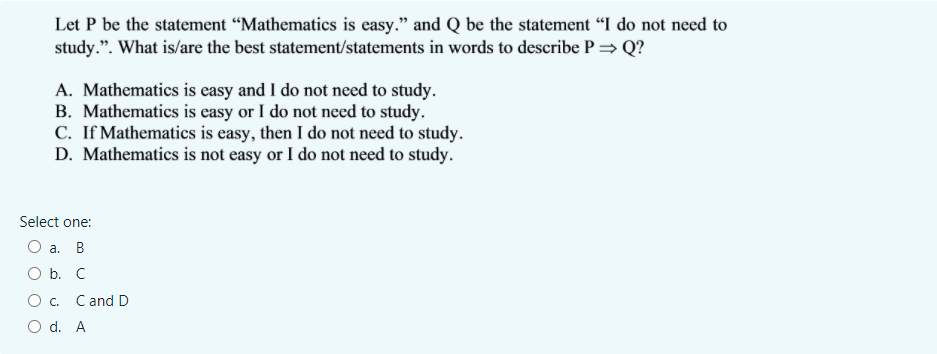
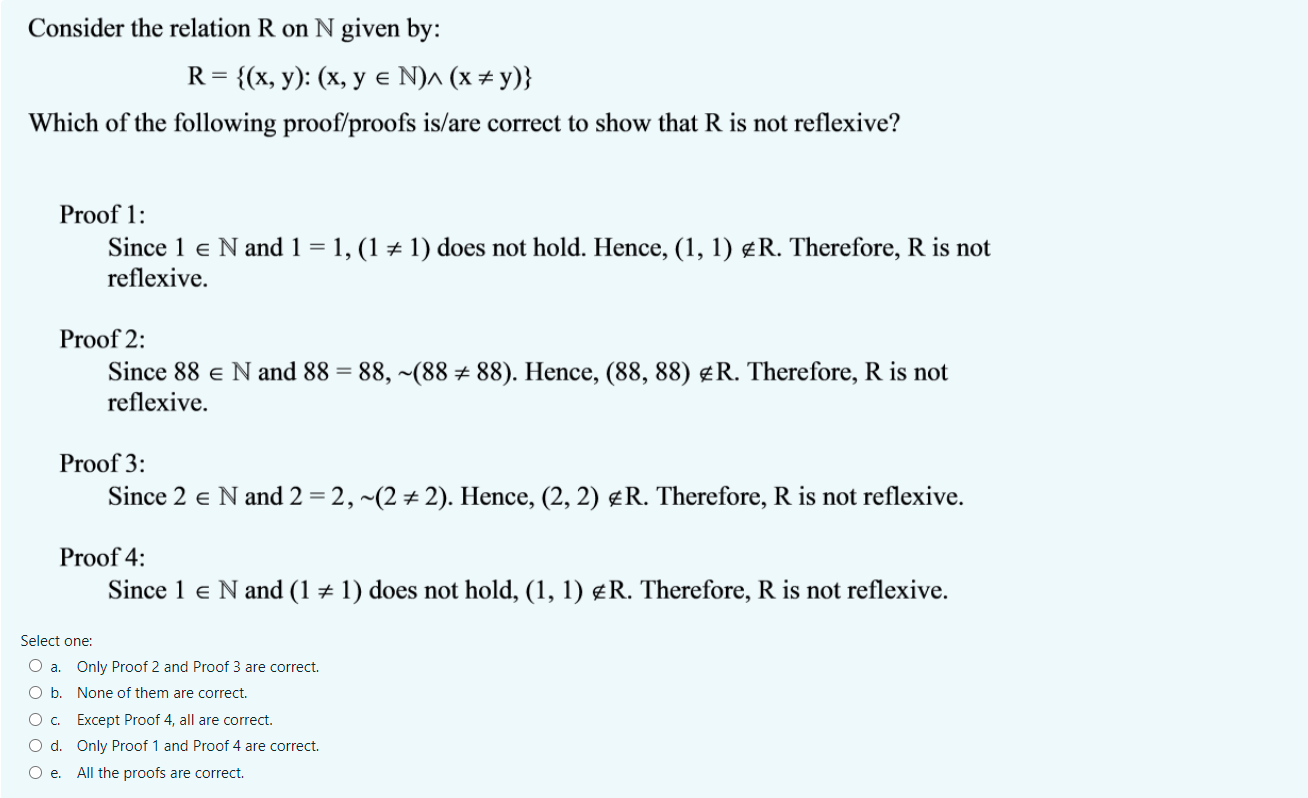
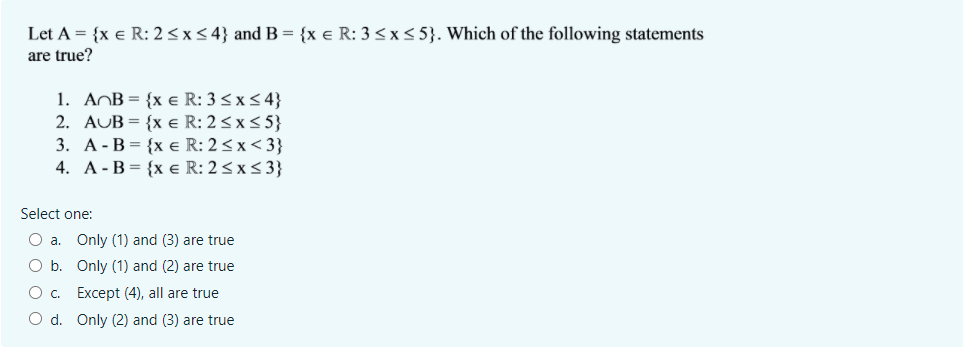
What is the most accurate assessment of the following proof: Given: 1 +4 + 7 + ... + (3k-2) = k(3k-1)/2 To prove: 1 + 4 + 7 + ... + (3k-2) + [3(k+1) -2] = (k + 1)[3(k + 1)-1)/2 Proof LHS = 1 + 4 + 7 + (3k - 2) + (3(k+1) - 2) = [1 + 4 + 7 +........ + (3k - 2)] + (3(k+1) - 2) k(3k-1) + (3(k+1)-2) k(3k-1) ) + (3k+1) k(3k-1)+2(3k+1) 2 3k2-k +6k+2 2 3k2 +5k +2 2 (k+1)(3k+2) (k+1)+3(k+1)-1) 2 RHS A. A proper proof using Law of Syllogism B. A proper proof using both rule of Modus Ponens and Law of Syllogism C. A improper proof D. A proper proof using logical rules E. A proper proof using Mathematical Induction Select one: O a. B Ob D Oc. C O d. E O. Consider the relation R on N given by: R= = {(x, y): (x, y = N)^ (x + y)} Which of the following proof/proofs is/are correct to show that R is not reflexive? Proof 1: Since 1 N and 1 = 1, (1 # 1) does not hold. Hence, (1, 1) &R. Therefore, R is not reflexive. Proof 2: Since 88 N and 88 = 88, -(88 #88). Hence, (88, 88) R. Therefore, R is not reflexive. Proof 3: Since 2 e N and 2 = 2, -(2 # 2). Hence, (2, 2) R. Therefore, R is not reflexive. Proof 4: Since 1 e N and (1 + 1) does not hold, (1, 1) R. Therefore, R is not reflexive. Select one: O a. Only Proof 2 and Proof 3 are correct. O b. None of them are correct. OC Except Proof 4, all are correct. O d. Only Proof 1 and Proof 4 are correct. O e. All the proofs are correct. Let A = {x ER:2
Step by Step Solution
There are 3 Steps involved in it

Get step-by-step solutions from verified subject matter experts
 Study Help