







Question: No5.6Including explanation For each hypothesis test you complete, please answer questions (a) through (i) listed below. (a) (1 point) What conditions should you check first
No5.6Including explanation
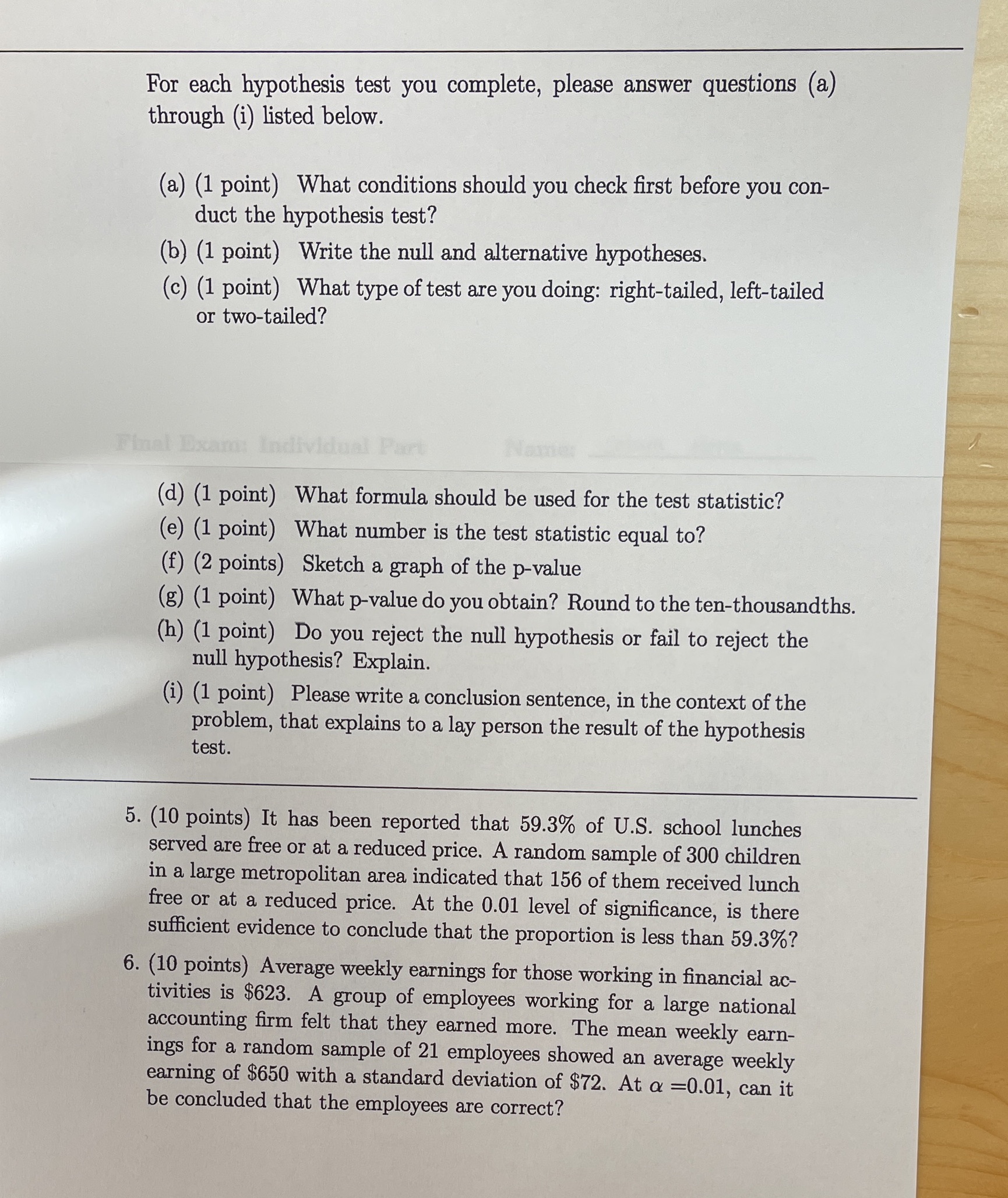
For each hypothesis test you complete, please answer questions (a) through (i) listed below. (a) (1 point) What conditions should you check first before you con- duct the hypothesis test? (b) (1 point) Write the null and alternative hypotheses. (c) (1 point) What type of test are you doing: right-tailed, left-tailed or two-tailed? Final Exam: Individual Part (d) (1 point) What formula should be used for the test statistic? (e) (1 point) What number is the test statistic equal to? (f) (2 points) Sketch a graph of the p-value (g) (1 point) What p-value do you obtain? Round to the ten-thousandths. (h) (1 point) Do you reject the null hypothesis or fail to reject the null hypothesis? Explain. (i) (1 point) Please write a conclusion sentence, in the context of the problem, that explains to a lay person the result of the hypothesis test. 5. (10 points) It has been reported that 59.3% of U.S. school lunches served are free or at a reduced price. A random sample of 300 children in a large metropolitan area indicated that 156 of them received lunch free or at a reduced price. At the 0.01 level of significance, is there sufficient evidence to conclude that the proportion is less than 59.3%? 6. (10 points) Average weekly earnings for those working in financial ac- tivities is $623. A group of employees working for a large national accounting firm felt that they earned more. The mean weekly earn- ings for a random sample of 21 employees showed an average weekly earning of $650 with a standard deviation of $72. At a =0.01, can it be concluded that the employees are correct
Step by Step Solution
There are 3 Steps involved in it

Get step-by-step solutions from verified subject matter experts
 Study Help