







Question: Note: Find the solution using Polymath software. The ideal gas law can represent the pressure-volume-temperature (PVT) relationship of gases only at low (near atmospheric) pressures.
Note: Find the solution using Polymath software.
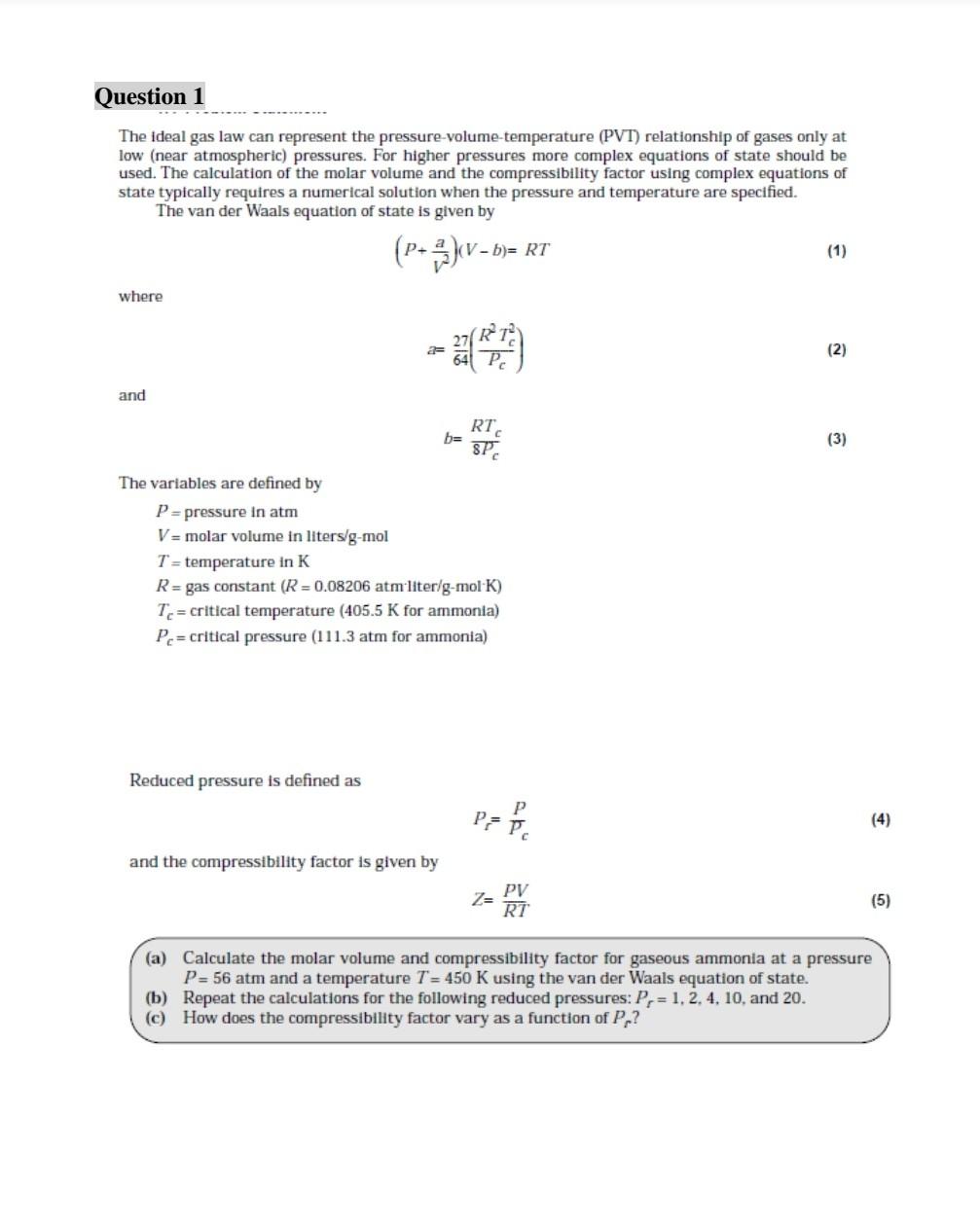
The ideal gas law can represent the pressure-volume-temperature (PVT) relationship of gases only at low (near atmospheric) pressures. For higher pressures more complex equations of state should be used. The calculation of the molar volume and the compressibility factor using complex equations of state typically requires a numerical solution when the pressure and temperature are specified. The van der Waals equation of state is given by (P+V2a)(Vb)=RT where a=6427(PcR2Tc2) and b=8PcRTc The variables are defined by P=pressureinatmV=molarvolumeinliters/g-molT=temperatureinKR=gasconstant(R=0.08206atm/iter/g-molK)Tc=criticaltemperature(405.5Kforammonia)Pc=criticalpressure(111.3atmforammonia) Reduced pressure is defined as Pr=PcP and the compressibility factor is given by Z=RTPV (a) Calculate the molar volume and compressibility factor for gaseous ammonia at a pressure P=56atm and a temperature T=450K using the van der Waals equation of state. (b) Repeat the calculations for the following reduced pressures: Pr=1,2,4,10, and 20. (c) How does the compressibility factor vary as a function of Pr
Step by Step Solution
There are 3 Steps involved in it

Get step-by-step solutions from verified subject matter experts
 Study Help