







Question: Note In case the lines L, and L, do not pass through the origin, we may take lines L, and L', which are parallel
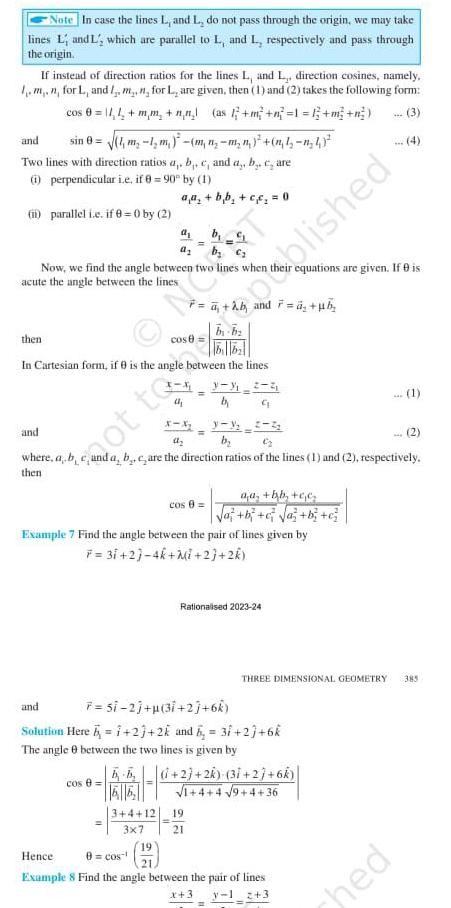
Note In case the lines L, and L, do not pass through the origin, we may take lines L, and L', which are parallel to L, and L, respectively and pass through the origin. If instead of direction ratios for the lines L., and L,, direction cosines, namely, 1m, n, for L, and l, m, n, for L, are given, then (1) and (2) takes the following form: cos 0=1+mm+nn +m+n=1=1+m+n) (3) (as and sin = (1,m,-1, m)-(m, n-m, n) + (n, 1, n, 1) Two lines with direction ratios a,, b, c, and a, b, c, are (4) (i) perpendicular i.e, if 0=90 by (1) (i) parallel ie. if 0-0 by (2) aa+bb,+ce,= 0 a Now, we find the angle between two lines when acute the angle between the lines equations are given. If 0 is F=a+b and F+b then ot to published In Cartesian form, if 0 is the angle between the lines and then = yy by .. (1) X-X 3-321-2 = (2) by Cz where, a, b, c,and a, b, c,are the direction ratios of the lines (1) and (2), respectively. cos 0= aa+b+cc a+b+ca+b+c Example 7 Find the angle between the pair of lines given by F=31+2)-4k+1+2}+2k) Rationalised 2023-24 THREE DIMENSIONAL GEOMETRY 385 and F=51-2j+(3+2j+6k) Solution Here =+2)+2k and h=3+2)+6k The angle between the two lines is given by (+2)+2k) (31+2)+6k)| Hence cos e- 66 1+4+49+4+36 3+4+12 19 3x7 21 19 Example 8 Find the angle between the pair of lines x+3 y-1 +3 ched
Step by Step Solution
There are 3 Steps involved in it

Get step-by-step solutions from verified subject matter experts
 Study Help