







Question: NOTE: Mohr Circles must be drawn to scale with equal scales for ( x ) and ( y ) axes. NOTE:
NOTE: Mohr Circles must be drawn to scale with equal scales for x and y axes.
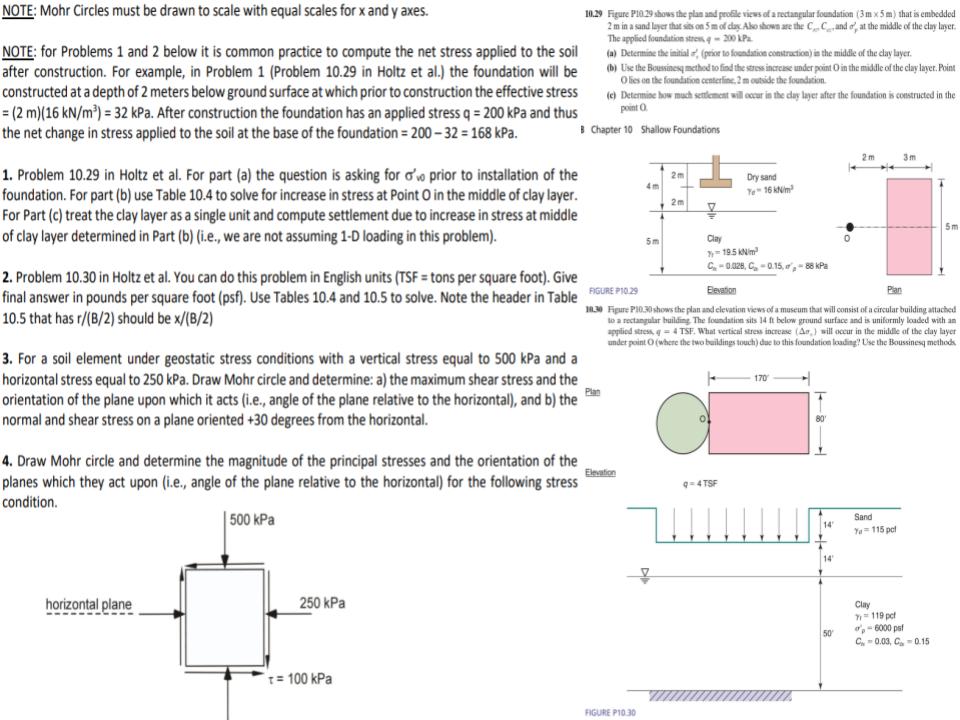
NOTE: for Problems and below it is common practice to compute the net stress applied to the soil after construction. For example, in Problem Problem in Holtz et al the foundation will be constructed at a depth of meters below ground surface at which prior to construction the effective stress mathrm~mleftmathrmkNmathrmmrightmathrmkPa After construction the foundation has an applied stress mathrmqmathrmkPa and thus the net change in stress applied to the soil at the base of the foundation mathrmkPa
Problem in Holtz et al For part a the question is asking for sigmaprime w prior to installation of the foundation. For part b use Table to solve for increase in stress at Point in the middle of clay layer. For Part c treat the clay layer as a single unit and compute settlement due to increase in stress at middle of clay layer determined in Part bie we are not assuming D loading in this problem
Problem in Holtz et al You can do this problem in English units TSF tons per square foot Give final answer in pounds per square foot psf Use Tables and to solve. Note the header in Table that has r B should be x B
For a soil element under geostatic stress conditions with a vertical stress equal to kPa and a horizontal stress equal to kPa Draw Mohr circle and determine: a the maximum shear stress and the orientation of the plane upon which it acts ie angle of the plane relative to the horizontal and b the normal and shear stress on a plane oriented degrees from the horizontal.
Draw Mohr circle and determine the magnitude of the principal stresses and the orientation of the planes which they act upon ie angle of the plane relative to the horizontal for the following stress condition.
Figure P shoss the plan and profle viese of a rectangular foundation mathrm~mtimes mathrm~m that is embedded The applied foundation stres mathrmkP
b Use the Bousinesy method to fisd the serss inctese under pount O in the middle of the clay layet. Point Fies on the foundition centerline, mo outide the foundation.
c Detonsise how much setulencat vill ocyar in the day layet after the foundation is constructed in the point
B Chapter Shallow Foundations
ROURE PIO.
Fipure Plo: shows the plan and clevation views of a museum that will consist of a circular building atiached to a rectangular huilding The foundatinn sits fi below ground surface and is uniformly loaded with an applied stress, TSF What vertical stress increase leftDelta sigmaright sill occur in the midlle of the clay layer under point O where the two buildings touch dae to this foundatios loaling?" Use the Boussinesy methods
Elevatio
Step by Step Solution
There are 3 Steps involved in it
1 Expert Approved Answer
Step: 1 Unlock

Question Has Been Solved by an Expert!
Get step-by-step solutions from verified subject matter experts
Step: 2 Unlock
Step: 3 Unlock
 Study Help