







Question: note: **Need help with this problem. Please provide detailed explanation. Two masses m1 = m2 = m are connected by a linear spring of stiffness
note: **Need help with this problem. Please provide detailed explanation.
Two masses m1 = m2 = m are connected by a linear spring of stiffness k. The masses
can slide on a horizontal surface, m1 with a friction coefficient = , and m2 with no
friction. Let the absolute displacements of the two blocks, x1 and x2 be measured from
an unstreched position of the spring, and the initial conditions are x1 (0) = 0, x2 (0) = mg/k
x1(derivative)(0)= 0, x2(derivative)(0)= 0
Find: (a) the maximum velocity of m1; (b)
the time when m1 first stops sliding.
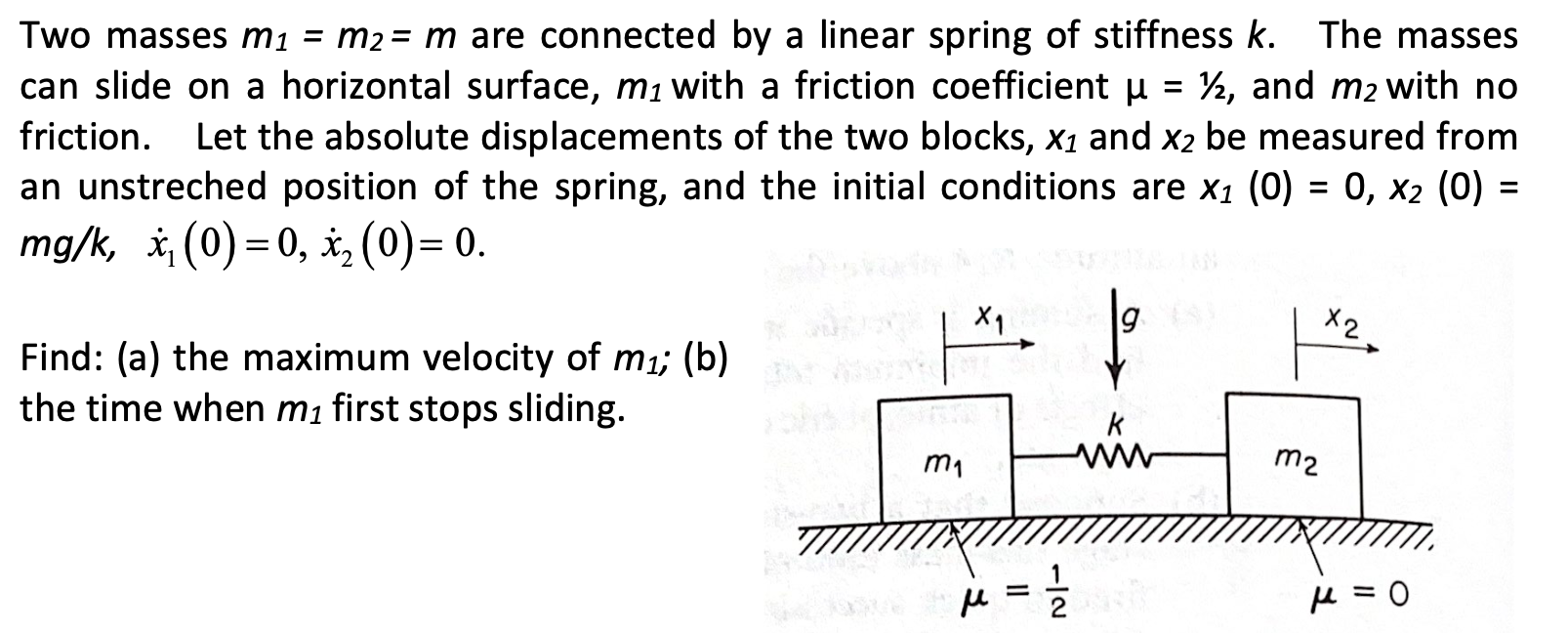
Two masses m1 = m2= m are connected by a linear spring of stiffness k. The masses can slide on a horizontal surface, my with a friction coefficient u = 1/2, and m2 with no friction. Let the absolute displacements of the two blocks, x1 and x2 be measured from an unstreched position of the spring, and the initial conditions are x1 (0) = 0, X2 (0) = mg/k, x, (0) = 0, x2 0) = 0. 9 X 2 . Find: (a) the maximum velocity of m1; (b) the time when m1 first stops sliding. K m1 m2 M = N/- M = 0
Step by Step Solution
There are 3 Steps involved in it

Get step-by-step solutions from verified subject matter experts
 Study Help