







Question: Note: Please provide in-text citations and harvard references as well word limit: 150 words for each qs CASE STUDY Case Study An Australian Manager in
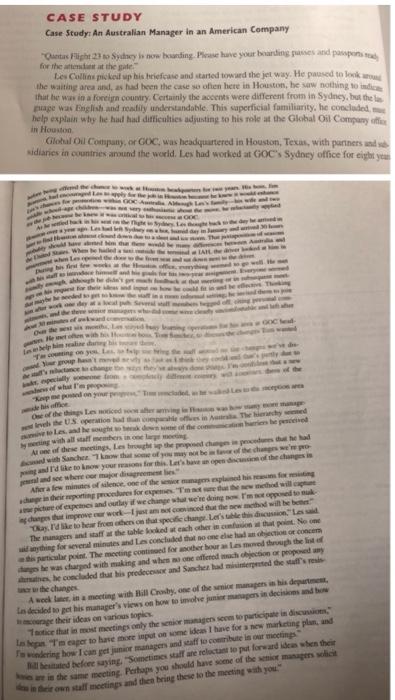
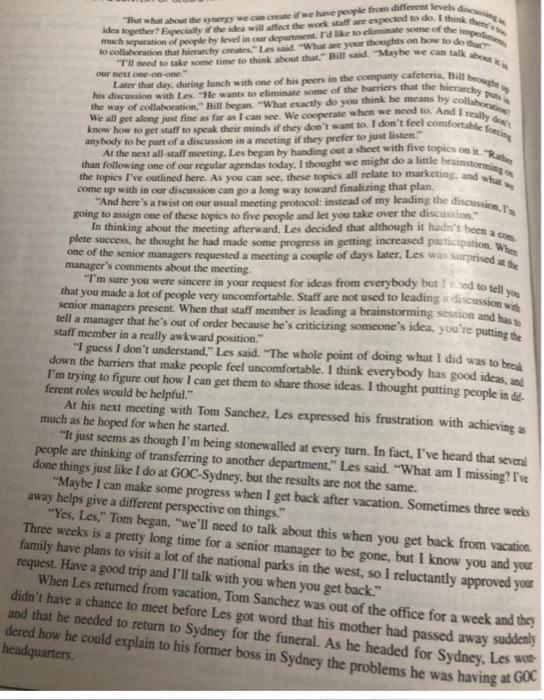
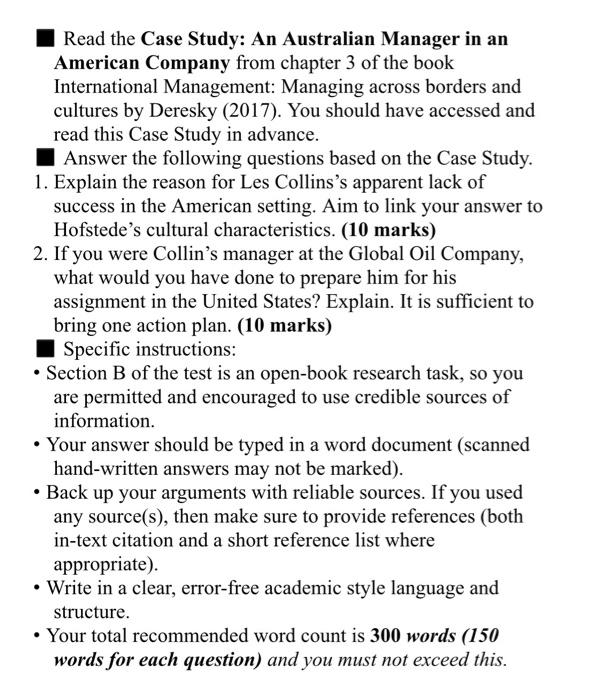
CASE STUDY Case Study An Australian Manager in an American Company for the attenitart at the gate- bes Collins mak ked wp his brieftase and started toward the jet way. He paused to lonk atwed. the waiting area and, as had been the cake sa ofien here in Houston, be saw nothing to indice that be was in a foreign coumry. Certainly the ascens were different froms in Sydney, bur the la riage was long fisk and reafily undentandable. This saperficial familiarity. he coscladed nest help explain w ty he baal had ditficulties adyusting to his role at the Glokal Oil Comepany affier. in Houston Giotal Oil Company, or GOKC, was headquattered in Houston, Texas, with parners asd sid sidianies in couniries amumd the world. Les had worked at COC's Syalncy office for eight ycat uther in the shinges. In keph. Te caper to laste more inpot on wome lidese 1 have for a new martirting plan, and "But wat about the synergy we can create if we have people from different levels divcuw ides topether? Hspecially if the ides will affect the work staff are expected to do. I think there's our neut one-mo-one." Later that day, during lunch with one of his peers in the company cafeteria, Bill bromate diserwsion with tes his discussion with les. "He wants to eliminate some of the burniers that-the hierarcty puty the way of collaboration," Bill began. "What exactly do you think he means by collaborationy We all get along just fine as far as I can see. We cooperate when we necd to. And I really drey. know how to get staff to speak their minds if they don't want to. I don't feel comfortable forches anybody to be part of a discussion in a meeting if they prefer to just listen." Ar the newt all-staff meeting. Les began by handing out a sheet with five topies on it. "Reche than following one of our regular agendas today, I thought we might do a little brainutormibg of come up with in our discussion can go a long way toward finalixing that plan. "And here's a twist on our usual mecting protocol: instead of my leading the discusion, Im going to assign one of these topics to five people and let yoe take over the discussion." In thinking about the meeting afterward, Les decided that although it hudn't been a coec. plete success, he thought he had made some progress in getting increased participation. Whem one of the senior managers requested a meeting a couple of days later, Les uas surprived at the manager's comments about the meeting. "I'm sure you were sincere in your request for adeas from everybody but I fised to tell yoe that you made a lot of people very uncomfortable. Staff are not used to leading a fiscussion wis senior managers present. When that staff member is leading a brainstorming session and has bo tell a manager that he's out of onder because he's criticiring someone's idea. you' re putting the staff member in a really awkward position." "I guess I don't understand," Les said. "The whole point of doing what I did was to break down the barriers that make people feel uncomfortable. I think everybody has good ideas, and I'm trying to figure out how I can get them to share those ideas. I thought putting people in dir. ferent roles would be helpful." At his next mecting with Tom Sancher. Les expressed his frustration with achieving a much as he hoped for when he started. "It just secms as though I'm being stoncwalled at every turn. In fact, I've heard that serenl people are thinking of transferring to another department," Les said. "What am I missing? Iie done things just like I do at GOC-Sydney, but the results are not the same. Maybe I can make some progress when I get back after vacation. Sometimes three wceks auay helps give a different perspective on things." "Yes, Les," Tom began, "we"ll need to talk about this when you get back from vacation. Three weeks is a pretty long time for a senior manager to be gone, but I know you and your family have plans to visit a lot of the national parks in the west, so I reluctantly approved your request. Have a good trip and I"II talk with you when you get back." When Les returned from vacation. Tom Sanchez was out of the office for a week and the? idn't have a chance to meet before Les got word that his mother had passed away suddenly If that he needed to return to Sydney for the funcral. As he headed for Sydney, Les wosred how he could explain to his former boss in Sydney the problems he was having at God Read the Case Study: An Australian Manager in an American Company from chapter 3 of the book International Management: Managing across borders and cultures by Deresky (2017). You should have accessed and read this Case Study in advance. E Answer the following questions based on the Case Study. 1. Explain the reason for Les Collins's apparent lack of success in the American setting. Aim to link your answer to Hofstede's cultural characteristics. (10 marks) 2. If you were Collin's manager at the Global Oil Company, what would you have done to prepare him for his assignment in the United States? Explain. It is sufficient to bring one action plan. (10 marks) Specific instructions: - Section B of the test is an open-book research task, so you are permitted and encouraged to use credible sources of information. - Your answer should be typed in a word document (scanned hand-written answers may not be marked). - Back up your arguments with reliable sources. If you used any source(s), then make sure to provide references (both in-text citation and a short reference list where appropriate). - Write in a clear, error-free academic style language and structure. - Your total recommended word count is 300 words (150 words for each question) and you must not exceed this
Step by Step Solution
There are 3 Steps involved in it

Get step-by-step solutions from verified subject matter experts
 Study Help