







Question: Note: Show your complete solution and use this link for graph https://www.desmos.com/calculator And to answer wrap question, click this link to see the the references
Note: Show your complete solution and use this link for graph https://www.desmos.com/calculator
And to answer wrap question, click this link to see the the references for A and B. https://drive.google.com/drive/folders/10gwgImAMj2YRDVDWRuuqhxZHZWxyhlJR?usp=share_link
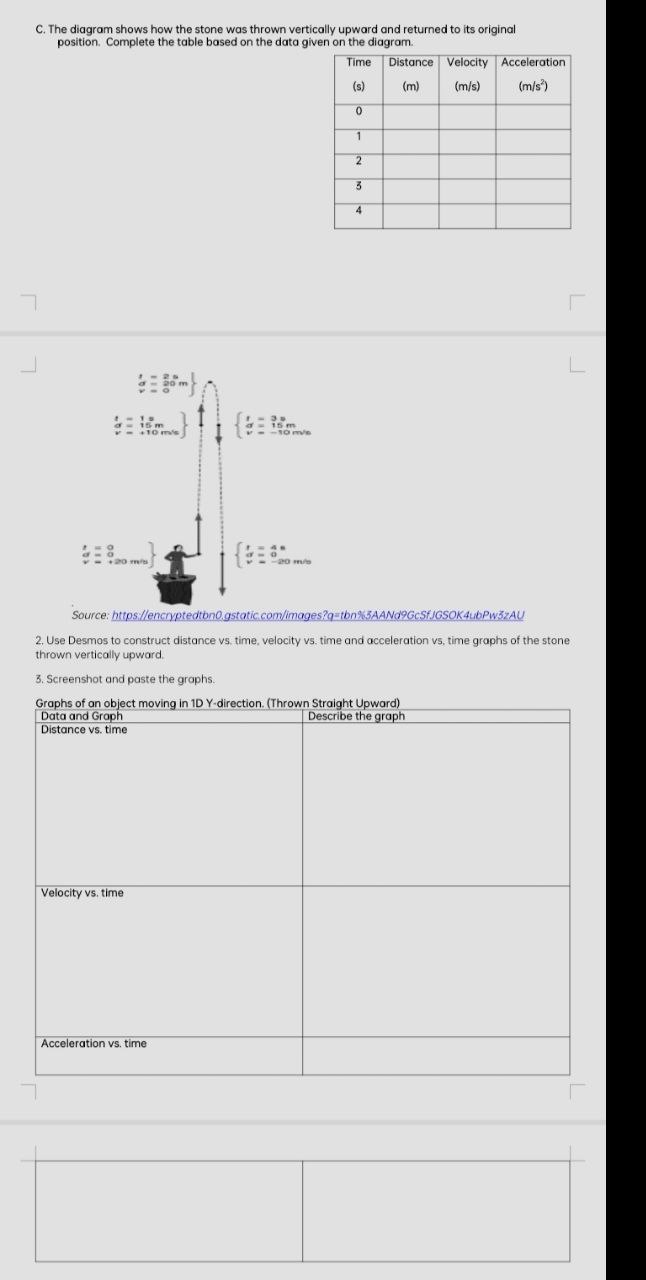
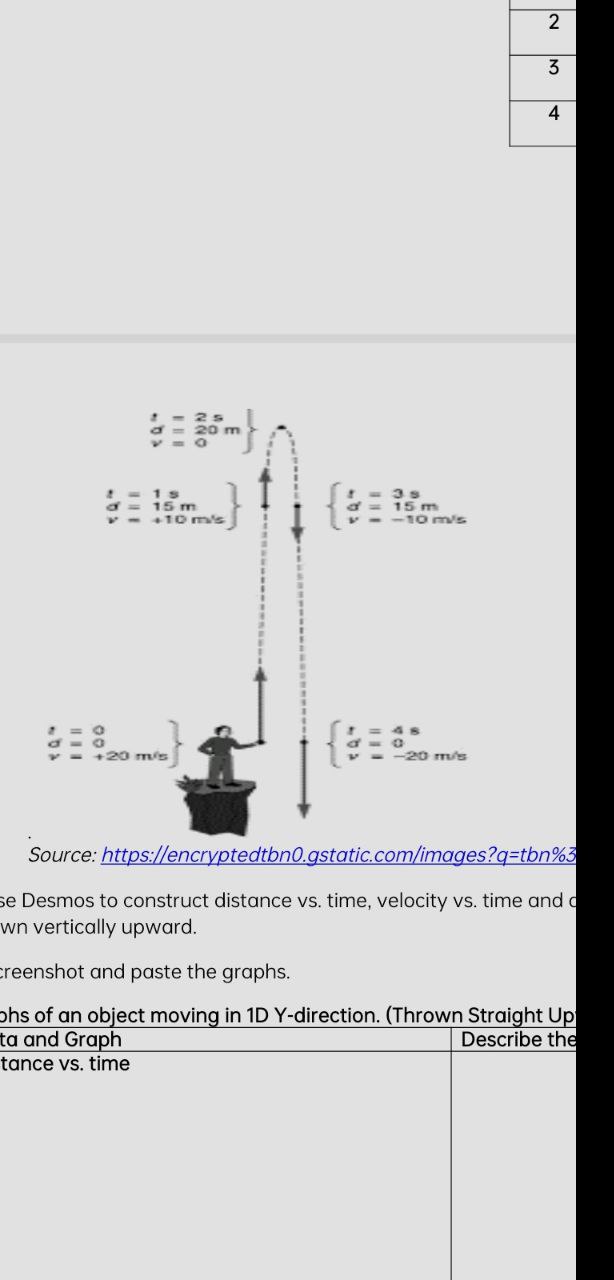
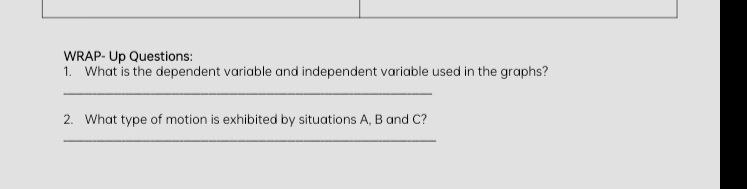
C. The diagram shows how the stone was thrown vertically upward and returned to its original position. Complete the table based on the data given on the diagram. Time Distance Velocity Acceleration (s) (m) (m/s) (m/s?) 0 L OUN To mis Source: https://encryptedton0.gstatic.com/images?q=tbn*3AAN(9GcSf.JGSOK4ubPW3ZAU 2, Use Desmos to construct distance vs. time. velocity vs. time and acceleration vs, time graphs of the stone thrown vertically upword. 3. Screenshot and paste the graphs. Graphs of an object moving in 1D Y-direction. (Thrown Straight Upward) Data and Graph Describe the graph Distance vs. time Velocity vs, time Acceleration vs. time2 CN 4 1 s E 15 m d = 15 m 410 ms -10 ms +20 mis -20 m/s Source: https://encryptedtbn0.gstatic.com/images?q=tbn%3 se Desmos to construct distance vs. time, velocity vs. time and d wn vertically upward. reenshot and paste the graphs. ohs of an object moving in 1D Y-direction. (Thrown Straight Up ta and Graph Describe the tance vs. timeWRAP- Up Questions: 1. What is the dependent variable and independent variable used in the graphs? 2. What type of motion is exhibited by situations A, B and C
Step by Step Solution
There are 3 Steps involved in it

Get step-by-step solutions from verified subject matter experts
 Study Help