







Question: Note: show your full steps and solutions with explanation. Show all steps in your arguments 1. In class, we introduced the notion of the contrapositive.

Note: show your full steps and solutions with explanation.
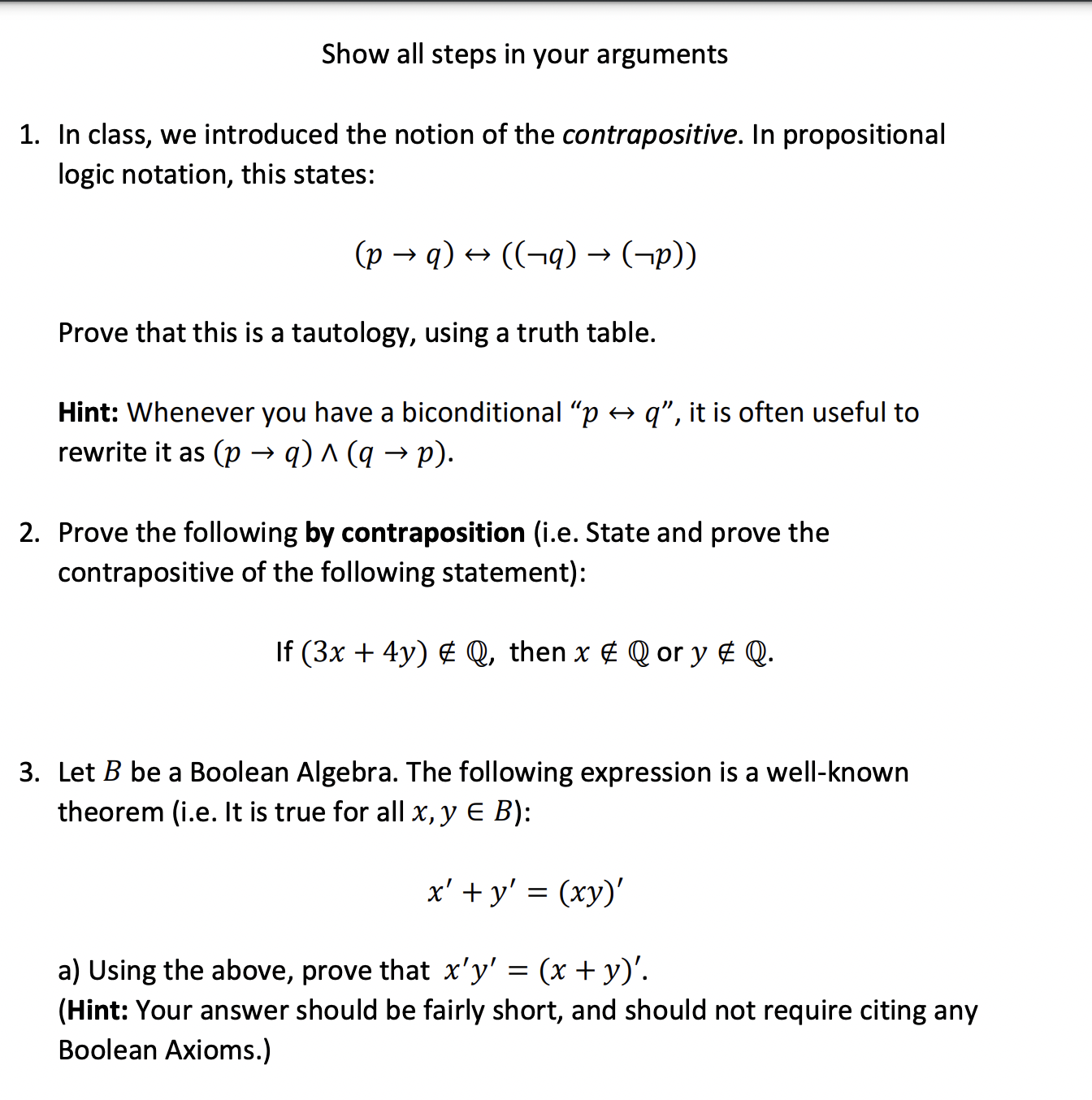

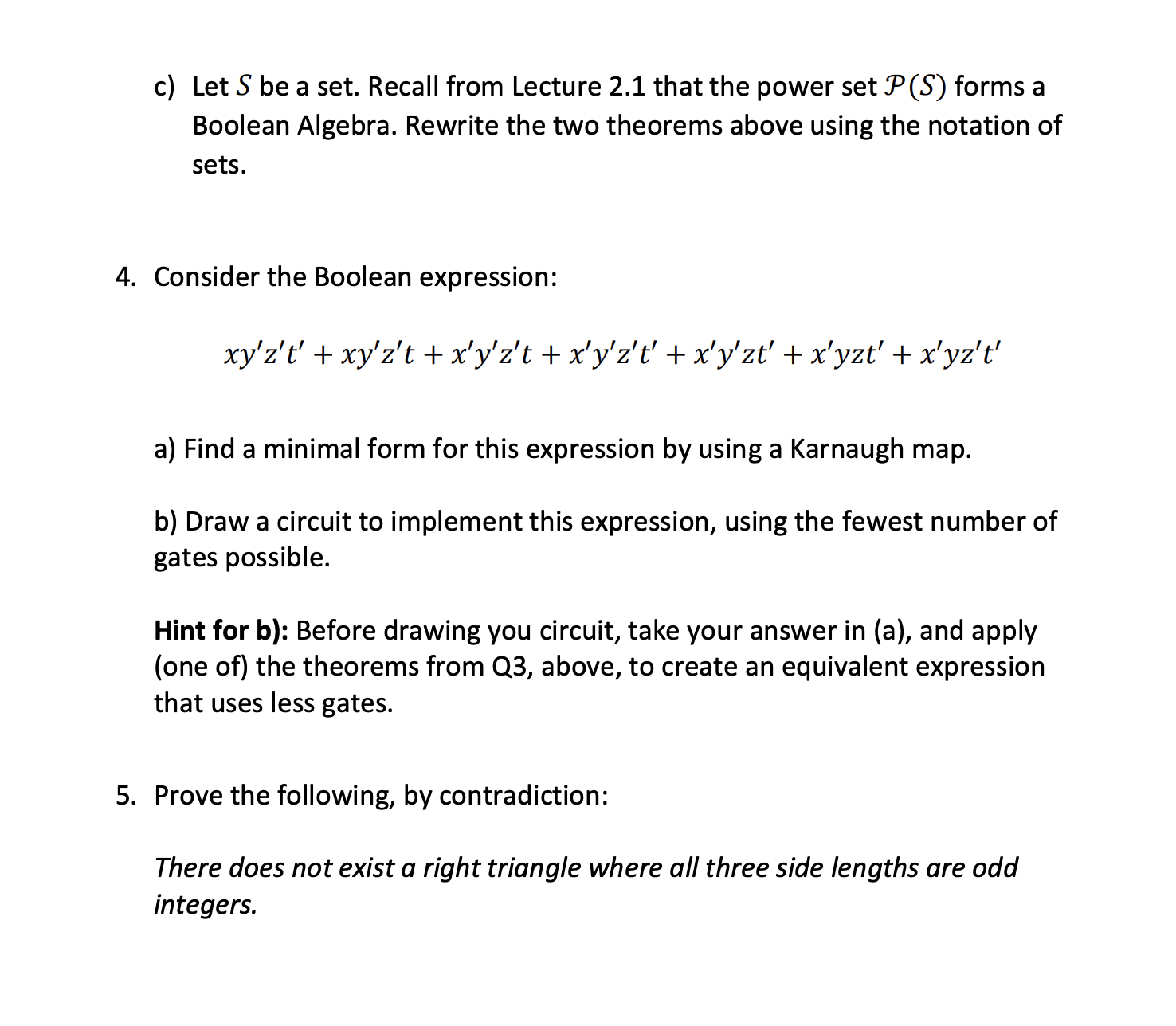
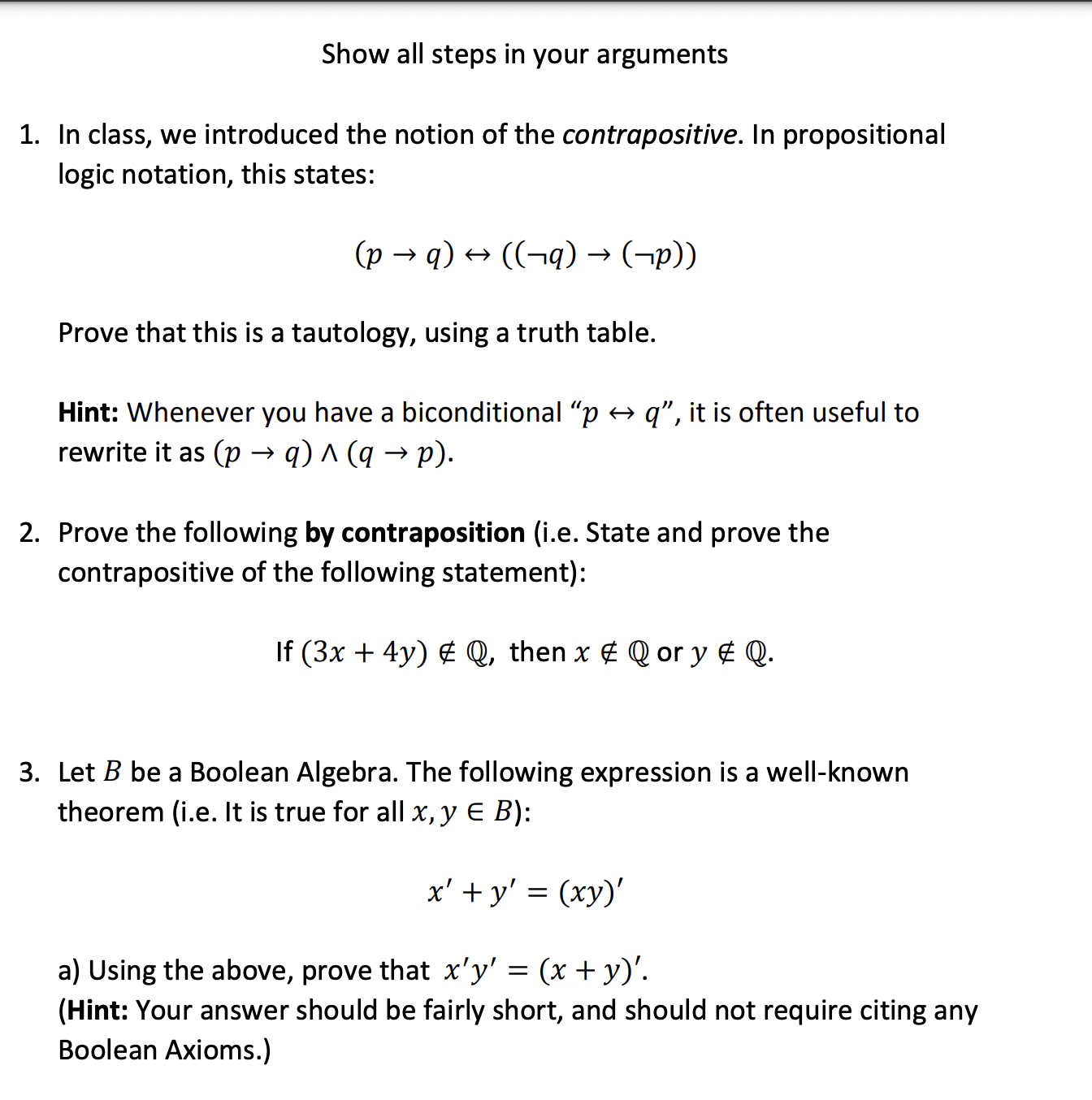
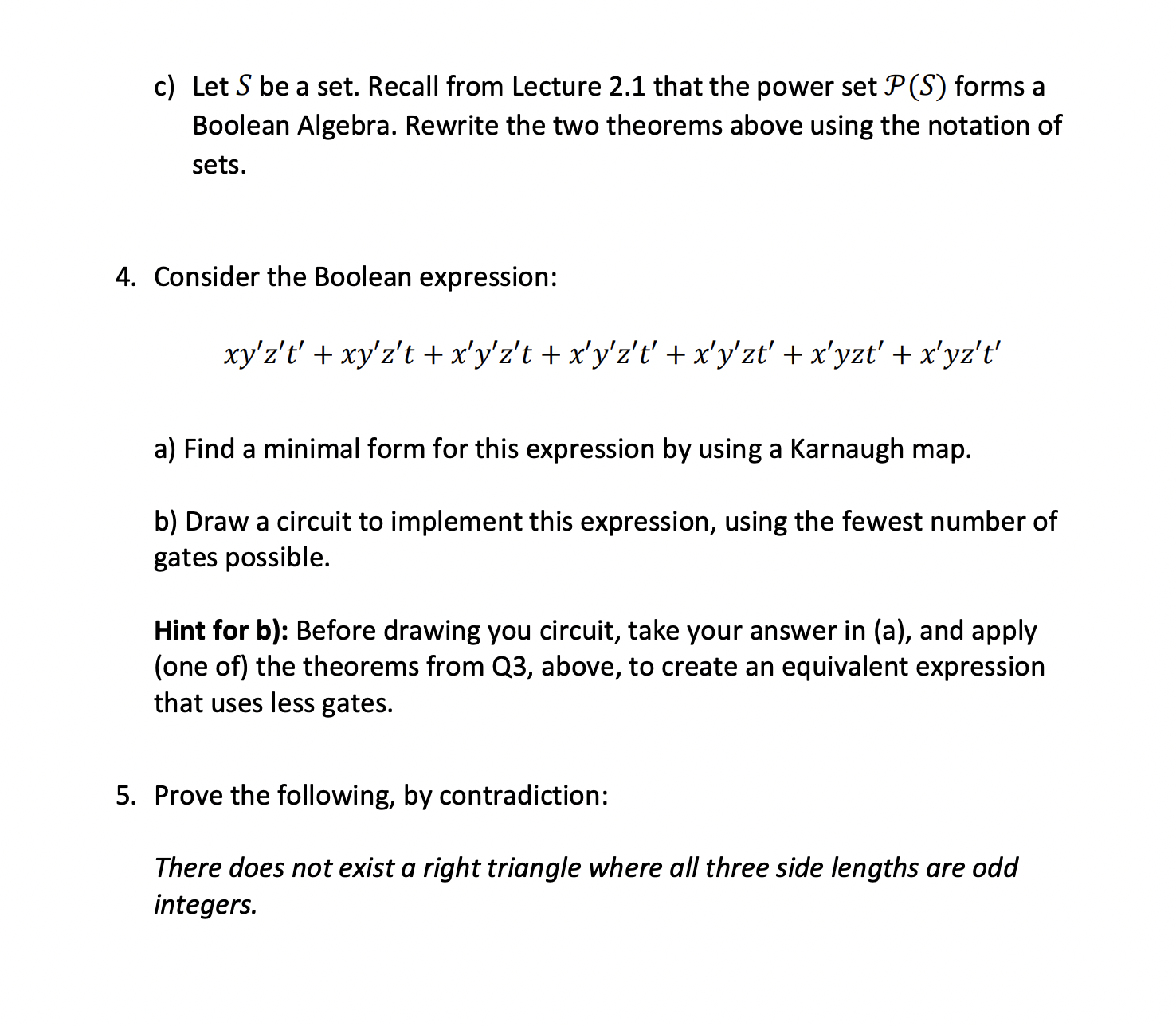
Show all steps in your arguments 1. In class, we introduced the notion of the contrapositive. In propositional logic notation, this states: (19 -> CD (HI) -) (aw) Prove that this is a tautology, using a truth table. Hint: Whenever you have a biconditional \"p q\b) Recall from Lecture 2.1 that the set of propositions forms a Boolean Algebra. Rewrite the two theorems above using the notation of propositions. c) Let S be a set. Recall from Lecture 2.1 that the power set ?(5) forms a Boolean Algebra. Rewrite the two theorems above using the notation of sets. . Consider the Boolean expression: if! Iii xy'z't' + xy'z't + x y z t + x y z t' + x'y'zt' + x'yzt' + x'yz't' a) Find a minimal form for this expression by using a Karnaugh map. b) Draw a circuit to implement this expression, using the fewest number of gates possible. Hint for b): Before drawing you circuit, take your answer in (a), and apply (one of) the theorems from Q3, above, to create an equivalent expression that uses less gates. . Prove the following, by contradiction: There does not exist a right triangle where all three side lengths are odd integers
Step by Step Solution
There are 3 Steps involved in it

Get step-by-step solutions from verified subject matter experts
 Study Help