







Question: Now using the 3 different methods of fluid flow. Give a generl discission and conclusion. Method 1-Viscosity Method 2- Shear Stress Method 3- Viscosity-Shear stress
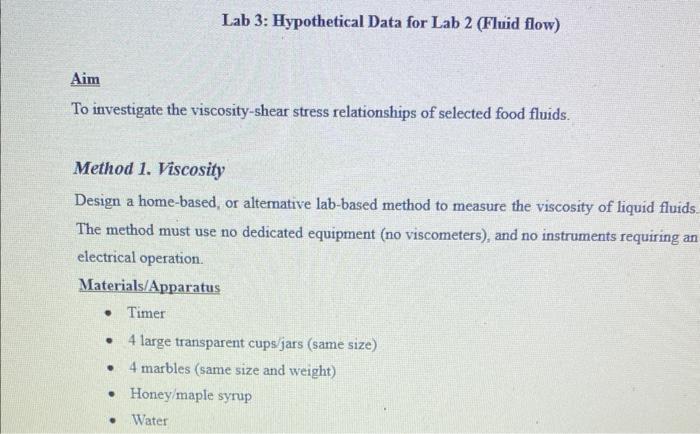
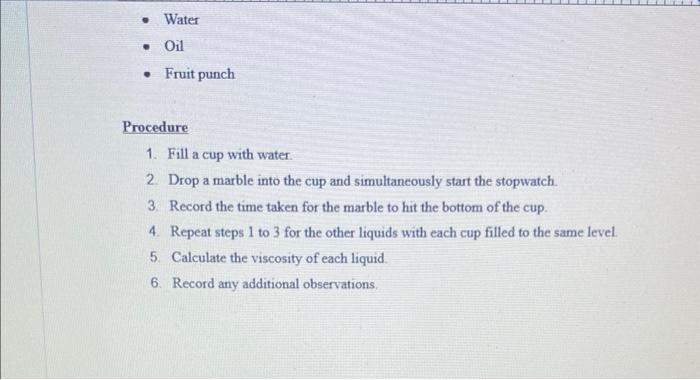
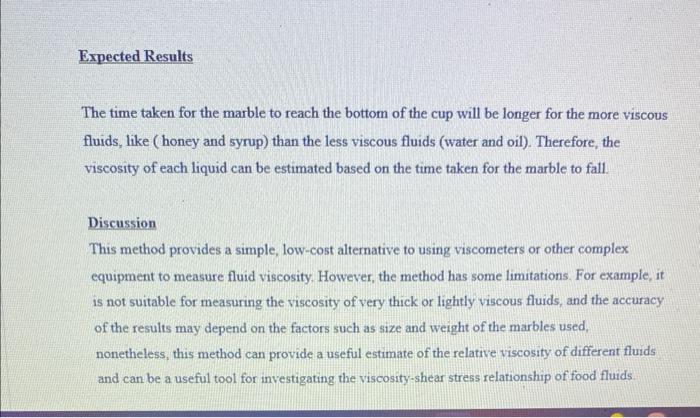
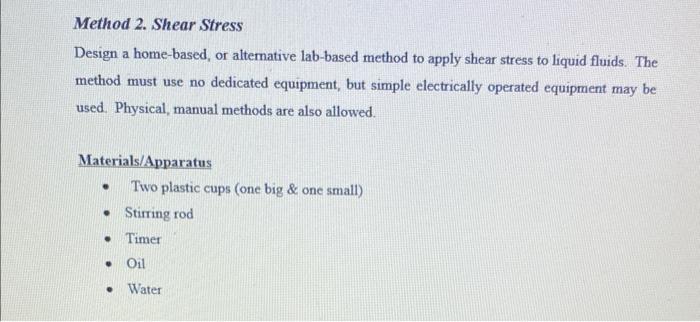
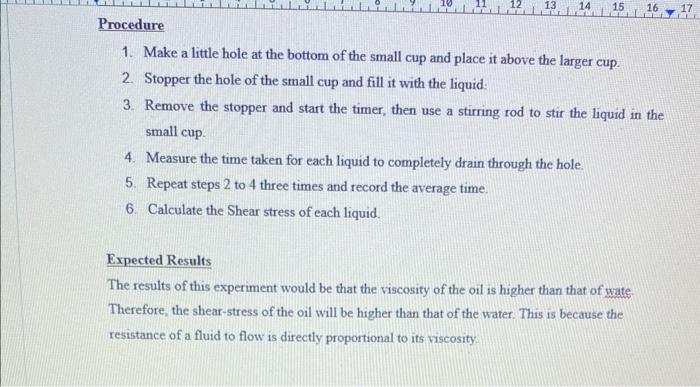
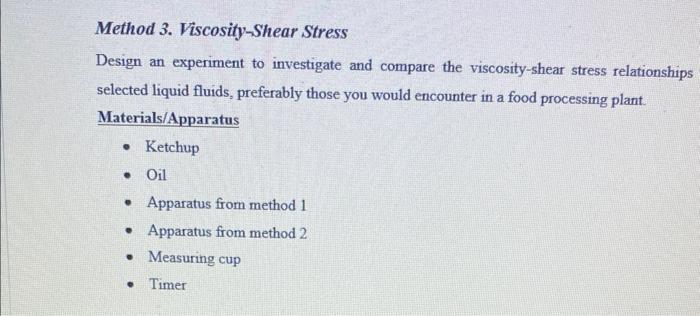
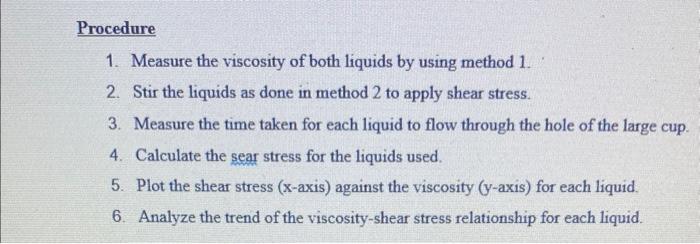
Lab 3: Hypothetical Data for Lab 2 (Fluid flow) Aim To investigate the viscosity-shear stress relationships of selected food fluids. Method 1. Viscosity Design a home-based, or alternative lab-based method to measure the viscosity of liquid fluids The method must use no dedicated equipment (no viscometers), and no instruments requiring an electrical operation. Materials/Apparatus - Timer - 4 large transparent cups/jars (same size) - 4 marbles (same size and weight) - Honey/maple syrup - Water - Water - Oil - Fruit punch Procedure 1. Fill a cup with water. 2. Drop a marble into the cup and simultancously start the stopwatch. 3. Record the time taken for the marble to hit the bottom of the cup. 4. Repeat steps 1 to 3 for the other liquids with each cup filled to the same level. 5. Calculate the viscosity of each liquid. 6. Record any additional observations. The time taken for the marble to reach the bottom of the cup will be longer for the more viscous fluids, like (honey and syrup) than the less viscous fluids (water and oil). Therefore, the viscosity of each liquid can be estimated based on the time taken for the marble to fall. Discussion This method provides a simple, low-cost alternative to using viscometers or other complex equipment to measure fluid viscosity. However, the method has some limitations. For example, it is not suitable for measuring the viscosity of very thick or lightly viscous fluids, and the accuracy of the results may depend on the factors such as size and weight of the marbles used, nonetheless, this method can provide a useful estimate of the relative viscosity of different fluids and can be a useful tool for investigating the viscosity-shear stress relationship of food fluids. Method 2. Shear Stress Design a home-based, or altemative lab-based method to apply shear stress to liquid fluids. The method must use no dedicated equipment, but simple electrically operated equipment may be used. Physical, manual methods are also allowed. Materials/Apparatus - Two plastic cups (one big & one small) - Stirring rod - Timer - Oil - Water Procedure 1. Make a little hole at the bottom of the small cup and place it above the larger cup. 2. Stopper the hole of the small cup and fill it with the liquid: 3. Remove the stopper and start the timer, then use a stirring rod to stir the liquid in the small cup. 4. Measure the time taken for each liquid to completely drain through the hole. 5. Repeat steps 2 to 4 three times and record the average time. 6. Calculate the Shear stress of each liquid. Expected Results The results of this experiment would be that the viscosity of the oil is higher than that of wate Therefore, the shear-stress of the oil will be higher than that of the water. This is because the resistance of a fluid to flow is directly proportional to its viscosity. Method 3. Viscosity-Shear Stress Design an experiment to investigate and compare the viscosity-shear stress relationships selected liquid fluids, preferably those you would encounter in a food processing plant. Materials/Apparatus - Ketchup - Oil - Apparatus from method 1 - Apparatus from method 2 - Measuring cup - Timer Procedure 1. Measure the viscosity of both liquids by using method 1 . 2. Stir the liquids as done in method 2 to apply shear stress. 3. Measure the time taken for each liquid to flow through the hole of the large cup. 4. Calculate the sear stress for the liquids used. 5. Plot the shear stress ( x-axis) against the viscosity ( y-axis) for each liquid. 6. Analyze the trend of the viscosity-shear stress relationship for each liquid
Step by Step Solution
There are 3 Steps involved in it

Get step-by-step solutions from verified subject matter experts
 Study Help