







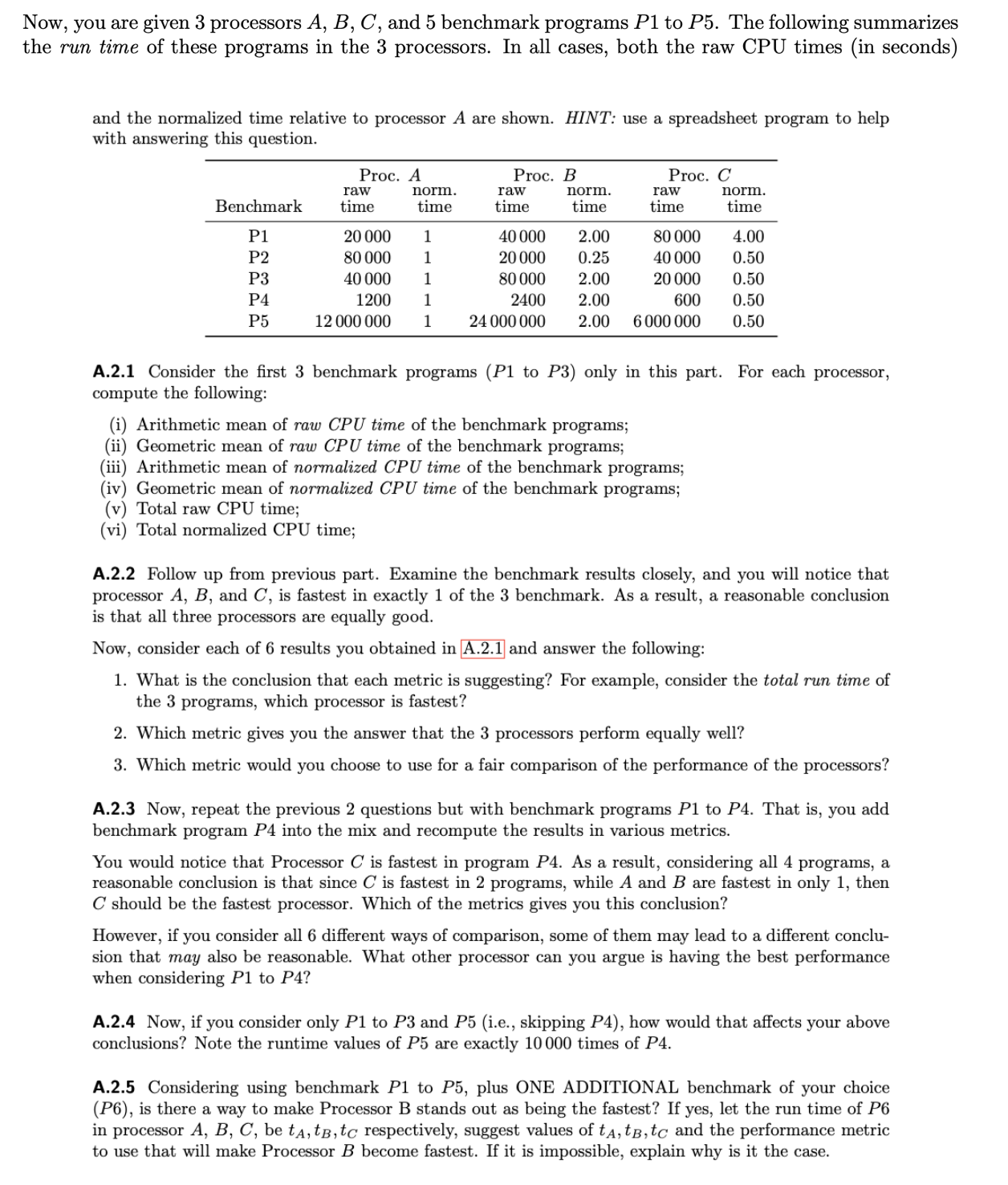
Question: Now, you are given 3 processors A , B , C , and 5 benchmark programs P 1 to P 5 . The following summarizes
Now, you are given processors and benchmark programs to The following summarizes
the run time of these programs in the processors. In all cases, both the raw CPU times in seconds
and the normalized time relative to processor A are shown. HINT: use a spreadsheet program to help
with answering this question.
A Consider the first benchmark programs to only in this part. For each processor,
compute the following:
i Arithmetic mean of raw CPU time of the benchmark programs;
ii Geometric mean of raw CPU time of the benchmark programs;
iii Arithmetic mean of normalized CPU time of the benchmark programs;
iv Geometric mean of normalized CPU time of the benchmark programs;
v Total raw CPU time;
vi Total normalized CPU time;
A Follow up from previous part. Examine the benchmark results closely, and you will notice that
processor and is fastest in exactly of the benchmark. As a result, a reasonable conclusion
is that all three processors are equally good.
Now, consider each of results you obtained in A and answer the following:
What is the conclusion that each metric is suggesting? For example, consider the total run time of
the programs, which processor is fastest?
Which metric gives you the answer that the processors perform equally well?
Which metric would you choose to use for a fair comparison of the performance of the processors?
A Now, repeat the previous questions but with benchmark programs to That is you add
benchmark program into the mix and recompute the results in various metrics.
You would notice that Processor is fastest in program As a result, considering all programs, a
reasonable conclusion is that since is fastest in programs, while A and are fastest in only then
should be the fastest processor. Which of the metrics gives you this conclusion?
However, if you consider all different ways of comparison, some of them may lead to a different conclu
sion that may also be reasonable. What other processor can you argue is having the best performance
when considering to
A Now, if you consider only to and ie skipping how would that affects your above
conclusions? Note the runtime values of are exactly times of
A Considering using benchmark to plus ONE ADDITIONAL benchmark of your choice
is there a way to make Processor B stands out as being the fastest? If yes, let the run time of
in processor be respectively, suggest values of and the performance metric
to use that will make Processor become fastest. If it is impossible, explain why is it the case.
Step by Step Solution
There are 3 Steps involved in it
1 Expert Approved Answer
Step: 1 Unlock

Question Has Been Solved by an Expert!
Get step-by-step solutions from verified subject matter experts
Step: 2 Unlock
Step: 3 Unlock
 Study Help