







Question: Numerical Computing/Numerical Analysis/Matlab Consider the quadratic equation ax^2 + bx + c = 0, where a = 1, b = 3, c = 10^-11. Evaluate
Numerical Computing/Numerical Analysis/Matlab
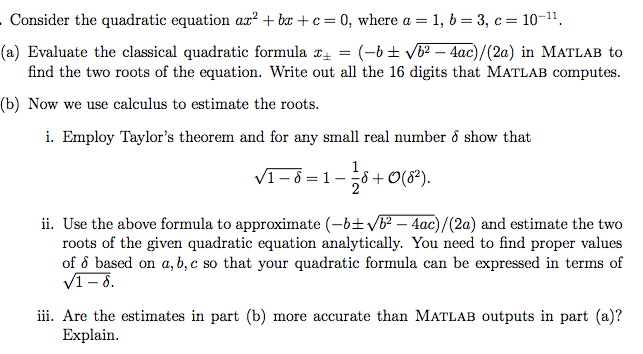
Consider the quadratic equation ax^2 + bx + c = 0, where a = 1, b = 3, c = 10^-11. Evaluate the classical quadratic formula x_plusminus = (-b plusminus square root b^2 - 4ac)./(2a) in MATLAB to find the two roots of the equation. Write out all the 16 digits that Matlab computes. Now we use calculus to estimate the roots. Employ Taylor's theorem and for any small real number delta show that Use the above formula to approximate (-b plusminus square root b^2 - 4ac)/(2a) and estimate the two roots of the given quadratic equation analytically. You need to find proper values of delta based on a, b, c so that your quadratic formula can be expressed in terms of iii. Are the estimates in part (b) more accurate than Matlab outputs in part (a)? Explain
Step by Step Solution
There are 3 Steps involved in it

Get step-by-step solutions from verified subject matter experts
 Study Help