







Question: o Basic bond valuation Complex Systems has an outstanding issue of $1,000-par-value bonds with a 9% coupon interest rate. The issue pays interest annually and
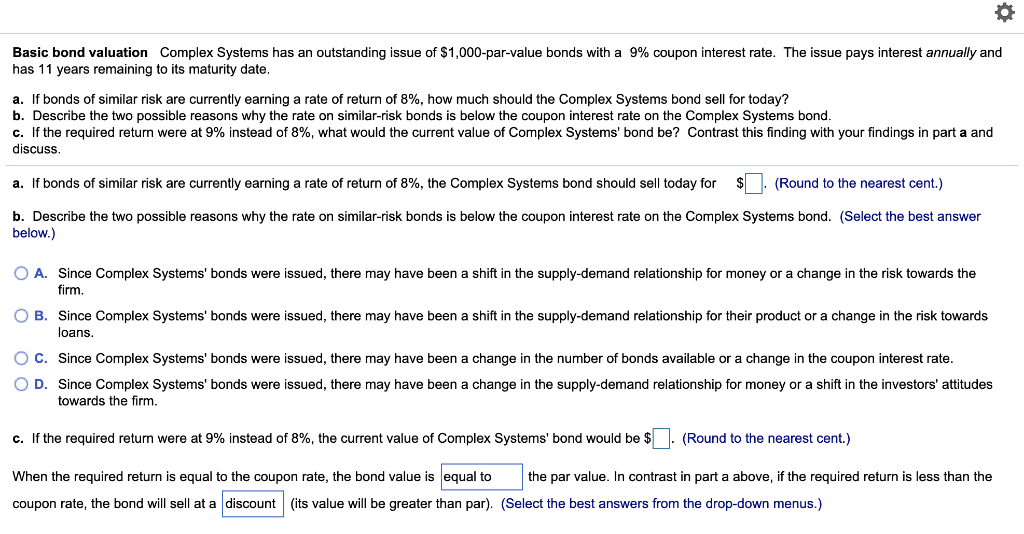
o Basic bond valuation Complex Systems has an outstanding issue of $1,000-par-value bonds with a 9% coupon interest rate. The issue pays interest annually and has 11 years remaining to its maturity date. a. If bonds of similar risk are currently earning rate of return of 8%, how much should the Complex Systems bond sell for today? b. Describe the two possible reasons why the rate on similar-risk bonds is below the coupon interest rate on the Complex Systems bond. c. If the required return were at 9% instead of 8%, what would the current value of Complex Systems' bond be? Contrast this finding with your findings in part a and discuss a. If bonds of similar risk are currently earning a rate of return of 8%, the Complex Systems bond should sell today for $ (Round to the nearest cent.) b. Describe the two possible reasons why the rate on similar-risk bonds is below the coupon interest rate on the Complex Systems bond. (Select the best answer below.) O A. Since Complex Systems' bonds were issued, there may have been a shift in the supply-demand relationship for money or a change in the risk towards the firm. OB. Since Complex Systems' bonds were issued, there may have been a shift in the supply-demand relationship for their product or a change in the risk towards loans OC. Since Complex Systems' bonds were issued, there may have been a change in the number of bonds available or a change in the coupon interest rate. OD. Since Complex Systems' bonds were issued, there may have been a change in the supply-demand relationship for money or a shift in the investors' attitudes towards the firm. c. If the required return were at 9% instead of 8%, the current value of Complex Systems' bond would be $ (Round to the nearest cent.) When the required return is equal to the coupon rate, the bond value is equal to the par value. In contrast in part a above, the required return is less than the coupon rate, the bond will sell at a discount (its value will be greater than par). (Select the best answers from the drop-down menus.) o Basic bond valuation Complex Systems has an outstanding issue of $1,000-par-value bonds with a 9% coupon interest rate. The issue pays interest annually and has 11 years remaining to its maturity date. a. If bonds of similar risk are currently earning rate of return of 8%, how much should the Complex Systems bond sell for today? b. Describe the two possible reasons why the rate on similar-risk bonds is below the coupon interest rate on the Complex Systems bond. c. If the required return were at 9% instead of 8%, what would the current value of Complex Systems' bond be? Contrast this finding with your findings in part a and discuss a. If bonds of similar risk are currently earning a rate of return of 8%, the Complex Systems bond should sell today for $ (Round to the nearest cent.) b. Describe the two possible reasons why the rate on similar-risk bonds is below the coupon interest rate on the Complex Systems bond. (Select the best answer below.) O A. Since Complex Systems' bonds were issued, there may have been a shift in the supply-demand relationship for money or a change in the risk towards the firm. OB. Since Complex Systems' bonds were issued, there may have been a shift in the supply-demand relationship for their product or a change in the risk towards loans OC. Since Complex Systems' bonds were issued, there may have been a change in the number of bonds available or a change in the coupon interest rate. OD. Since Complex Systems' bonds were issued, there may have been a change in the supply-demand relationship for money or a shift in the investors' attitudes towards the firm. c. If the required return were at 9% instead of 8%, the current value of Complex Systems' bond would be $ (Round to the nearest cent.) When the required return is equal to the coupon rate, the bond value is equal to the par value. In contrast in part a above, the required return is less than the coupon rate, the bond will sell at a discount (its value will be greater than par). (Select the best answers from the drop-down menus.)
Step by Step Solution
There are 3 Steps involved in it

Get step-by-step solutions from verified subject matter experts
 Study Help