







Question: o Math 116 7 Team Homework Assignment #6, Fall 2019 Due Date: November 25 or 26 (Your instructor will tell you the exact date and
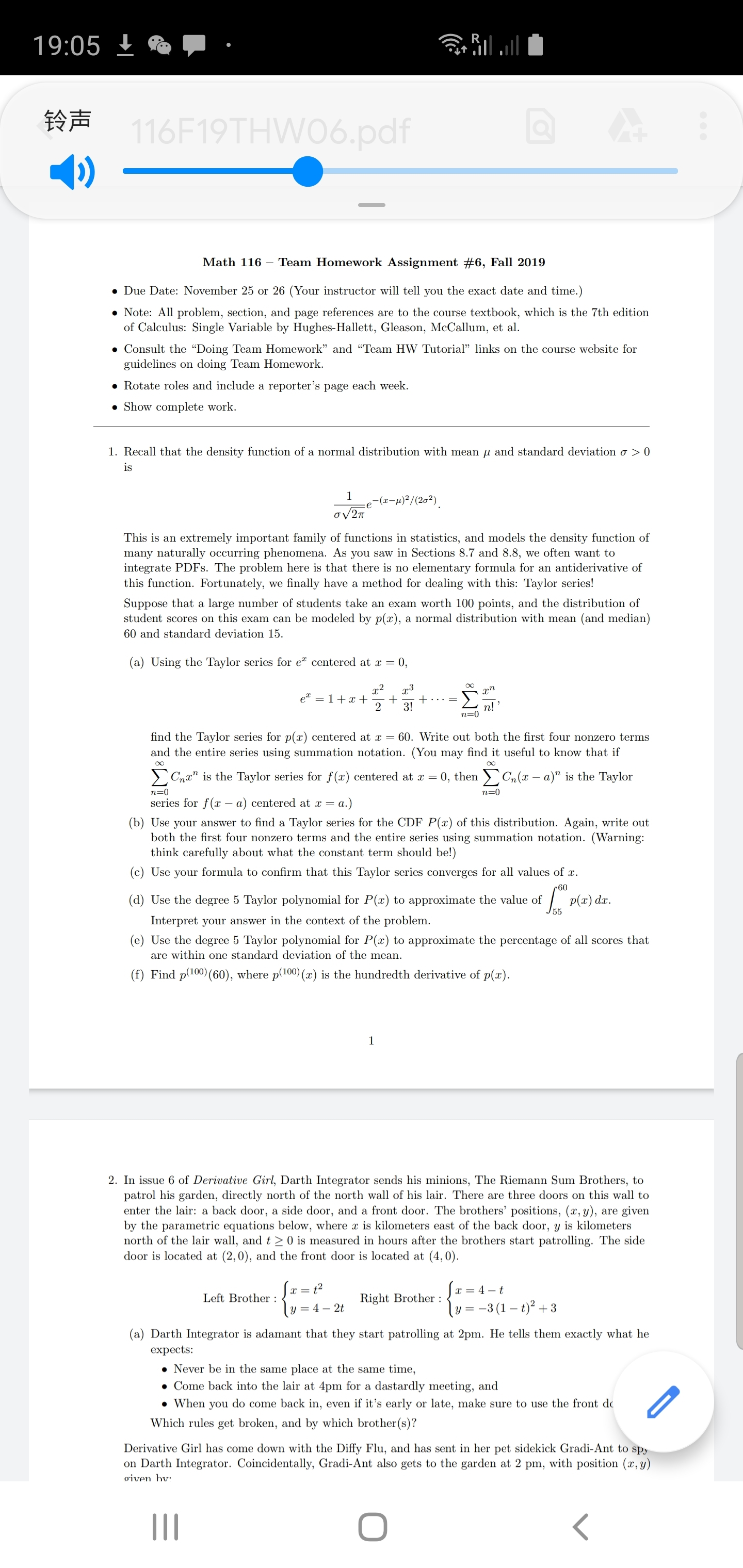
o Math 116 7 Team Homework Assignment #6, Fall 2019 Due Date: November 25 or 26 (Your instructor will tell you the exact date and time.) Note: All problem, section, and page references are to the course textbook, which is the 7th edition of Calculus: Single Variable by Hughes-Hallett, Gleason, McCallum, et al. Consult the \"Doing Team Homework\" and \"Team HW Tutorial\" links on the course website for guidelines on doing Team Homework. Rotate roles and include a reporter's page each week. Show complete work. 1. 2. Recall that the density function of a normal distribution with mean a and standard deviation 6 > 0 is 1 e-(I-u)2/(252)_ UV 27r This is an extremely important family of functions in statistics, and models the density function of many naturally occurring phenomena. As you saw in Sections 8.7 and 8.8, we often want to integrate PDFs. The problem here is that there is no elementary formula for an antiderivative of this function. Fortunately, we finally have a method for dealing with this: Taylor series! Suppose that a large number of students take an exam worth 100 points, and the distribution of Student scores on this exam can be modeled by [1(1), a normal distribution with mean (and median) 60 and standard deviation 15. (a) Using the Taylor series for e\" centered at a: : 0, 2 3 9 1 a: m" em=1+ac+++w=22ma u: nd the Taylor series for 19(1) centered at a: : 60. Write out both the rst four nonzero terms and the entire series using summation notation. (You may nd it useful to know that if 00 m 2 Cum" is the Taylor series for f (I) centered at z = 0, then 2 Unt (1.)" is the Taylor n=0 "=0 series for f (z a) centered at 1: = a.) (b) Use your answer to nd a Taylor series for the CDF P(m) of this distribution. Again, write out both the rst four nonzero terms and the entire series using summation notation. (Warning: think carefully about what the constant term should be!) (c) Use your formula to conrm that this Taylor series converges for all values of 35. 60 (d) Use the degree 5 Taylor polynomial for P(m) to approximate the value of / 19(2) dz. 55 Interpret your answer in the context of the problem. (e) Use the degree 5 Taylor polynomial for 13(2) to approximate the percentage of all scores that are within one standard deviation of the mean. (f) Find pl100)(60), where p
Step by Step Solution
There are 3 Steps involved in it

Get step-by-step solutions from verified subject matter experts
 Study Help