







Question: OBJECTIONABLE CONTAMINANTS IN EXPORT GRAIN The problem started when loading a vessel of barley destined for Saudi Arabia from the port at Fremantle. For this
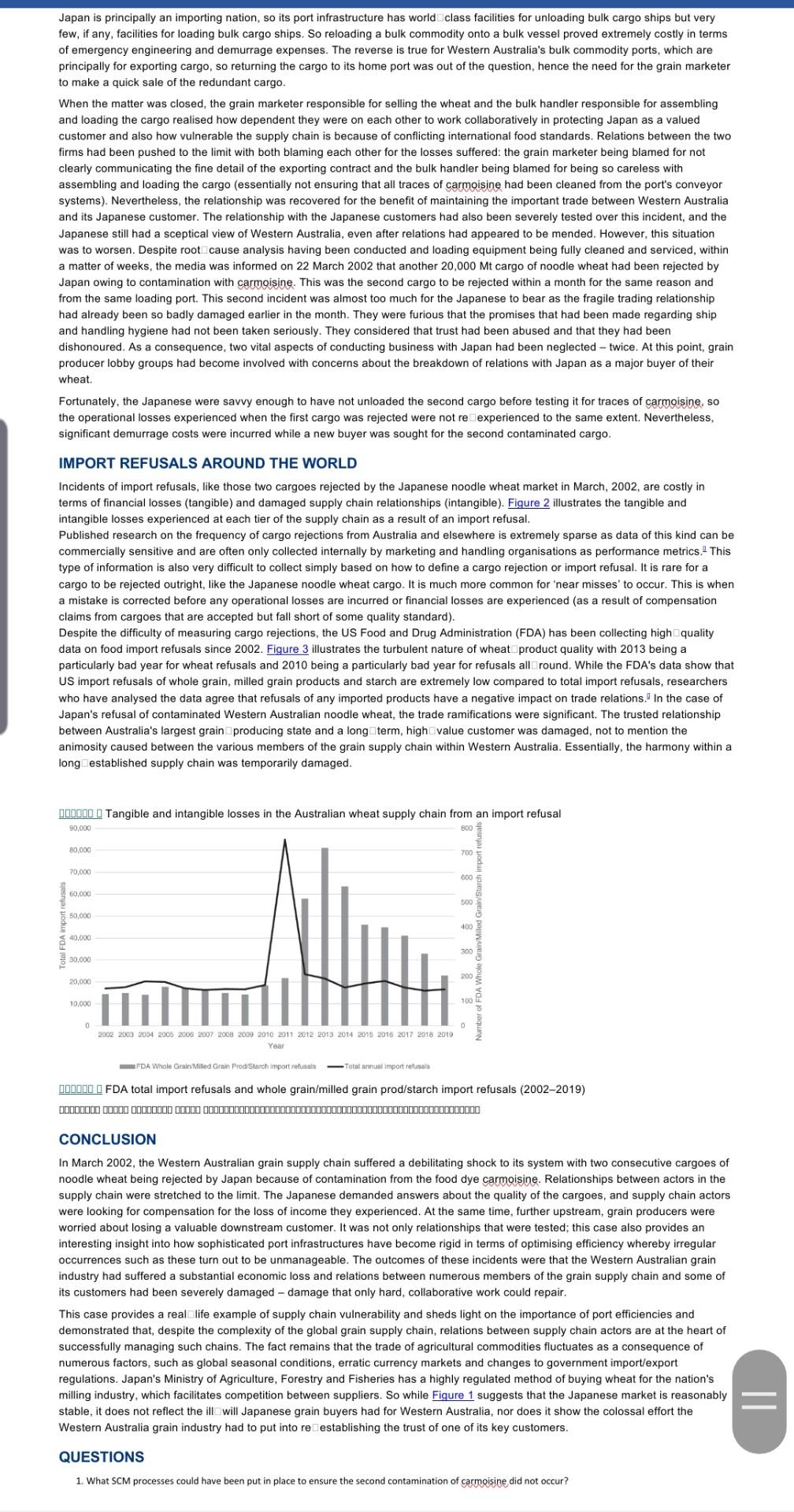
OBJECTIONABLE CONTAMINANTS IN EXPORT GRAIN The problem started when loading a vessel of barley destined for Saudi Arabia from the port at Fremantle. For this shipment, all quality control checks had been undertaken and showed that all standards for shipping barley to Saudi Arabia had been met, including a particular additive to the cargo, namely carmoisine. Carmoisine is a red food dye that is often used in the red meat industry to certify carcass grading. The Saudi Arabian market demands that about 1% of all imported grain is coloured with carmoisine in an attempt to minimise black market grain trading. The colouring process is carried out at the time of loading bulk grain onto the ship destined for Saudi Arabia. The liquid food dye is slowly dripped onto the conveyor belt that is loading the grain onto the ship to ensure that a tiny quantity of grains appear red in colour to certify their authenticity. After the shipment of barley left for Saudi Arabia, the next ship to be loaded at the port of Fremantle was high value noodle wheat bound for Japan. As per standard practice, all quality checks were undertaken, the vessel was loaded and set sail. Once the vessel reached its destination in Japan in early March 2002, unloading commenced and local authorities began their stringent import checks, during which they identified an 'objectionable contaminant' in the cargo - this is one of the most serious claims that can be made about a cargo of food. Western Australia's most important Japanese customers were horrified by this finding and contacted the grain marketing agent immediately to express their outrage about the unacceptable condition of the cargo. Upon rigorous testing of the grain samples, it was found that the objectionable contaminant was traces of grain that had been treated with carmoisine. Unloading the vessel was ceased and the ship was to be berthed until the problem was resolved. The allegation of the carmoisine contaminated cargo had the Western Australia grain industry in turmoil: valuable customers had been disappointed, an entire cargo of premium quality wheat was split between the ship and port storage, the Japanese port had suspended operations, thereby preventing other vessels from berthing, extraordinary demurrage costs were being incurred from the ship being left idle and there was a threat of the customers demanding monetary compensation for loss of earnings. Western Australian grain marketers found it perplexing that their Japanese customers should find miniscule traces of a food dye so unacceptable, particularly because it was an additive that another customer (Saudi Arabia) demanded as a standard treatment. After identifying the immediate problem, substantial cracks started to appear in the seemingly robust supply chain. OBJECTIONABLE CONTAMINANT: CARMOISINE Objectionable contaminants in bulk grain commodities are usually traces of poisonous or dangerous substances such as pesticides, traces of herbicides used in crop management, traces of fertiliser from previous handling equipment, rust or paint flakes from inside the hold of a vessel, small pieces of metal from handling machinery, bird or rodent droppings from unclean storage facilities, poisonous gases from antiquated storage facilities or fungal mycotoxins produced during the growth or storage of wheat crops. International food standards specify a nil tolerance of generic objectionable contaminants (such as those listed above), but individual markets also specify particular substances as objectionable. In Japan, Canada, the US, Norway and Sweden, carmoisine is banned, based on evidence that it is linked to hyperactivity in children and hence is regarded as an objectionable contaminant in food importing The confirmation that the objectionable contaminant found in the wheat cargo was carmoisine resulted in the declaration of a 'distressed cargo': the entire cargo being rejected by Japan. This left the cargo of high quality grain split between the port and the vessel, and without an owner taking responsibility for the cargo. The grain marketer eventually found a new buyer for the cargo at an enormous financial cost, but the most significant operational cost was finding a way to return the part unloaded cargo onto the ship. Japan is principally an importing nation, so its port infrastructure has world class facilities for unloading bulk cargo ships but very few, if any, facilities for loading bulk cargo ships. So reloading a bulk commodity onto a bulk vessel proved extremely costly in terms of emergency engineering and demurrage expenses. The reverse is true for Western Australia's bulk commodity ports, which are principally for exporting cargo, so returning the cargo to its home port was out of the question, hence the need for the grain marketer to make a quick sale of the redundant cargo. When the matter was closed, the grain marketer responsible for selling the wheat and the bulk handler responsible for assembling and loading the cargo realised how dependent they were on each other to work collaboratively in protecting Japan as a valued customer and also how vulnerable the supply chain is because of conflicting international food standards. Relations between the two firms had been pushed to the limit with both blaming each other for the losses suffered: the grain marketer being blamed for not clearly communicating the fine detail of the exporting contract and the bulk handler being blamed for being so careless with assembling and loading the cargo (essentially not ensuring that all traces of carmoisine had been cleaned from the port's conveyor systems). Nevertheless, the relationship was recovered for the benefit of maintaining the important trade between Western Australia and its Japanese customer. The relationship with the Japanese customers had also been severely tested over this incident, and the Japanese still had a sceptical view of Western Australia, even after relations had appeared to be mended. However, this situation was to worsen. Despite root cause analysis having been conducted and loading equipment being fully cleaned and serviced, within a matter of weeks, the media was informed on 22 March 2002 that another 20,000 Mt cargo of noodle wheat had been rejected by Japan owing to contamination with carmoisine. This was the second cargo to be rejected within a month for the same reason and from the same loading port. This second incident was almost too much for the Japanese to bear as the fragile trading relationship had already been so badly damaged earlier in the month. They were furious that the promises that had been made regarding ship and handling hygiene had not been taken seriously. They considered that trust had been abused and that they had been dishonoured. As a consequence, two vital aspects of conducting business with Japan had been neglected - twice. At this point, grain producer lobby groups had become involved with concerns about the breakdown of relations with Japan as a major buyer of their wheat. Fortunately, the Japanese were savvy enough to have not unloaded the second cargo before testing it for traces of carmoisine, so the operational losses experienced when the first cargo was rejected were not re experienced to the same extent. Nevertheless, significant demurrage costs were incurred while a new buyer was sought for the second contaminated cargo. IMPORT REFUSALS AROUND THE WORLD Incidents of import refusals, like those two cargoes rejected by the Japanese noodle wheat market in March, 2002, are costly in terms of financial losses (tangible) and damaged supply chain relationships (intangible). Figure 2 illustrates the tangible and intangible losses experienced at each tier of the supply chain as a result of an import refusal. Published research on the frequency of cargo rejections from Australia and elsewhere is extremely sparse as data of this kind can be commercially sensitive and are often only collected internally by marketing and handling organisations as performance metrics. This type of information is also very difficult to collect simply based on how to define a cargo rejection or import refusal. It is rare for a cargo to be rejected outright, like the Japanese noodle wheat cargo. It is much more common for 'near misses' to occur. This is when a mistake is corrected before any operational losses are incurred or financial losses are experienced (as a result of compensation claims from cargoes that are accepted but fall short of some quality standard). Despite the difficulty of measuring cargo rejections, the US Food and Drug Administration (FDA) has been collecting high quality data on food import refusals since 2002. Figure 3 illustrates the turbulent nature of wheat product quality with 2013 being a particularly bad year for wheat refusals and 2010 being a particularly bad year for refusals allround. While the FDA's data show that US import refusals of whole grain, milled grain products and starch are extremely low compared to total import refusals, researchers who have analysed the data agree that refusals of any imported products have a negative impact on trade relations. In the case of Japan is principally an importing nation, so its port infrastructure has world class facilities for unloading bulk cargo ships but very few, if any, facilities for loading bulk cargo ships. So reloading a bulk commodity onto a bulk vessel proved extremely costly in terms of emergency engineering and demurrage expenses. The reverse is true for Western Australia's bulk commodity ports, which are principally for exporting cargo, so returning the cargo to its home port was out of the question, hence the need for the grain marketer to make a quick sale of the redundant cargo. When the matter was closed, the grain marketer responsible for selling the wheat and the bulk handler responsible for assembling and loading the cargo realised how dependent they were on each other to work collaboratively in protecting Japan as a valued customer and also how vulnerable the supply chain is because of conflicting international food standards. Relations between the two firms had been pushed to the limit with both blaming each other for the losses suffered: the grain marketer being blamed for not clearly communicating the fine detail of the exporting contract and the bulk handler being blamed for being so careless with assembling and loading the cargo (essentially not ensuring that all traces of carmoisine had been cleaned from the port's conveyor systems). Nevertheless, the relationship was recovered for the benefit of maintaining the important trade between Western Australia and its Japanese customer. The relationship with the Japanese customers had also been severely tested over this incident, and the Japanese still had a sceptical view of Western Australia, even after relations had appeared to be mended. However, this situation was to worsen. Despite root cause analysis having been conducted and loading equipment being fully cleaned and serviced, within a matter of weeks, the media was informed on 22 March 2002 that another 20,000 Mt cargo of noodle wheat had been rejected by Japan owing to contamination with carmoisine. This was the second cargo to be rejected within a month for the same reason and from the same loading port. This second incident was almost too much for the Japanese to bear as the fragile trading relationship had already been so badly damaged earlier in the month. They were furious that the promises that had been made regarding ship and handling hygiene had not been taken seriously. They considered that trust had been abused and that they had been dishonoured. As a consequence, two vital aspects of conducting business with Japan had been neglected - twice. At this point, grain producer lobby groups had become involved with concerns about the breakdown of relations with Japan as a major buyer of their wheat. Fortunately, the Japanese were savvy enough to have not unloaded the second cargo before testing it for traces of carmoisine, so the operational losses experienced when the first cargo was rejected were not re experienced to the same extent. Nevertheless, significant demurrage costs were incurred while a new buyer was sought for the second contaminated cargo. IMPORT REFUSALS AROUND THE WORLD Incidents of import refusals, like those two cargoes rejected by the Japanese noodle wheat market in March, 2002, are costly in terms of financial losses (tangible) and damaged supply chain relationships (intangible). Figure 2 illustrates the tangible and intangible losses experienced at each tier of the supply chain as a result of an import refusal. Published research on the frequency of cargo rejections from Australia and elsewhere is extremely sparse as data of this kind can be commercially sensitive and are often only collected internally by marketing and handling organisations as performance metrics. This type of information is also very difficult to collect simply based on how to define a cargo rejection or import refusal. It is rare for a cargo to be rejected outright, like the Japanese noodle wheat cargo. It is much more common for 'near misses' to occur. This is when a mistake is corrected before any operational losses are incurred or financial losses are experienced (as a result of compensation claims from cargoes that are accepted but fall short of some quality standard). Despite the difficulty of measuring cargo rejections, the US Food and Drug Administration (FDA) has been collecting high quality data on food import refusals since 2002. Figure 3 illustrates the turbulent nature of wheat product quality with 2013 being a particularly bad year for wheat refusals and 2010 being a particularly bad year for refusals allround. While the FDA's data show that US import refusals of whole grain, milled grain products and starch are extremely low compared to total import refusals, researchers who have analysed the data agree that refusals of any imported products have a negative impact on trade relations. In the case of Japan's refusal of contaminated Western Australian noodle wheat, the trade ramifications were significant. The trusted relationship between Australia's largest grain producing state and a long term, high value customer was damaged, not to mention the animosity caused between the various members of the grain supply chain within Western Australia. Essentially, the harmony within a long established supply chain was temporarily damaged. 000000 I Tangible and intangible losses in the Australian wheat supply chain from an import refusal 90,000 800 80,000 700 70,000 600 60,000 5002 50,000 400 40,000 300 30,000 200 20,000 100 10,000 0 0 2002 2003 2004 2005 2006 2007 2008 2009 2010 2011 2012 2013 2014 2015 2016 2017 2018 2019 Year -DA Whole Grain/Milind Grain Prod/Starch import refusals Total anual import refusals D00000 I FDA total import refusals and whole grain/milled grain prod/starch import refusals (2002-2019) 10000000 10000 00000000 000 0000000000 000000000000 CONCLUSION In March 2002, the Western Australian grain supply chain suffered a debilitating shock to its system with two consecutive cargoes of noodle wheat being rejected by Japan because of contamination from the food dye carmoisine. Relationships between actors in the supply chain were stretched to the limit. The Japanese demanded answers about the quality of the cargoes, and supply chain actors were looking for compensation for the loss of income they experienced. At the same time, further upstream, grain producers were worried about losing a valuable downstream customer. It was not only relationships that were tested; this case also provides an interesting insight into how sophisticated port infrastructures have become rigid in terms of optimising efficiency whereby irregular occurrences such as these turn out to be unmanageable. The outcomes of these incidents were that the Western Australian grain industry had suffered a substantial economic loss and relations between numerous members of the grain supply chain and some of its customers had been severely damaged - damage that only hard, collaborative work could repair. This case provides a real life example of supply chain vulnerability and sheds light on the importance of port efficiencies and demonstrated that, despite the complexity of the global grain supply chain, relations between supply chain actors are at the heart of successfully managing such chains. The fact remains that the trade of agricultural commodities fluctuates as a consequence of numerous factors, such as global seasonal conditions, erratic currency markets and changes to government import/export regulations. Japan's Ministry of Agriculture, Forestry and Fisheries has a highly regulated method of buying wheat for the nation's milling industry, which facilitates competition between suppliers. So while Figure 1 suggests that the Japanese market is reasonably stable, it does not reflect the ill will Japanese grain buyers had for Western Australia, nor does it show the colossal effort the Western Australia grain industry had to put into reestablishing the trust of one of its key customers. = QUESTIONS 1. What SCM processes could have been put in place to ensure the second contamination of carmoisine did not occur
Step by Step Solution
There are 3 Steps involved in it
1 Expert Approved Answer
Step: 1 Unlock

Question Has Been Solved by an Expert!
Get step-by-step solutions from verified subject matter experts
Step: 2 Unlock
Step: 3 Unlock
 Study Help