







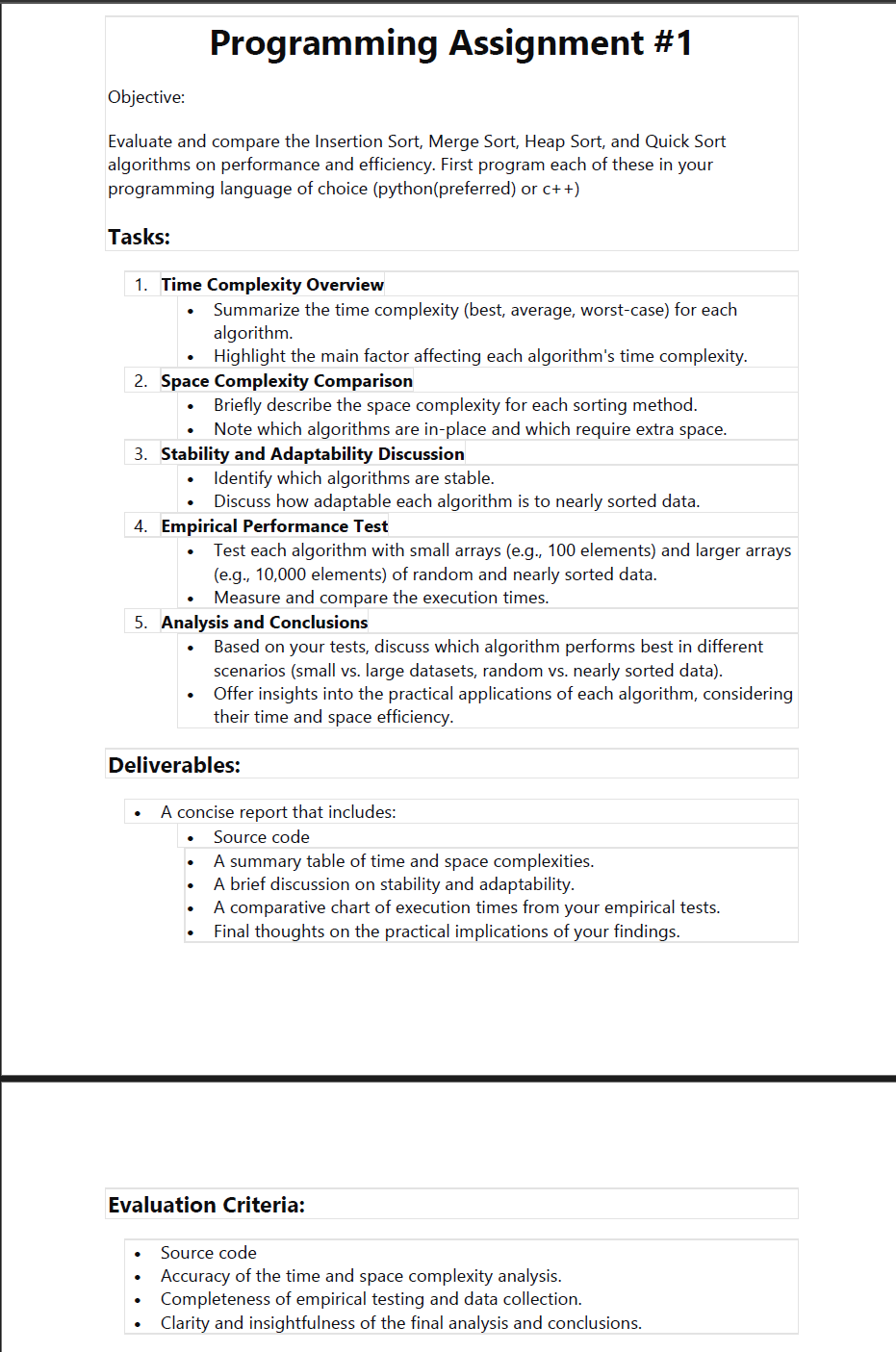
Question: Objective: Evaluate and compare the Insertion Sort, Merge Sort, Heap Sort, and Quick Sort algorithms on performance and efficiency. First program each of these in
Objective:
Evaluate and compare the Insertion Sort, Merge Sort, Heap Sort, and Quick Sort
algorithms on performance and efficiency. First program each of these in your
programming language of choice pythonpreferred or
Tasks:
Time Complexity Overview
Summarize the time complexity best average, worstcase for each
algorithm.
Highlight the main factor affecting each algorithm's time complexity.
Space Complexity Comparison
Briefly describe the space complexity for each sorting method.
Note which algorithms are inplace and which require extra space.
Stability and Adaptability Discussion
Identify which algorithms are stable.
Discuss how adaptable each algorithm is to nearly sorted data.
Empirical Performance Test
Test each algorithm with small arrays eg elements and larger arrays
eg elements of random and nearly sorted data.
Measure and compare the execution times.
Analysis and Conclusions
Based on your tests, discuss which algorithm performs best in different
scenarios small vs large datasets, random vs nearly sorted data
Offer insights into the practical applications of each algorithm, considering
their time and space efficiency.
Deliverables:
A concise report that includes:
Source code
A summary table of time and space complexities.
A brief discussion on stability and adaptability.
A comparative chart of execution times from your empirical tests.
Final thoughts on the practical implications of your findings.
Evaluation Criteria:
Source code
Accuracy of the time and space complexity analysis.
Completeness of empirical testing and data collection.
Clarity and insightfulness of the final analysis and conclusions.
Step by Step Solution
There are 3 Steps involved in it
1 Expert Approved Answer
Step: 1 Unlock

Question Has Been Solved by an Expert!
Get step-by-step solutions from verified subject matter experts
Step: 2 Unlock
Step: 3 Unlock
 Study Help