







Question: Objective: To give the student practice working with different assumptions/types of preferences. Demonstrate how modeling preferences can be applied to a policy discussion. Homework 3
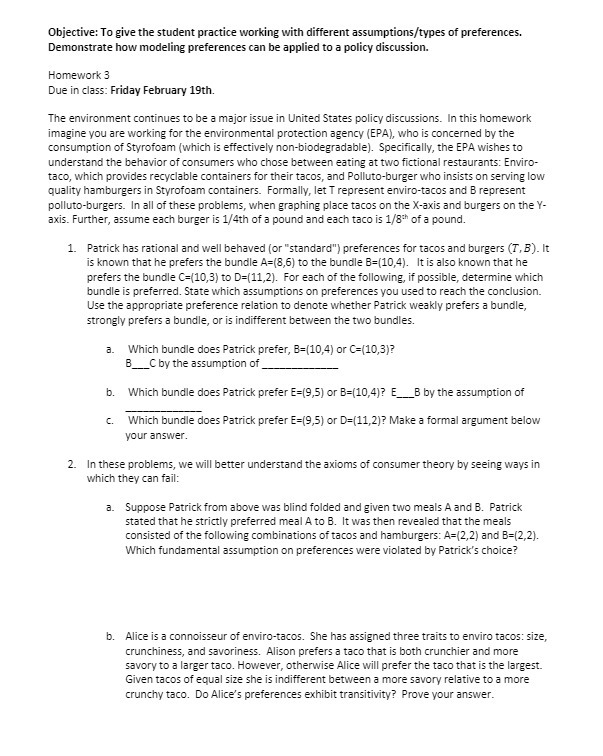
Objective: To give the student practice working with different assumptions/types of preferences. Demonstrate how modeling preferences can be applied to a policy discussion. Homework 3 Due in class: Friday February 19th. The environment continues to be a major issue in United States policy discussions. In this homework imagine you are working for the environmental protection agency (EPA), who is concerned by the consumption of Styrofoam (which is effectively non-biodegradable). Specifically, the EPA wishes to understand the behavior of consumers who chose between eating at two fictional restaurants: Enviro- taco, which provides recyclable containers for their tacos, and Polluto-burger who insists on serving low quality hamburgers in Styrofoam containers. Formally, let T represent enviro-tacos and B represent polluto-burgers. In all of these problems, when graphing place tacos on the X-axis and burgers on the Y- axis. Further, assume each burger is 1/4th of a pound and each taco is 1/8" of a pound. 1. Patrick has rational and well behaved (or "standard") preferences for tacos and burgers (7, B). It is known that he prefers the bundle A=(8,6) to the bundle B=(10,4). It is also known that he prefers the bundle C=(10,3) to D=(11,2). For each of the following, if possible, determine which bundle is preferred. State which assumptions on preferences you used to reach the conclusion. Use the appropriate preference relation to denote whether Patrick weakly prefers a bundle, strongly prefers a bundle, or is indifferent between the two bundles. a. Which bundle does Patrick prefer, B=(10,4) or C=(10,3)? B__C by the assumption of b. Which bundle does Patrick prefer E=(9,5) or B=(10,4)? E___B by the assumption of C. Which bundle does Patrick prefer E=(9,5) or D=(11,2)? Make a formal argument below your answer. 2. In these problems, we will better understand the axioms of consumer theory by seeing ways in which they can fail: a. Suppose Patrick from above was blind folded and given two meals A and B. Patrick stated that he strictly preferred meal A to B. It was then revealed that the meals consisted of the following combinations of tacos and hamburgers: A=(2,2) and B=(2,2). Which fundamental assumption on preferences were violated by Patrick's choice? b. Alice is a connoisseur of enviro-tacos. She has assigned three traits to enviro tacos: size, crunchiness, and savoriness. Alison prefers a taco that is both crunchier and more savory to a larger taco. However, otherwise Alice will prefer the taco that is the largest. Given tacos of equal size she is indifferent between a more savory relative to a more crunchy taco. Do Alice's preferences exhibit transitivity? Prove your
Step by Step Solution
There are 3 Steps involved in it

Get step-by-step solutions from verified subject matter experts
 Study Help