







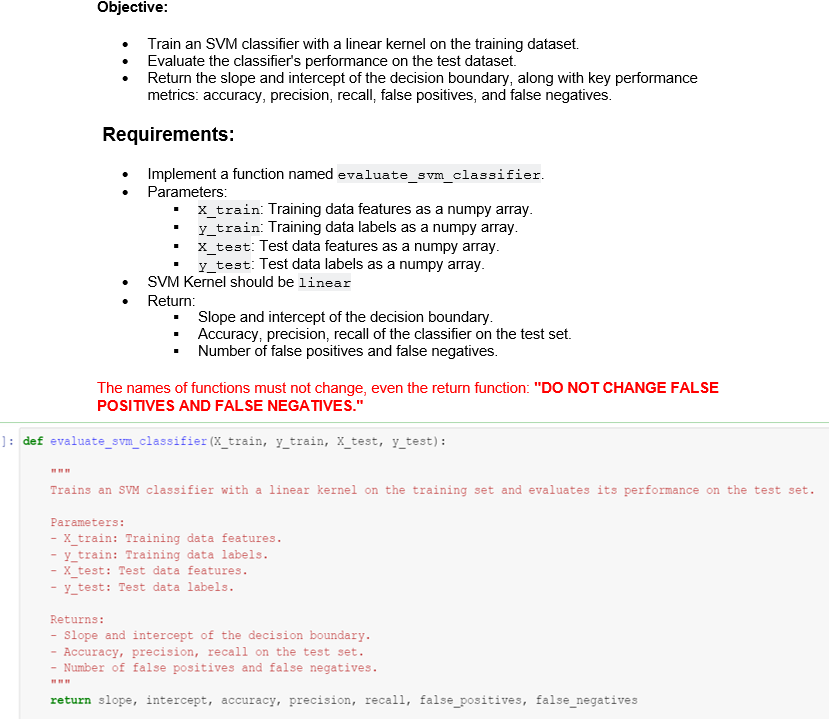
Question: Objective: Train an SVM classifier with a linear kernel on the training dataset. Evaluate the classifier's performance on the test dataset. Return the slope and
Objective:
Train an SVM classifier with a linear kernel on the training dataset.
Evaluate the classifier's performance on the test dataset.
Return the slope and intercept of the decision boundary, along with key performance
metrics: accuracy, precision, recall, false positives, and false negatives.
Requirements:
Implement a function named evaluatesvmclassifier.
Parameters:
xtrain: Training data features as a numpy array.
ytrain: Training data labels as a numpy array.
xtest: Test data features as a numpy array.
ytest: Test data labels as a numpy array.
SVM Kernel should be linear
Return:
Slope and intercept of the decision boundary.
Accuracy, precision, recall of the classifier on the test set.
Number of false positives and false negatives.
The names of functions must not change, even the return function: DO NOT CHANGE FALSE
POSITIVES AND FALSE NEGATIVES."
def evaluatesvmclassifierXtrain, ytrain, Xtest, ytest:
Trains an SVM classifier with a linear kernel on the training set and evaluates its performance on the test set.
Parameters:
Xtrain: Training data features.
ytrain: Training data labels.
Xtest: Test data features.
ytest: Test data labels.
Returns:
Slope and intercept of the decision boundary.
Accuracy, precision, recall on the test set.
Number of false positives and false negatives.
n
return slope, intercept, accuracy, precision, recall, falsepositives, falseF
From the expert
dataset is missing
Dataset is passed as parameter.
No need. I will call your functions and pass the dataset as a parameter. Also you do not need to split the data to training and testing subsets
Step by Step Solution
There are 3 Steps involved in it
1 Expert Approved Answer
Step: 1 Unlock

Question Has Been Solved by an Expert!
Get step-by-step solutions from verified subject matter experts
Step: 2 Unlock
Step: 3 Unlock
 Study Help