







Question: OBJECTIVES - Determine the relationship between incident and retracted angles. - Compare simulated refraction with theoretical formula. - Observe phenomenon of total internal reection. -
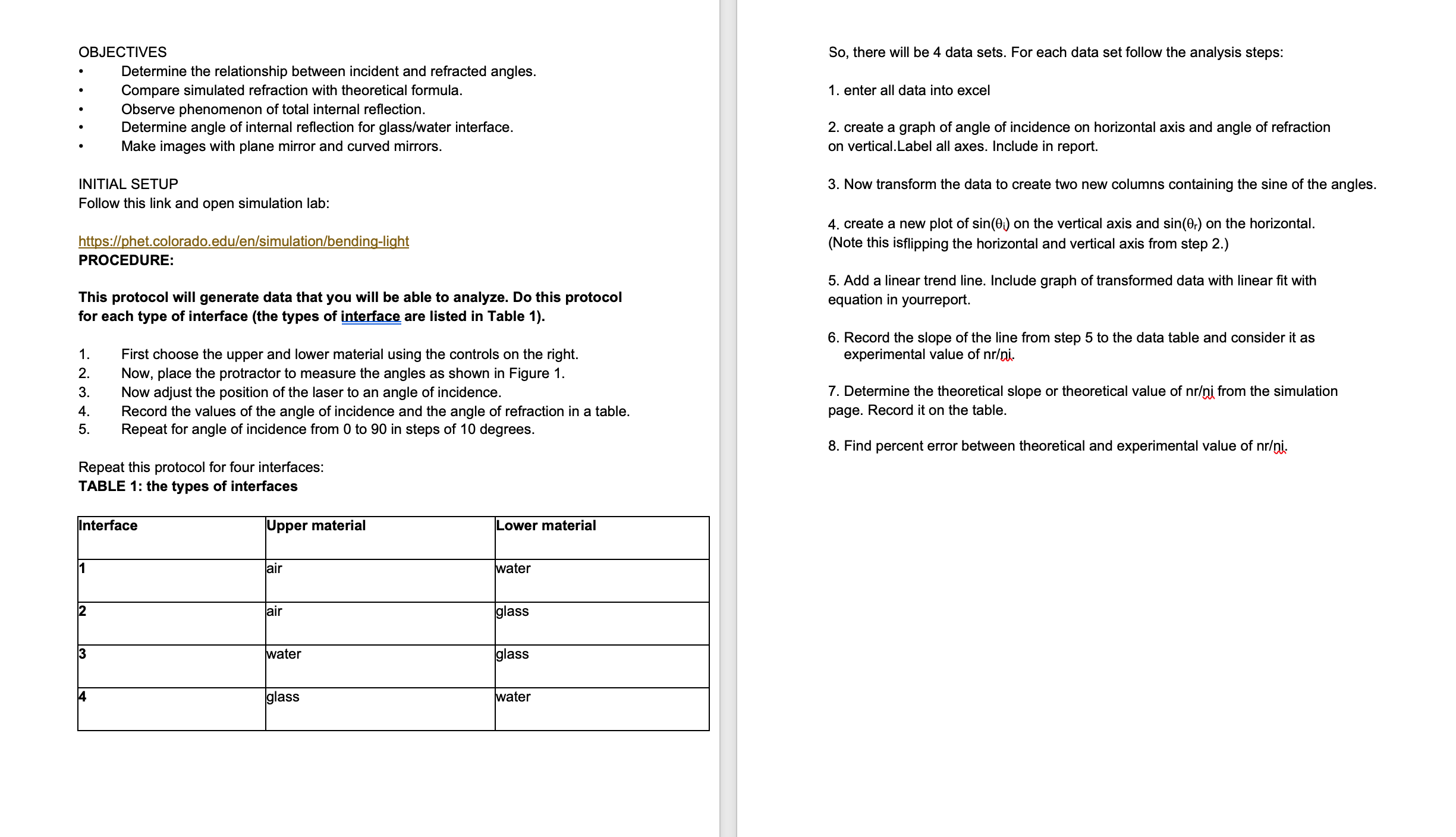
OBJECTIVES - Determine the relationship between incident and retracted angles. - Compare simulated refraction with theoretical formula. - Observe phenomenon of total internal reection. - Determine angle of intemal reection for glass/water interface. - Make images with plane mirror and curved mirrors. INITIAL SETUP Follow this link and open simulation lab: https:l/phet.co|orado.edu/enlsimulation/bending-light PROCEDURE: This protocol will generate data that you will be able to analyze. Do this protocol for each type of interface (the types of interface are listed in Table 1). First choose the upper and lower material using the controls on the right. Now, place the protractor to measure the angles as shown in Figure 1. Now adjust the position of the laser to an angle of incidence. 9'P9'Nr' Repeat for angle of incidence from 0 to 90 in steps of 10 degrees. Repeat this protocol for four interfaces: TABLE 1: the types of interfaces Record the values of the angle of incidence and the angle of refraction in a table. Interface Upper material Lower material 1 air water 2 air glass 3 water glass 4 glass water So, there will be 4 data sets. For each data set follow the analysis steps: 1. enter all data into excel 2. create a graph of angle of incidence on horizontal axis and angle of refraction on vertical.Labe| all axes. Include in report. 3. Now transform the data to create two new columns containing the sine of the angles. 4. create a new plot of sin(eo on the vertical axis and sinlt-I.) on the horizontal. (Note this isflipping the horizontal and vertical axis from step 2.) 5. Add a linear trend line. Include graph of transformed data with linear fit with equation in yourreport. 6. Record the slope of the line from step 5 to the data table and consider it as experimental value of nrL 7. Determine the theoretical slope or theoretical value of mini from the simulation page. Record it on the table. 8. Find percent error between theoretical and experimental value of nr/uL
Step by Step Solution
There are 3 Steps involved in it

Get step-by-step solutions from verified subject matter experts
 Study Help