







Question: Objectives: Develop Python programs that run the game of life in a distributed fashion using MPI 4 PY . Tools and Concepts: Python: Programming language.
Objectives:
Develop Python programs that run the game of life in a distributed fashion using MPIPY
Tools and Concepts:
Python: Programming language.
Packages: MPIPY
The game of life
a Description
The Game of Life, devised by mathematician John Conway, is a cellular automaton simulation. It
consists of a grid of cells, each of which can be in one of two states: alive or dead The state of
each cell at the next time step is determined by the following rules:
Any live cell with fewer than two live neighbors dies, as if by underpopulation.
Any live cell with two or three live neighbors lives on to the next generation.
Any live cell with more than three live neighbors dies, as if by overpopulation.
Any dead cell with exactly three live neighbors becomes a live cell, as if by reproduction.
The Game of Life is an example of a zeroplayer game, meaning that its evolution is determined
by its initial state, requiring no further input from human players.
b Use of the game of life
The Game of Life, despite its simplicity, serves as a fascinating example of cellular automata and
has several purposes and uses in various fields:
i Mathematical Exploration:
The Game of Life is a rich subject for mathematical analysis and has led to the discovery of
various patterns and structures, such as still lifes, oscillators, and spaceships. It provides a playground
for exploring concepts in geometry, algebra, and theoretical biology.
ii Biological and Physical Modeling:
While the Game of Life is not a perfect model for any real biological or physical system, it is an
example of how simple rules can lead to complex behavior. It is used as a metaphor for processes
such as the growth of bacterial colonies, spread of diseases, and formation of biological patterns.
iii Philosophical Inquiry:
The Game of Life raises philosophical questions about the nature of life and the universe. It
shows how lifelike behavior can emerge from simple, nonliving components, contributing to
discussions about the definition of life and the possibility of artificial life.Objectives:
Develop Python programs that run the game of life in a distributed fashion using MPIPY
Tools and Concepts:
Python: Programming language.
Packages: MPIPY
The game of life
a Description
The Game of Life, devised by mathematician John Conway, is a cellular automaton simulation. It
consists of a grid of cells, each of which can be in one of two states: alive or dead The state of
each cell at the next time step is determined by the following rules:
Any live cell with fewer than two live neighbors dies, as if by underpopulation.
Any live cell with two or three live neighbors lives on to the next generation.
Any live cell with more than three live neighbors dies, as if by overpopulation.
Any dead cell with exactly three live neighbors becomes a live cell, as if by reproduction.
The Game of Life is an example of a zeroplayer game, meaning that its evolution is determined
by its initial state, requiring no further input from human players.
b Use of the game of life
The Game of Life, despite its simplicity, serves as a fascinating example of cellular automata and
has several purposes and uses in various fields:
i Mathematical Exploration:
The Game of Life is a rich subject for mathematical analysis and has led to the discovery of
various patterns and structures, such as still lifes, oscillators, and spaceships. It provides a playground
for exploring concepts in geometry, algebra, and theoretical biology.
ii Biological and Physical Modeling:
While the Game of Life is not a perfect model for any real biological or physical system, it is an
example of how simple rules can lead to complex behavior. It is used as a metaphor for processes
such as the growth of bacterial colonies, spread of diseases, and formation of biological patterns.
iii Philosophical Inquiry:
The Game of Life raises philosophical questions about the nature of life and the universe. It
shows how lifelike behavior can emerge from simple, nonliving components, contributing to
discussions about the definition of life and the possibility of artificial life.
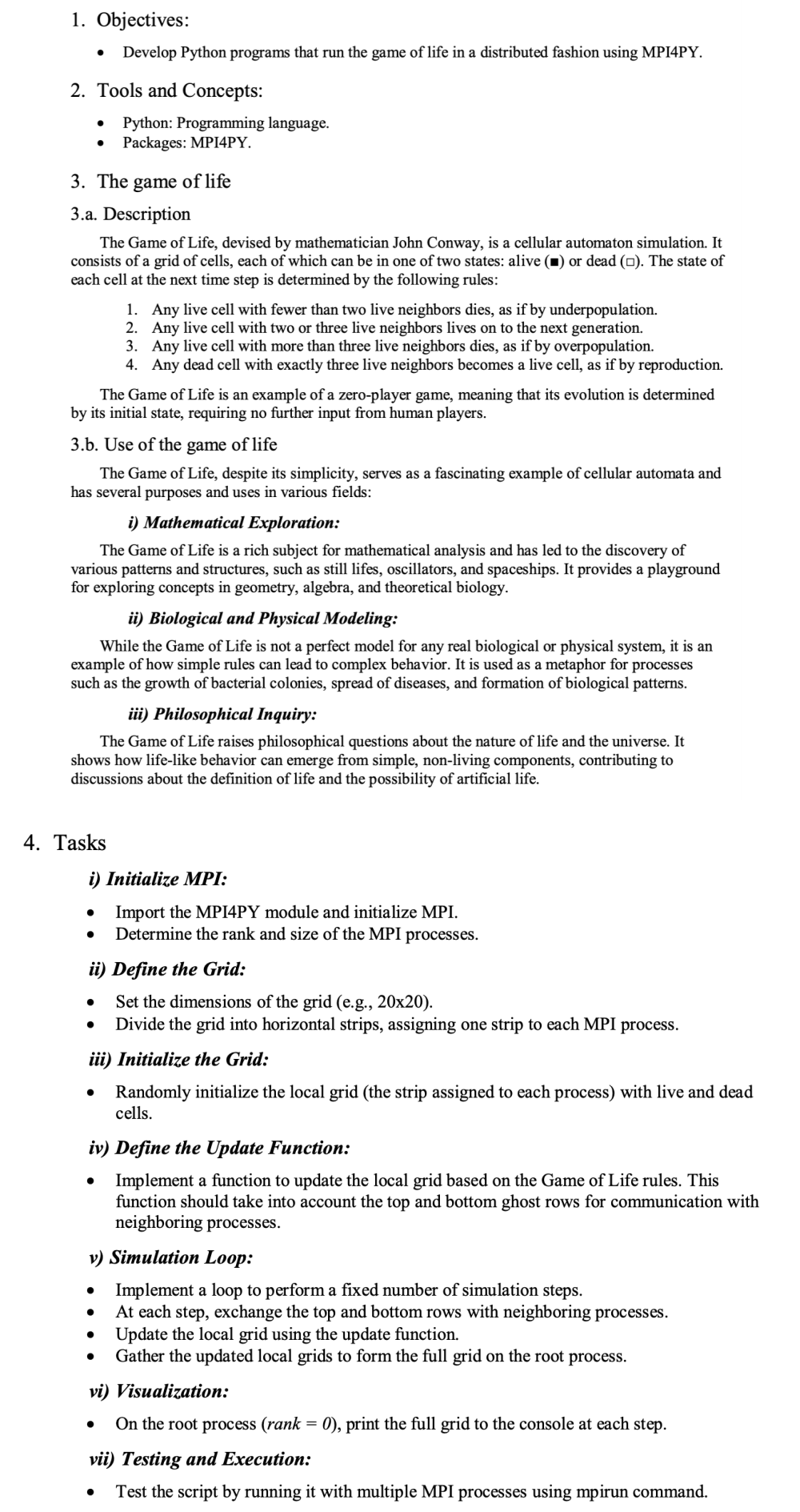
Tasks
i Initialize MPI:
Import the MPIPY module and initialize MPI.
Determine the rank and size of the MPI processes.
ii Define the Grid:
Set the dimensions of the grid egx
Divide the grid into horizontal strips, assigning one strip to each MPI process.
iii Initialize the Grid:
Randomly initialize the local grid the strip assigned to each process with live and dead
cells.
iv Define the Update Function:
Implement a function to update the local grid based on the Game of Life rules. This
function should take into account the top and bottom ghost rows for communication with
neighboring processes.
v Simulation Loop:
Implement a loop to perform a fixed number of simulation steps.
At each step, exchange the top and botto
Step by Step Solution
There are 3 Steps involved in it
1 Expert Approved Answer
Step: 1 Unlock

Question Has Been Solved by an Expert!
Get step-by-step solutions from verified subject matter experts
Step: 2 Unlock
Step: 3 Unlock
 Study Help