







Question: Observe the following declarations: class Node{ public: int data: Node * next }: Node *p1 = new Node, *p2 = new Node, *p3 = new
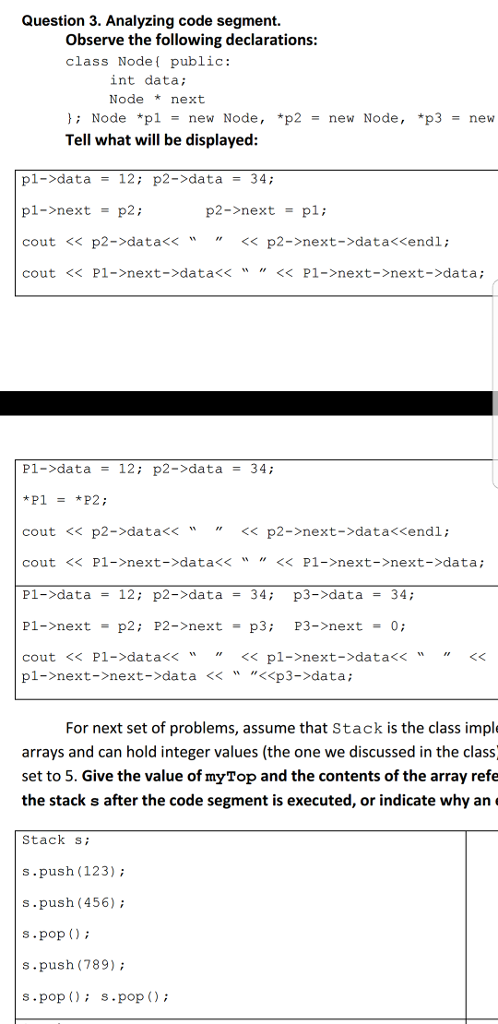
Observe the following declarations: class Node{ public: int data: Node * next }: Node *p1 = new Node, *p2 = new Node, *p3 = new Tell what will be displayed: p1- > data = 12: p2- > data = 34: p1- > next = p2: p2- > next = p1: cout data next- > data next- > data next- > next- > data: P1- > data = 12: p2- > data= 34: *P1 = *P2: cout data next- > data next- > data next- > next- > data: P1- > data = 12: p2- > data= 34: p3- > data = 34: P1- > next - p2: P2- > next- p3: P3- > next = 0: cout data next- > next- > data next- > data next- > next- > data data: For next set of problems, assume that Stack is the class arrays and can hold integer values (the one we discussed in the class) set to 5. Give the value of myTop and the contents of the array the stack s after the code segment is executed, or indicate why an Stack s: s push(123): s. push(456): s.pop(): s push(789): s.pop(): s.pop()
Step by Step Solution
There are 3 Steps involved in it

Get step-by-step solutions from verified subject matter experts
 Study Help