







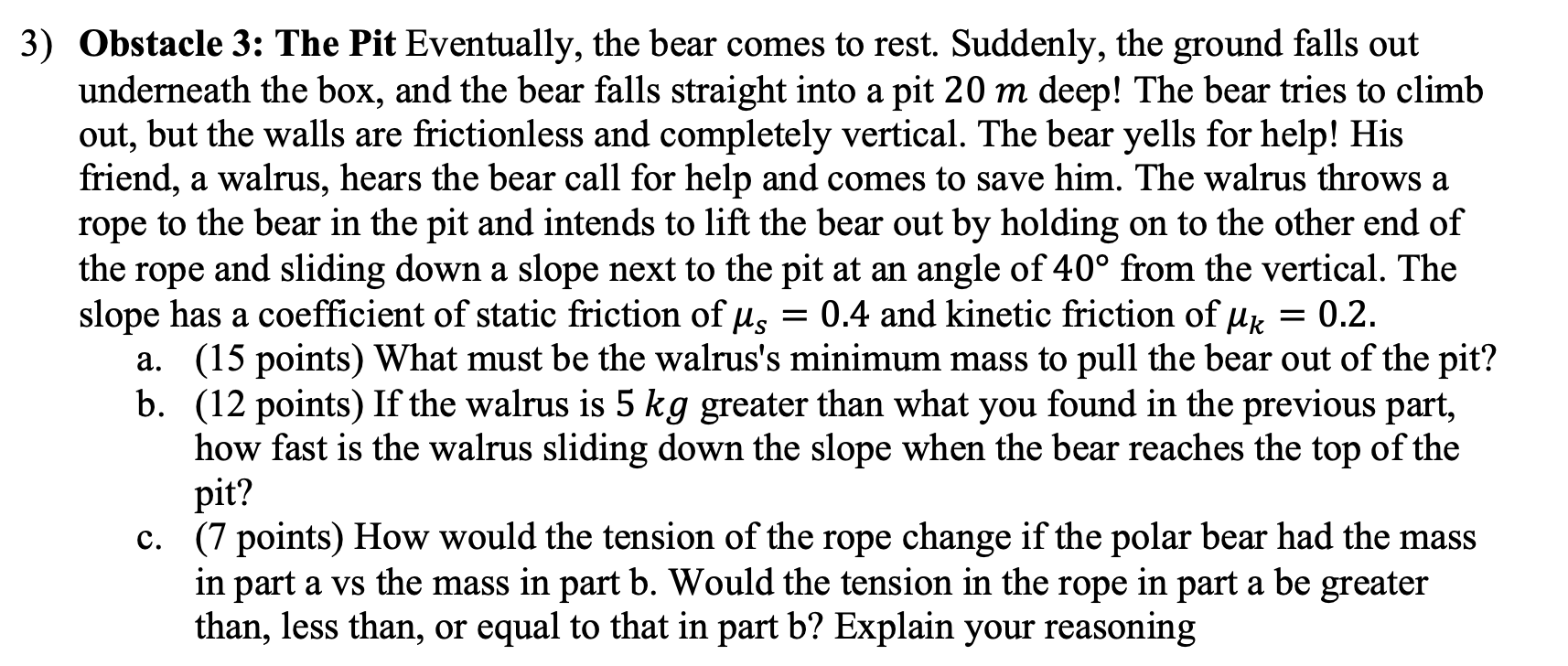
Question: Obstacle 3 : The Pit Eventually, the bear comes to rest. Suddenly, the ground falls out underneath the box, and the bear falls straight into
Obstacle : The Pit Eventually, the bear comes to rest. Suddenly, the ground falls out
underneath the box, and the bear falls straight into a pit m deep! The bear tries to climb
out, but the walls are frictionless and completely vertical. The bear yells for help! His
friend, a walrus, hears the bear call for help and comes to save him. The walrus throws a
rope to the bear in the pit and intends to lift the bear out by holding on to the other end of
the rope and sliding down a slope next to the pit at an angle of @ from the vertical. The
slope has a coefficient of static friction of mus and kinetic friction of muk Mass of bear is kg
a points What must be the walrus's minimum mass to pull the bear out of the pit?
b points If the walrus is kg greater than what you found in the previous part,
how fast is the walrus sliding down the slope when the bear reaches the top of the
pit?
c points How would the tension of the rope change if the polar bear had the mass
in part a vs the mass in part b Would the tension in the rope in part a be greater
than, less than, or equal to that in part b Explain your reasoning
Step by Step Solution
There are 3 Steps involved in it
1 Expert Approved Answer
Step: 1 Unlock

Question Has Been Solved by an Expert!
Get step-by-step solutions from verified subject matter experts
Step: 2 Unlock
Step: 3 Unlock
 Study Help