







Question: ocument Sharing Jser Settings You've just discovered a new X - ray binary, which we will call Hyp - X 1 ( Hyp
ocument Sharing
Jser Settings
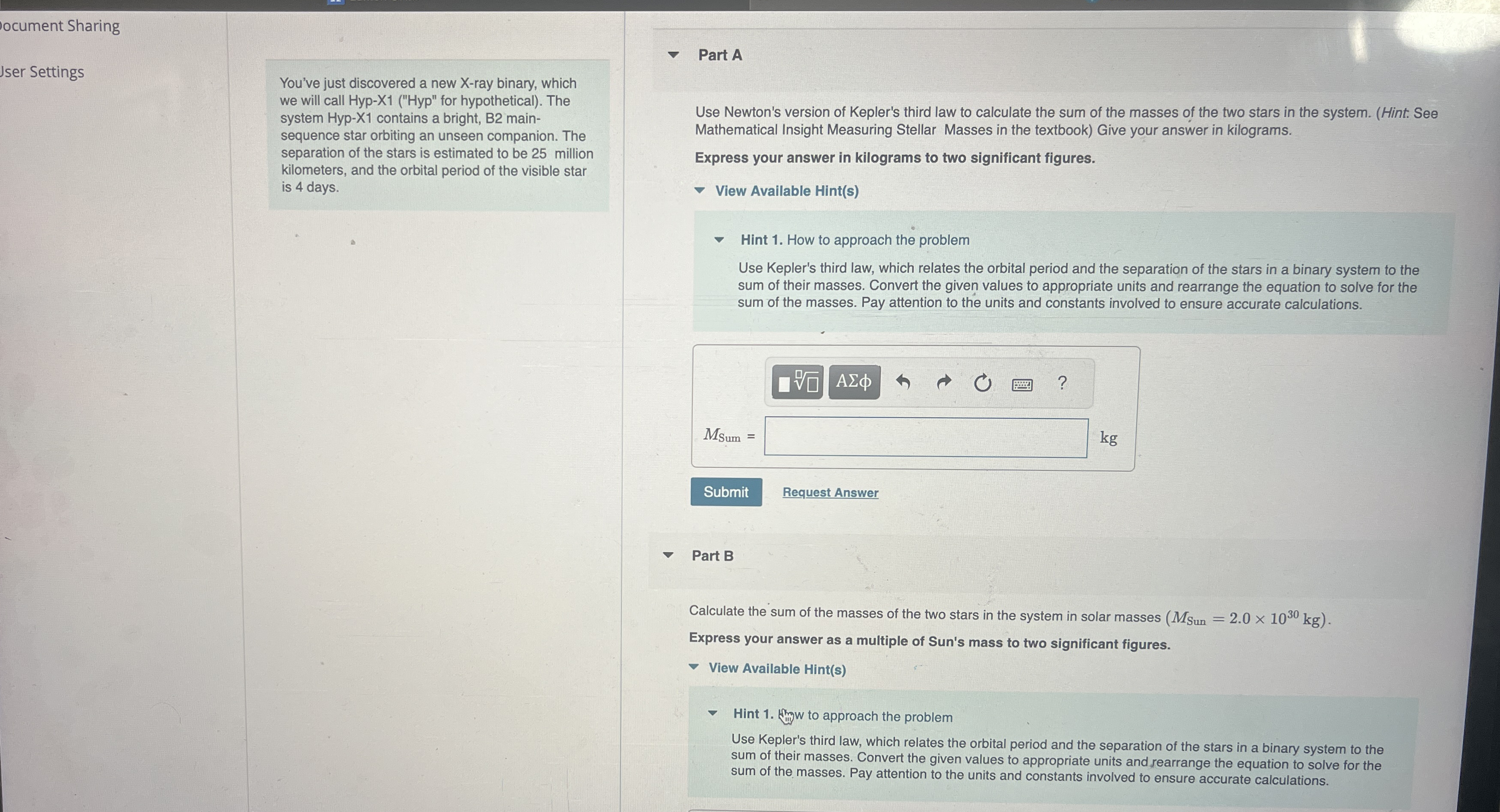
You've just discovered a new Xray binary, which we will call HypXHyp for hypothetical The system HypX contains a bright, B mainsequence star orbiting an unseen companion. The separation of the stars is estimated to be million kilometers, and the orbital period of the visible star is days.
Part A
Use Newton's version of Kepler's third law to calculate the sum of the masses of the two stars in the system. Hint See Mathematical Insight Measuring Stellar Masses in the textbook Give your answer in kilograms.
Express your answer in kilograms to two significant figures.
View Available Hints
Hint How to approach the problem
Use Kepler's third law, which relates the orbital period and the separation of the stars in a binary system to the sum of their masses. Convert the given values to appropriate units and rearrange the equation to solve for the sum of the masses. Pay attention to the units and constants involved to ensure accurate calculations.
Request Answer
Part B
Calculate the sum of the masses of the two stars in the system in solar masses
Express your answer as a multiple of Sun's mass to two significant figures.
View Available Hints
Use Kepler's third law, which relates the orbital period and the separation of the stars in a binary system to the sum of their masses. Convert the given values to appropriate units and rearrange the equation to solve for the sum of the masses. Pay attention to the units and constants involved to ensure accurate calculations.
Step by Step Solution
There are 3 Steps involved in it
1 Expert Approved Answer
Step: 1 Unlock

Question Has Been Solved by an Expert!
Get step-by-step solutions from verified subject matter experts
Step: 2 Unlock
Step: 3 Unlock
 Study Help