



Question: OJUS 3312 ANOVA (ANOVA will not be on the exam) Researchers have suggested that females who have more friends are at greater risk for receiving
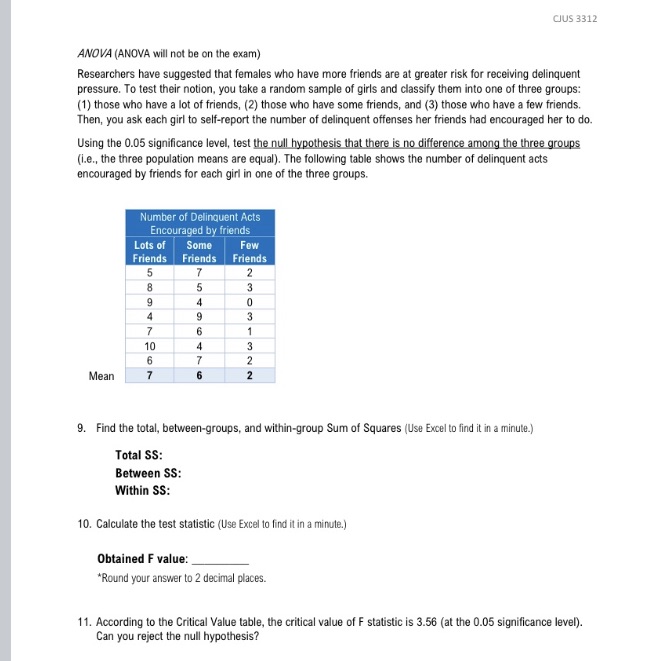
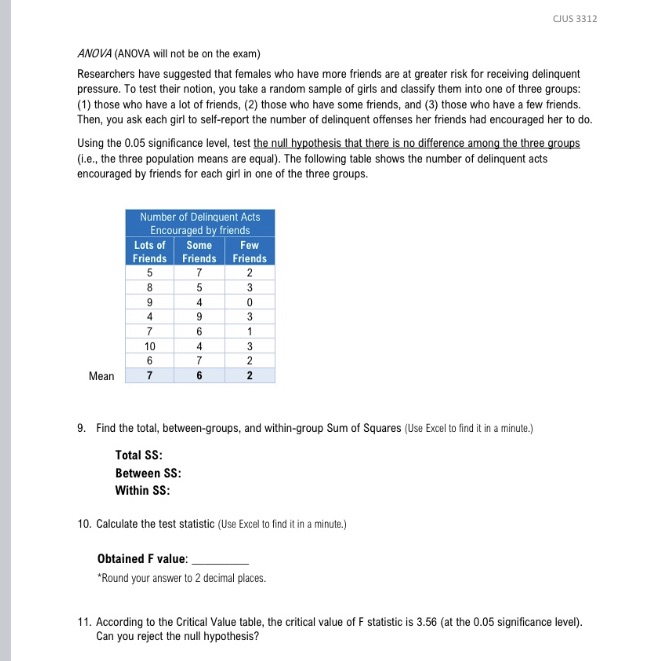
OJUS 3312 ANOVA (ANOVA will not be on the exam) Researchers have suggested that females who have more friends are at greater risk for receiving delinquent pressure. To test their notion, you take a random sample of girls and classify them into one of three groups: (1) those who have a lot of friends, (2) those who have some friends, and (3) those who have a few friends. Then, you ask each girl to self-report the number of delinquent offenses her friends had encouraged her to do. Using the 0.05 significance level, test the null hypothesis that there is no difference among the three groups (i.e., the three population means are equal). The following table shows the number of delinquent acts encouraged by friends for each girl in one of the three groups. Number of Delinquent Acts Encouraged by friends Lots of Some Few Friends Friends Friends 5 7 2 10 Mean 6 2 9. Find the total, between-groups, and within-group Sum of Squares (Use Excel to find it in a minute.) Total SS: Between SS: Within SS: 10. Calculate the test statistic (Use Excel to find it in a minute.) Obtained F value: 'Round your answer to 2 decimal places. 11. According to the Critical Value table, the critical value of F statistic is 3.56 (at the 0.05 significance level). Can you reject the null hypothesis
Step by Step Solution
There are 3 Steps involved in it

Get step-by-step solutions from verified subject matter experts