







Question: Okun's Law s written as u u(-1) = -0.4 (9,- 3%) - What is the sign of u u(-1) in a recession? During a
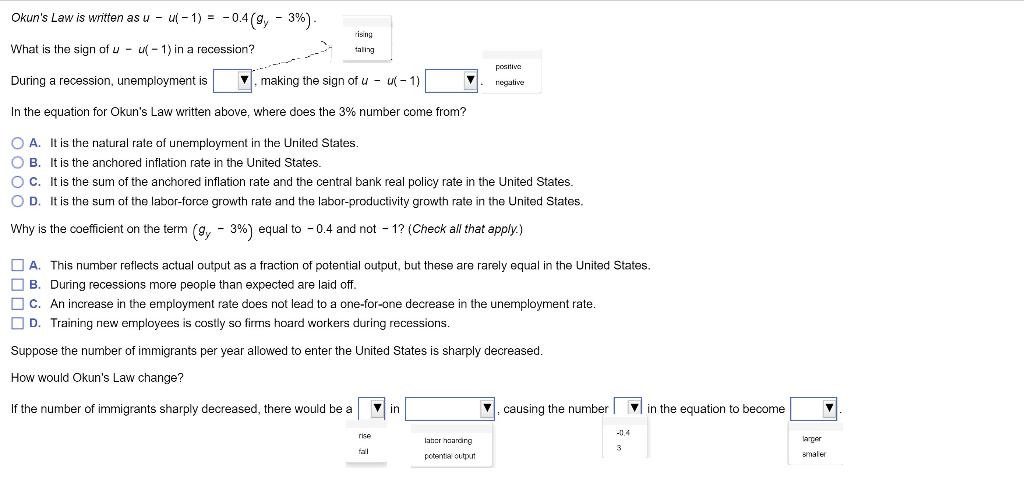
Okun's Law s written as u u(-1) = -0.4 (9,- 3%) - What is the sign of u u(-1) in a recession? During a recession, unemployment is , making the sign of u-u(-1) In the equation for Okun's Law written above, where does the 3% number come from? O A. It is the natural rate of unemployment in the United States. OB. It is the anchored inflation rate in the United States. rising taling OC. It is the sum of the anchored inflation rate and the central bank real policy rate in the United States. OD. It is the sum of the labor-force growth rate and the labor-productivity growth rate in the United States. Why is the coefficient on the term (gy - 3%) equal to -0.4 and not -1? (Check all that apply.) A. This number reflects actual output as a fraction of potential output, but these are rarely equal in the United States. B. During recessions more people than expected are laid off. C. An increase in the employment rate does not lead to a one-for-one decrease in the unemployment rate. D. Training new employees is costly so firms hoard workers during recessions. Suppose the number of immigrants per year allowed to enter the United States is sharply decreased. How would Okun's Law change? If the number of immigrants sharply decreased, there would be a rise positive negative fall in labor hoarding potential output causing the number -14 in the equation to become larger smaler
Step by Step Solution
3.47 Rating (150 Votes )
There are 3 Steps involved in it
In case of recession Our unemployment rate will be hi... View full answer

Get step-by-step solutions from verified subject matter experts
 Study Help