







Question: Old MathJax webview Develop a project scope statement for this project Develop a project scope statement for this project SUMMATIVE ASSESSMENT - 2021 SECOND SEMESTER
Old MathJax webview
Develop a project scope statement for this project
Develop a project scope statement for this project
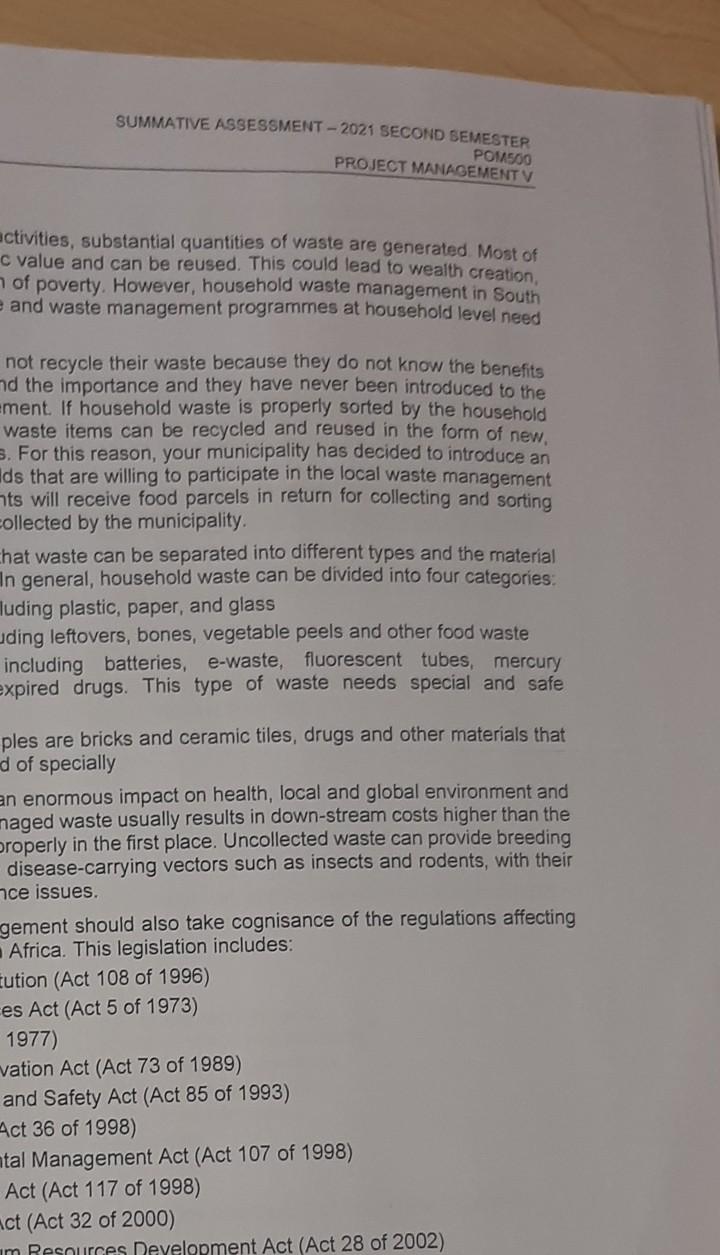
SUMMATIVE ASSESSMENT - 2021 SECOND SEMESTER POM500 PROJECT MANAGEMENT V activities, substantial quantities of waste are generated Most of c value and can be reused. This could lead to wealth creation of poverty. However, household waste management in South e and waste management programmes at household level need not recycle their waste because they do not know the benefits nd the importance and they have never been introduced to the ement If household waste is properly sorted by the household waste items can be recycled and reused in the form of new, s. For this reason, your municipality has decided to introduce an ds that are willing to participate in the local waste management nts will receive food parcels in return for collecting and sorting collected by the municipality. hat waste can be separated into different types and the material In general, household waste can be divided into four categories: luding plastic, paper, and glass uding leftovers, bones, vegetable peels and other food waste including batteries, e-waste, fluorescent tubes, mercury expired drugs. This type of waste needs special and safe ples are bricks and ceramic tiles, drugs and other materials that d of specially an enormous impact on health, local and global environment and maged waste usually results in down-stream costs higher than the properly in the first place. Uncollected waste can provide breeding disease-carrying vectors such as insects and rodents, with their nce issues. gement should also take cognisance of the regulations affecting Africa. This legislation includes: Eution (Act 108 of 1996) es Act (Act 5 of 1973) 1977) vation Act (Act 73 of 1989) and Safety Act (Act 85 of 1993) Act 36 of 1998) mtal Management Act (Act 107 of 1998) Act (Act 117 of 1998) ct (Act 32 of 2000) am Resources Development Act (Act 28 of 2002) SUMMATIVE ASSESSMENT - 2021 SECOND SEMESTER POM500 PROJECT MANAGEMENT V activities, substantial quantities of waste are generated Most of c value and can be reused. This could lead to wealth creation of poverty. However, household waste management in South e and waste management programmes at household level need not recycle their waste because they do not know the benefits nd the importance and they have never been introduced to the ement If household waste is properly sorted by the household waste items can be recycled and reused in the form of new, s. For this reason, your municipality has decided to introduce an ds that are willing to participate in the local waste management nts will receive food parcels in return for collecting and sorting collected by the municipality. hat waste can be separated into different types and the material In general, household waste can be divided into four categories: luding plastic, paper, and glass uding leftovers, bones, vegetable peels and other food waste including batteries, e-waste, fluorescent tubes, mercury expired drugs. This type of waste needs special and safe ples are bricks and ceramic tiles, drugs and other materials that d of specially an enormous impact on health, local and global environment and maged waste usually results in down-stream costs higher than the properly in the first place. Uncollected waste can provide breeding disease-carrying vectors such as insects and rodents, with their nce issues. gement should also take cognisance of the regulations affecting Africa. This legislation includes: Eution (Act 108 of 1996) es Act (Act 5 of 1973) 1977) vation Act (Act 73 of 1989) and Safety Act (Act 85 of 1993) Act 36 of 1998) mtal Management Act (Act 107 of 1998) Act (Act 117 of 1998) ct (Act 32 of 2000) am Resources Development Act (Act 28 of 2002)Step by Step Solution
There are 3 Steps involved in it
1 Expert Approved Answer
Step: 1 Unlock

Question Has Been Solved by an Expert!
Get step-by-step solutions from verified subject matter experts
Step: 2 Unlock
Step: 3 Unlock
 Study Help