







Question: Old MathJax webview Every question should be done stepwise TOPIC: CAL NEWPORT- WHY YOU SHOULD QUIT SOCIAL MEDIA write all questions sequence wise in proper
Old MathJax webview
Every question should be done stepwise TOPIC: CAL NEWPORT- WHY YOU SHOULD QUIT SOCIAL MEDIA
write all questions sequence wise in proper way
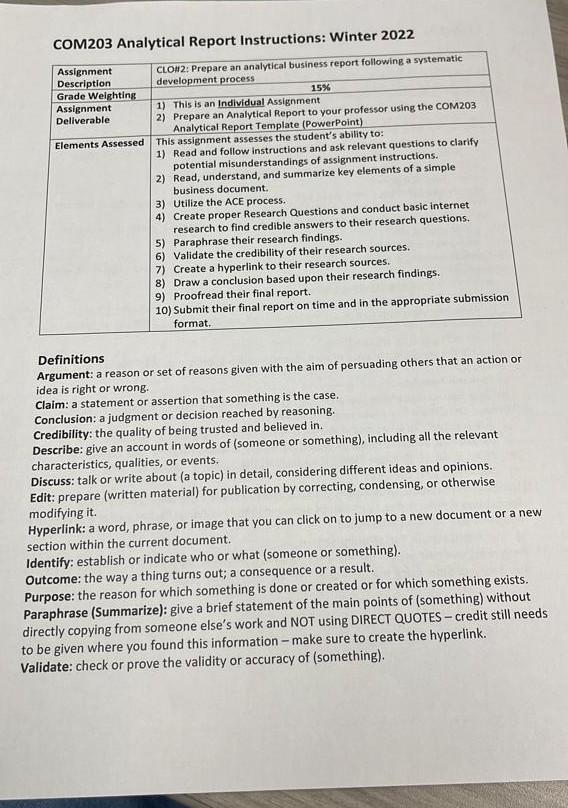
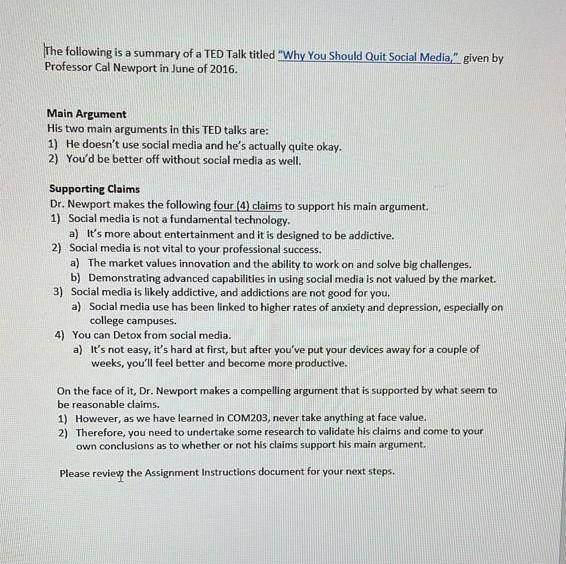
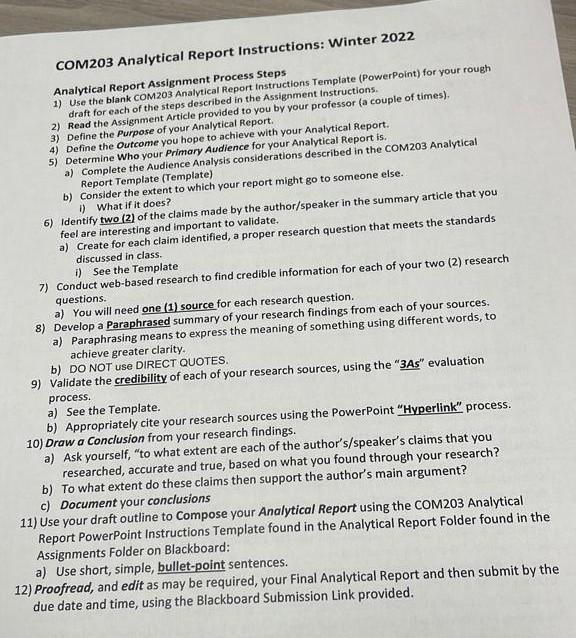
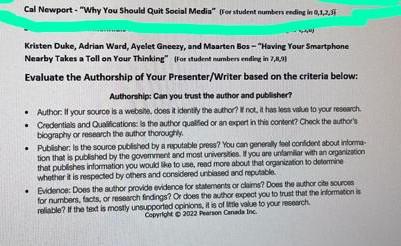
COM203 Analytical Report Instructions: Winter 2022 Assignment CLON2: Prepare an analytical business report following a systematic Description development process Grade Weighting 15% Assignment 1) This is an Individual Assignment Deliverable 2) Prepare an Analytical Report to your professor using the COM203 Analytical Report Template (PowerPoint) Elements Assessed This assignment assesses the student's ability to: 1) Read and follow instructions and ask relevant questions to clarify potential misunderstandings of assignment instructions. 2) Read, understand, and summarize key elements of a simple business document, 3) Utilize the ACE process. 4) Create proper Research Questions and conduct basic internet research to find credible answers to their research questions. 5) Paraphrase their research findings. 6) Validate the credibility of their research sources. 7) Create a hyperlink to their research sources. 8) Draw a conclusion based upon their research findings. 9) Proofread their final report. 10) Submit their final report on time and in the appropriate submission format. Definitions Argument: a reason or set of reasons given with the aim of persuading others that an action or idea is right or wrong. Claim: a statement or assertion that something is the case. Conclusion: a judgment or decision reached by reasoning. Credibility: the quality of being trusted and believed in. Describe: give an account in words of (someone or something), including all the relevant characteristics, qualities, or events. Discuss: talk or write about (a topic) in detail, considering different ideas and opinions. Edit: prepare (written material) for publication by correcting, condensing, or otherwise modifying it. Hyperlink: a word, phrase, or image that you can click on to jump to a new document or a new section within the current document. Identify: establish or indicate who or what (someone or something). Outcome: the way a thing turns out; a consequence or a result. Purpose: the reason for which something is done or created or for which something exists. Paraphrase (Summarize): give a brief statement of the main points of (something) without directly copying from someone else's work and NOT using DIRECT QUOTES - credit still needs to be given where you found this information - make sure to create the hyperlink. Validate: check or prove the validity or accuracy of (something) The following is a summary of a TED Talk titled "Why You Should Quit Social Media," given by Professor Cal Newport in June of 2016. Main Argument His two main arguments in this TED talks are: 1) He doesn't use social media and he's actually quite okay. 2) You'd be better off without social media as well. Supporting Claims Dr. Newport makes the following four (4) claims to support his main argument. 1) Social media is not a fundamental technology a) It's more about entertainment and it is designed to be addictive. 2) Social media is not vital to your professional success. a) The market values innovation and the ability to work on and solve big challenges. b) Demonstrating advanced capabilities in using social media is not valued by the market. 3) Social media is likely addictive, and addictions are not good for you. a) Social media use has been linked to higher rates of anxiety and depression, especially on college campuses. 4) You can Detox from social media. a) It's not easy, it's hard at first, but after you've put your devices away for a couple of weeks, you'll feel better and become more productive. On the face of it, Dr. Newport makes a compelling argument that is supported by what seem to be reasonable claims. 1) However, as we have learned in COM203, never take anything at face value. 2) Therefore, you need to undertake some research to validate his daims and come to your own conclusions as to whether or not his claims support his main argument. Please review the Assignment Instructions document for your next steps. COM203 Analytical Report Instructions: Winter 2022 Analytical Report Assignment Process Steps 1) Use the blank COM203 Analytical Report Instructions Template (PowerPoint) for your rough draft for each of the steps described in the Assignment Instructions. 2) Read the Assignment Article provided to you by your professor (a couple of times). 3) Define the Purpose of your Analytical Report. 4) Define the outcome you hope to achieve with your Analytical Report. 5) Determine who your Primary Audience for your Analytical Report is. a) Complete the Audience Analysis considerations described in the COM203 Analytical Report Template Template) b) Consider the extent to which your report might go to someone else. 1) What if it does? 6) Identify two (2) of the claims made by the author/speaker in the summary article that you feel are interesting and important to validate. a) Create for each claim identified, a proper research question that meets the standards discussed in class. i) See the Template 7) Conduct web-based research to find credible information for each of your two (2) research questions. a) You will need one (1) source for each research question. 8) Develop a Paraphrased summary of your research findings from each of your sources. a) Paraphrasing means to express the meaning of something using different words, to achieve greater clarity. b) DO NOT use DIRECT QUOTES. 9) Validate the credibility of each of your research sources, using the "3As" evaluation process. a) See the Template. b) Appropriately cite your research sources using the PowerPoint "Hyperlink" process. 10) Draw a Conclusion from your research findings. a) Ask yourself, "to what extent are each of the author's/speaker's claims that you researched, accurate and true, based on what you found through your research? b) To what extent do these claims then support the author's main argument? c) Document your conclusions 11) Use your draft outline to Compose your Analytical Report using the COM203 Analytical Report PowerPoint Instructions Template found in the Analytical Report Folder found in the Assignments Folder on Blackboard: a) Use short, simple, bullet-point sentences. 12) Proofread, and edit as may be required, your Final Analytical Report and then submit by the due date and time, using the Blackboard Submission Link provided. Cal Newport - "Why You Should Quit Social Media" e student numben eeding in 0,1,2,3 Kristen Duke, Adrian Ward, Ayelet Gneezy, and Maarten Bos - "Having Your Smartphone Nearby Takes a Toll on Your Thinking for student numbens ending in 7,8,91 Evaluate the Authorship of Your Presenter/Writer based on the criteria below: Authorship: Can you trust the author and publisher? Author If your source is a website, does it identity the author not, it has sve to your research . Credentials and unifications: la the author qualified or an expert in this conto? Check the author's biography or research the author thoroughly. Publisher: Is the source published by a putable press You can generally feel confident about informa tion that is published by the government and most universities you are unfamiliar with an organization that publishes Information you would like to , rend more about that organization to determine whether it is respected by others and considered unbiased and reputable Evidence: Does the author provide evidence for statements or claims? Does the author has su for numbers, facts, or research findings? Or does the author expect you to trust that the information is reliable? If the text is mostly unsupported opinions. It is ofte value to your research. Cont 2022 Pearson Canada IncStep by Step Solution
There are 3 Steps involved in it
1 Expert Approved Answer
Step: 1 Unlock

Question Has Been Solved by an Expert!
Get step-by-step solutions from verified subject matter experts
Step: 2 Unlock
Step: 3 Unlock
 Study Help